Partner Judy Matlack
Queer Places:
Cambridge Rindge & Latin School, 459 Broadway, Cambridge, MA 02138, Stati Uniti
Shady Hill School, 178 Coolidge Hill, Cambridge, MA 02138, Stati Uniti
Wild Knoll, Surf Point Rd, York, ME 03909, Stati Uniti
Nelson Cemetery, Nelson, New Hampshire 03457, Stati Uniti
 May Sarton (born Eleanore Marie Sarton; May 3, 1912 – July 16, 1995) was an acclaimed Belgian-born American poet, novelist, and memoirist. Highly prolific, she published
over 50 books throughout her lifetime, including 19 novels, 17 collections of poetry, and 15 nonfiction works. Her writing is celebrated for its deep, vulnerable
explorations of solitude, aging, love, friendship, and the artistic process.
May Sarton (born Eleanore Marie Sarton; May 3, 1912 – July 16, 1995) was an acclaimed Belgian-born American poet, novelist, and memoirist. Highly prolific, she published
over 50 books throughout her lifetime, including 19 novels, 17 collections of poetry, and 15 nonfiction works. Her writing is celebrated for its deep, vulnerable
explorations of solitude, aging, love, friendship, and the artistic process.
Sarton was born in Wondelgem, Belgium (today a part of the city of Ghent). She was the only child of George Sarton, a prominent historian of science, and Mabel Eleanor
Elwes, an English artist and designer. In 1914, following the assassination of Archduke Franz Ferdinand and the subsequent German invasion of Belgium during World War I, her
family fled to Ipswich, England, where her maternal grandmother lived.
A year later, the family immigrated to the United States, settling in Boston, Massachusetts, where George Sarton began teaching at Harvard University. May grew up in
Cambridge, attending the progressive Shady Hill School and later graduating from Cambridge High and Latin School in 1929.
Though she won a scholarship to Vassar College, Sarton was captivated by the stage after seeing legendary actress
Eva Le Gallienne perform. Rather than attending college, she moved to New York City in 1930 to join Le Gallienne's Civic
Repertory Theatre as an apprentice. She went on to found the Apprentice Theatre in New York and later served as director of the Associated Actors Theatre in Hartford,
Connecticut.
When her theater ventures ultimately closed, Sarton shifted her creative focus entirely to writing. She traveled to England, where she became connected with prominent
literary figures, including Virginia Woolf, Julian Huxley, and the novelist Elizabeth Bowen, with
whom Sarton shared a profound and intimate romantic relationship.
In 1937, she published her first collection of poetry, Encounter in April, launching her literary career.
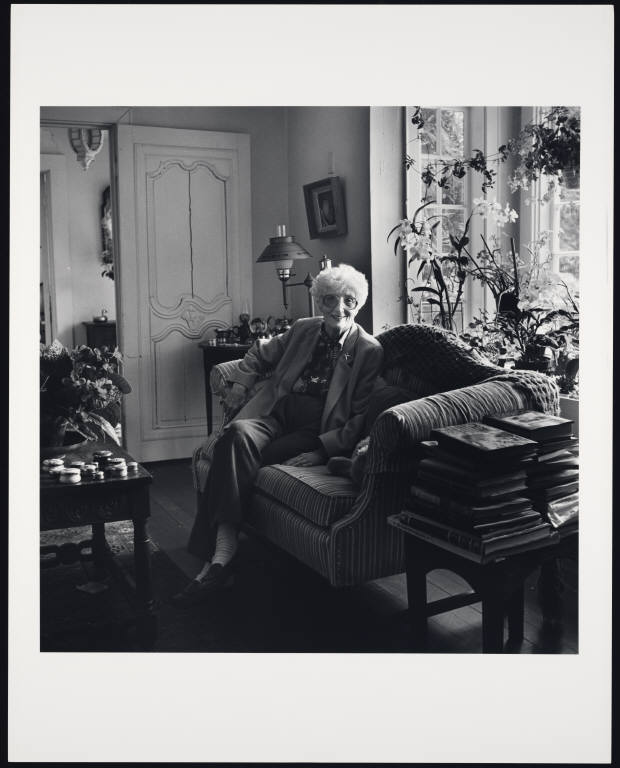
Featured in
Particular Voices: Portraits of Gay
and Lesbian Writers by Robert Giard [Rights Notice: Copyright Jonathan G. Silin (jsilin@optonline.net)]

May Sarton by Lotte Jacobi

by Stathis Orphanos
In 1945, while vacationing in Santa Fe, New Mexico, Sarton met Judith "Judy" Matlack, a professor of English at Simmons
College. Matlack became her domestic partner for the next thirteen years. The couple lived together until 1956, separating shortly after the death of Sarton's father. Sarton
subsequently moved to a home in Nelson, New Hampshire.
Despite their separation, Matlack remained a central and vital presence in Sarton's life. Their relationship was later memorialized in Sarton's Honey in the Hive (1988),
and Sarton deeply reflected on Matlack's significance—as well as her own Unitarian Universalist upbringing—in her acclaimed memoir At Seventy (1984). In 1958, Sarton was
elected a Fellow of the American Academy of Arts and Sciences.
For years, Sarton taught at various institutions, including Harvard and Wellesley College, while writing full-time. In 1965, she published the novel Mrs. Stevens Hears
the Mermaids Singing. In this book, Sarton openly wrote about her lesbianism at a time when doing so was highly unusual and carried immense professional risk.
While the book established her as a pioneer and earned her a dedicated feminist and lesbian readership, Sarton actively resisted being classified solely as a "lesbian
writer". She maintained that her central themes—isolation, spiritual balance, and human love—possessed a universal appeal that transcended labels.
In 1973, seeking peace and closer proximity to the ocean, Sarton sold her Nelson home and rented Wild Knoll, a house situated on a rugged, scenic cliffside in York,
Maine.
It was here, in her "house by the sea," that Sarton entered one of her most prolific and beloved phases. Her daily life, the changing of the Maine seasons, her love for
her pets, and her dedicated tending of the property's terrace gardens became the primary subjects of her highly popular journals—most notably The House by the Sea (1977).
At Wild Knoll, Sarton received a massive influx of fan mail, which she meticulously answered by hand. The ocean air and solitary environment also inspired several
late-career poetry collections, including Halfway to Silence (1980) and Letters from Maine (1984).
In 1990, Sarton suffered a severe stroke that temporarily compromised her physical abilities and her capacity to focus. Determined to continue working, she began using a
tape recorder to dictate her thoughts, which were transcribed into her final journals, starting with Endgame: A Journal of the Seventy-Ninth Year (1992) and followed by
Encore (1993).
On July 16, 1995, Sarton passed away from breast cancer in York, Maine. She was buried in Nelson Cemetery in Nelson, New Hampshire, alongside her former partner Judy
Matlack.
The beloved house Wild Knoll was eventually demolished, leaving only the overgrown terrace gardens Sarton had lovingly cultivated. However, the site has been given a
unique second life.
The land is now part of the Surf Point Artist in Residence Program. In 2021, visual artist Carly Glovinski—inspired by reading Sarton's The House by the Sea
on-site—initiated the Wild Knoll Foundation Garden. Working alongside regenerative farmers and master gardeners, Glovinski restored Sarton’s original terrace plantings and
constructed a "footprint garden" built to the exact architectural scale of the demolished house.
Today, low garden beds outlined in 2x4s map out the former first-floor rooms of Sarton’s home. Each "room" is color-themed and planted with flora that Sarton herself
wrote about, serving as a living, botanical monument to the author's creative spirit and her deep connection to the Maine coastline.
References:
Other references:
- https://en.wikipedia.org/wiki/May_Sarton
Support this project
This website is a passion project researched, developed, and funded entirely by me. If you find the content valuable and would like to help support the ongoing research and hosting costs, any contribution is deeply appreciated.
Thank you for keeping this independent resource alive!
My books on Amazon: Elisa Rolle's books
BACK TO HOME PAGE


