BURIED TOGETHER
Partner Lilian Whiting
Queer Places:
Mount Auburn Cemetery, 580 Mt Auburn St, Cambridge, MA 02138, Stati Uniti
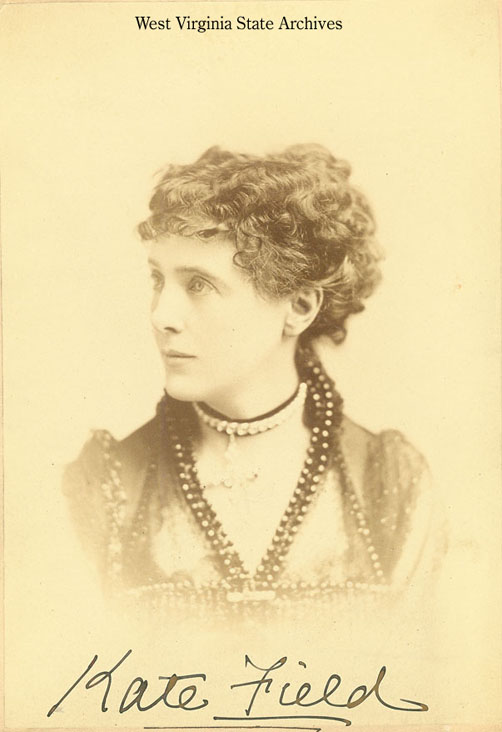 Mary Katherine Keemle "Kate" Field (October 1, 1838 – May 19, 1896) was an intensely independent American journalist, lecturer, actress, and editor. Famed for her sharp wit
and eccentric talents, she defied the domestic expectations of the Victorian era, choosing a life of public engagement and literary autonomy over traditional marriage.
Mary Katherine Keemle "Kate" Field (October 1, 1838 – May 19, 1896) was an intensely independent American journalist, lecturer, actress, and editor. Famed for her sharp wit
and eccentric talents, she defied the domestic expectations of the Victorian era, choosing a life of public engagement and literary autonomy over traditional marriage.
Born in St. Louis, Missouri, to actors Joseph M. Field and Eliza Riddle, Kate was a precocious child who published her first poem at age nine. Raised in the theatrical
worlds of New Orleans and St. Louis, she was later educated at the Lasell Ladies' Seminary in Massachusetts.
At sixteen, she was sent to Europe to finish her education. In Florence, Italy, she studied voice and began dispatching articles to American newspapers. Her time in
Sicily even birthed a legendary tale of her being captured by brigands; the gang's leader allegedly fell so deeply in love with her that he proposed, later entering a
monastery after she turned him down.
In 1860, Field entered a vibrant Anglo-American expatriate circle in Florence that would fundamentally shape her views on independence and sexuality. This network
seamlessly bridged same-sex couples, literary giants, and unmarried bohemian intellectuals.
Having recently traveled to Italy to heal from an unrequited infatuation with a married aunt, Field was uniquely primed to appreciate the alternative romantic structures
she encountered:
She became a favorite of Robert Browning and Elizabeth Barrett Browning
and befriended Walter Savage Landor and Mary Somerville.
Field bore witness to thriving "Boston marriages" and lesbian romances. She playfully addressed her hostess, Isa Blagden, as
“Hubby”; exchanged gifts with feminist Frances Power Cobbe; and watched
Louisa Baring, Lady Ashburton kneel before the sculptor Harriet Hosmer.
Having met the iconic actress Charlotte Cushman through her aunt, Field slyly celebrated Cushman’s romantic,
quasi-marital partnership with sculptor Emma Stebbins by addressing Cushman as "Beloved Romeo" and referring to Stebbins as
"Juliet."
It was also in Florence that Field met the celebrated English novelist Anthony Trollope. Their profound, lifelong connection has long been treated in Trollope studies as
his singular "study in scarlet"—the only hint that he was ever less than completely faithful to his wife.
While Trollope deeply admired Field's intellect and assisted her career, their dynamic was consistently strained by her fierce commitment to female autonomy. Trollope
constantly badgered her to "go & marry a husband," once writing that he didn't "at all understand how you are living, where— with whom— or on what terms." Despite his
confusion, Field inspired his writing; he modeled the fiercely self-willed (though ultimately married) protagonist of his 1863 story "Miss Ophelia Gledd" directly after her.
Field returned to America and carved out a highly visible, if financially volatile, public career:
In 1871, she embarked on a grueling tour across New York and the Midwest. Though she drew international attention, she privately loathed the experience, admitting six
months later that she "loathed the life... I did it for money." (During a stop in Buffalo, she also earned the distinct animosity of fellow lecturer
Mark Twain).
In 1874, she pivoted to the theater, appearing as Peg Woffington at Booth's Theatre in New York, later shifting to dance and recitation. In 1882, she spearheaded the
short-lived Coöperative Dress Association, which ended in a conspicuous commercial failure.
Her most enduring professional triumph came in 1889 when she established Kate Field's Washington, a weekly political and literary journal published in the nation's
capital.
In 1882, Field met the woman who would become her definitive life partner: journalist and author Lilian Whiting. Their domestic and
romantic partnership lasted until Field's death, challenging the boundaries of traditional Victorian companionship.
When apart, the two women wrote to each other daily. In 1895, Whiting dedicated a volume of poetry to Field, openly naming her the "central interest" and "magnetic
centre" of her life.
While on assignment in Honolulu, Hawaii, in 1896, Field caught a fatal case of pneumonia and died at the age of 57. Whiting was utterly devastated, inheriting all of
Field’s private papers, letters, and effects.
Whiting immediately channeled her grief into two landmark literary tributes that successfully operated within, yet subtly pushed past, strict Victorian biographical
conventions:
The Story of a Summer (1897) is a spiritualist memoir featuring Field’s portrait as the frontispiece. In it, Whiting wrote passionately of "she—who was dearest of all to
me," documenting the telepathic, electric "mysterious thrills" she felt when communicating with Field's spirit to prove love survives death.
Kate Field: A Record (1899) is a comprehensive biography compiled from their daily correspondence. While Whiting maintained the period's required authorial
invisibility—referring to herself only as "the biographer"—she left unmistakable traces of their intimacy. She casual mentioned living together, Field’s desire to
financially support her, and left sensuous rhapsodies detailing Field's physical beauty drawn straight from her own "memory."
Though historical mid-century accounts (such as Blanche Cox Clegg’s entry in the American National Biography) traditionally coded their relationship as a "close
friendship" or "tender and consecrated friendship," modern queer historiography recognizes their bond as a foundational romantic partnership.
Today, the two women rest side-by-side; Whiting's ashes were buried directly next to Kate Field at Mount Auburn Cemetery in Cambridge, Massachusetts.
References:
Other references:
- https://en.wikipedia.org/wiki/Kate_Field
Support this project
This website is a passion project researched, developed, and funded entirely by me. If you find the content valuable and would like to help support the ongoing research and hosting costs, any contribution is deeply appreciated.
Thank you for keeping this independent resource alive!
My books on Amazon: Elisa Rolle's books
BACK TO HOME PAGE
