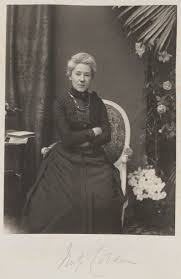
 Emma Jane Catherine Cobden (later known as Jane Cobden Unwin, April 28, 1851 - July 7, 1947) was a pioneer in British radical politics, women's rights, land reform, and
anti-imperialism.
Emma Jane Catherine Cobden (later known as Jane Cobden Unwin, April 28, 1851 - July 7, 1947) was a pioneer in British radical politics, women's rights, land reform, and
anti-imperialism.Queer Places:
10A Cunningham Pl, London NW8 8JT, UK
Dunford House, Dunford Hollow, Heyshott, Midhurst, West Sussex GU29 0AF, United Kingdom
Emma Jane Catherine Cobden (later known as Jane Cobden Unwin, April 28, 1851 - July 7, 1947) was a pioneer in British radical politics, women's rights, land reform, and
anti-imperialism.
Born into a prominent political family, Jane was the third daughter of Richard Cobden. Following her father's death in 1865, Jane and her sisters (including writer Ellen Cobden and suffragette Anne Cobden-Sanderson) dedicated themselves to carrying forward his legacy of radical Liberal activism, free trade, and international peace.
By the late 1870s, Jane joined the National Society for Women's Suffrage, serving on its executive and finance committees and lecturing across Britain. She was a staunch advocate for Irish Home Rule and the Irish Plan of Campaign, actively working alongside Irish leaders like John Dillon and William O'Brien.
In 1889, local government was reorganized under the Local Government Act 1888, creating the London County Council (LCC). Jane Cobden stood as a Liberal candidate for Bow and Bromley (Tower Hamlets), alongside Lady Margaret Sandhurst (Brixton). Both women won their seats, becoming the first female municipal councilors in British history.
However, conservative opponents challenged their right to hold office because of their gender. The High Court ruled against Sandhurst and Cobden. Though Cobden was legally barred from voting on council matters under penalty of severe fines, she refused to resign her seat, continuing to attend meetings as a silent protester until her term ended in 1892.
In 1892, at age 41, Jane married radical publisher Thomas Fisher Unwin. Together, they broadened their activism globally:
They fiercely opposed the Second Boer War (1899–1902) and co-founded the South African Conciliation Committee.
She campaigned against South African segregation policies following the formation of the Union of South Africa in 1910.
In 1928, she donated her family estate, Dunford House, to serve as an educational center dedicated to peace and Cobdenite principles.
While 19th-century history often viewed women’s living arrangements through the lens of platonic companionate households, modern queer historiography recognizes these spaces as vital hubs of female autonomy, romantic friendships, and queer community building outside traditional marriage.
In 1889, during the height of her historic LCC campaign, Jane Cobden lodged at 10A Cunningham Place, St John's Wood, London. The residence was owned and shared by:
Emily Mary Osborn: A pioneering Victorian feminist painter celebrated for her depictions of working women and women in distress (most notably Nameless and Friendless).
Mary Elizabeth Dunn: Osborn’s romantic companion and domestic partner, with whom she lived for over 40 years until their deaths.
Jane's link to the Osborn-Dunn household was part of a deep family connection:
In 1885, Jane's older sister, Ellen Cobden (later a novelist writing under the pen name Miles Amber), lived with Osborn and Dunn at Cunningham Place prior to her marriage to artist Walter Sickert. Osborn and Dunn served as official witnesses at Ellen's wedding.
When Ellen wrote her 1914 novel Sylvia Saxon: Episodes in a Life, she dedicated the book to Osborn and Dunn and left both women a small legacy in her will "as a token of love".
While Jane lived with them in 1889, Osborn painted her portrait, which was publicly exhibited at the National Gallery in 1890. That same year, Cobden, Osborn, and Dunn all jointly signed the landmark declaration supporting women's suffrage.
In Victorian England, single women in political and artistic movements frequently formed same-sex households to pool financial resources, avoid forced patriarchal marriages, and create safe spaces for radical organizing.
Jane Cobden’s residence with Emily Mary Osborn and Mary Elizabeth Dunn highlights how early feminist political infrastructure in London was directly nurtured by and intertwined with queer female domestic partnerships.
References:
Other references:
Support this project
This website is a passion project researched, developed, and funded entirely by me. If you find the content valuable and would like to help support the ongoing research and hosting costs, any contribution is deeply appreciated.
Thank you for keeping this independent resource alive!
My books on Amazon: Elisa Rolle's books

