Wife Dorothy Thompson
Queer Places:
The Sinclair Lewis Boyhood Home , 810 Sinclair Lewis Ave, Sauk Centre, MN 56378
Yale University (Ivy League), 38 Hillhouse Ave, New Haven, CT 06520
Greenwood Cemetery, Sauk Centre, MN 56378, United States
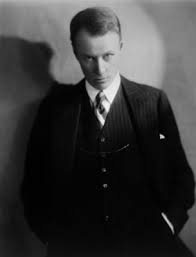 Harry Sinclair Lewis (February 7, 1885 – January 10, 1951) was born on February 7, 1885, in Sauk Centre, Minnesota, the youngest of three sons born to
country doctor Edwin J. Lewis and Emma Kermott Lewis. His mother passed away when he was six years old, and the following year his father married Isabel
Warner, who played a significant role in his upbringing. As a lonely and bookish child who felt like an outsider in his small Midwestern hometown, Lewis
immersed himself deeply in reading. He left Sauk Centre in 1902 to attend Oberlin Academy in Ohio before entering Yale University. During his time at
Yale, he distinguished himself as a writer for the Yale Literary Magazine, forged lifelong literary friendships, and spent summers working on cattle
boats. He graduated from Yale in 1908.
Harry Sinclair Lewis (February 7, 1885 – January 10, 1951) was born on February 7, 1885, in Sauk Centre, Minnesota, the youngest of three sons born to
country doctor Edwin J. Lewis and Emma Kermott Lewis. His mother passed away when he was six years old, and the following year his father married Isabel
Warner, who played a significant role in his upbringing. As a lonely and bookish child who felt like an outsider in his small Midwestern hometown, Lewis
immersed himself deeply in reading. He left Sauk Centre in 1902 to attend Oberlin Academy in Ohio before entering Yale University. During his time at
Yale, he distinguished himself as a writer for the Yale Literary Magazine, forged lifelong literary friendships, and spent summers working on cattle
boats. He graduated from Yale in 1908.
Following graduation, Lewis spent several years drifting across the United States, working temporary editorial jobs for various New York publishing
houses and trying his hand at poetry and short fiction. His early literary career yielded several minor novels, beginning with Hike and the Aeroplane
(1912) published under the pseudonym Tom Graham, followed by Our Mr. Wrenn (1914), The Trail of the Hawk (1915), The Job (1917), and Free Air (1919). In
1914, he married his first wife, Grace Livingston Hegger, an editor at Vogue magazine, with whom he had his first son, Wells Lewis.
Lewis achieved a massive national and international breakthrough with the publication of Main Street in 1920. A satirical yet affectionate critique of
small-town hypocrisy and provincialism modeled on his native Sauk Centre, the novel became an unprecedented commercial success. This triumph ushered in
the most creatively fertile decade of his life. He followed it with a series of masterworks that defined American social criticism: Babbitt (1922), which
lampooned the vacuous materialism of the American businessman; Arrowsmith (1925), an exploration of medical ethics and scientific integrity; Elmer Gantry
(1927), a scathing exposé of religious hypocrisy and evangelism; and Dodsworth (1929), which examined American marriage and European culture. In 1926,
Lewis was awarded the Pulitzer Prize for Arrowsmith, but he famously declined it on the grounds that prizes were restrictive and commercialized. In 1930,
he cemented his historical status by becoming the first American author to be awarded the Nobel Prize in Literature.
Despite his professional peaks, Lewis's personal life grew increasingly turbulent. His marriage to Grace Hegger dissolved in divorce in 1928. Later
that year, he married the prominent journalist and foreign correspondent Dorothy Thompson, with whom he had
his second son, Michael. This second high-profile marriage also ended in divorce, concluding in 1942. Throughout the 1930s and 1940s, Lewis continued to
write prolifically, producing works such as Ann Vickers (1933), the anti-fascist warning It Can't Happen Here (1935), and Kingsblood Royal (1947), a
searing critique of institutional racism. However, his later books did not match the critical acclaim of his 1920s output, and he battled worsening
alcoholism and deepening isolation. In 1944, his older son Wells was killed in action by a sniper in France during World War II, a tragedy that deeply
devastated him. Lewis spent his final years traveling abroad, living in Europe as an expatriate, and died of heart disease in Rome on January 10, 1951,
at the age of sixty-five.
While Sinclair Lewis was conventionally married twice and involved in heterosexual relationships, his life, social circles, and literary themes
intersect with LGBTQ history in notable ways. As an iconic chronicler of American nonconformity, marginalization, and social rebellion, Lewis cultivated
close personal and professional associations within bohemian and artistic circles that frequently challenged the rigid gender and sexual mores of
early-to-mid 20th-century America. Throughout his collegiate years at Yale and his early days in New York's literary scene, he deliberately gravitated
toward nonconformists, intellectual outcasts, and individuals who stood outside traditional societal structures.
Furthermore, Lewis's second wife, Dorothy Thompson—with whom he shared a tumultuous, high-profile marriage—was a pioneering journalist whose own
intimate relationships with women (such as her famous romance with author Christa Winsloe and novelist
Sonia Sekula) are a significant part of queer literary history. Their marriage operated within complex, modern
boundaries that reflected the unconventional social circles they inhabited. In his fiction, Lewis frequently subverted traditional Victorian gender roles
and attacked the suffocating moral policing of American bourgeois society, championing characters who rejected standard domestic expectations. His
outspoken defense of individual liberty and his fierce opposition to censorship, fascism, and social dogmatism made his broader social circle deeply
appealing to the emerging vanguard of modern liberal and queer intellectuals of the mid-century.
References:
- Schorer, Mark. Sinclair Lewis: An American Life. New York: McGraw-Hill Book Company, 1961. (The foundational, comprehensive full-length biography detailing Lewis's life, literary rise, and personal struggles.)
- Lingeman, Richard. Sinclair Lewis: Rebel from Main Street. St. Paul: Borealis Books, 2002. (A widely acclaimed modern critical biography re-examining Lewis's cultural impact and rebellious literary vision.)
- Harcourt, Alfred, and Oliver Harrison, eds. From Main Street to Stockholm: Letters of Sinclair Lewis, 1919–1930. New York: Harcourt, Brace, 1952. (A primary collection of correspondence capturing Lewis during his most creatively fertile decade.)
- Koblas, John J., and Dave Page, eds. Selected Letters of Sinclair Lewis. St. Paul: Minnesota Historical Society Press, 1985. (An insightful epistolary window into his personal thoughts, professional relationships, and inner life.)
- Lewis, Grace Hegger. With Love from Gracie: Sinclair Lewis: 1912–1925. New York: Harcourt, Brace, 1955. (A firsthand memoir and biographical account written by his first wife, focusing on his early breakthrough years.)
- Killough, George, ed. Minnesota Diary, 1942–1946. Moscow, ID: University of Idaho Press, 2000. (Lewis's personal wartime journals offering a direct look at his later years and introspective thoughts.)
- The Sinclair Lewis Society. Hosted by Illinois State University, dedicated to ongoing scholarship, archival resources, and critical essays regarding Lewis's bibliography and cultural footprint.
- The Library of America. Sinclair Lewis: Main Street and Babbitt (LOA #59) and associated authoritative collected editions, featuring detailed chronological notes and textual history.
Support this project
This website is a passion project researched, developed, and funded entirely by me. If you find the content valuable and would like to help support the ongoing research and hosting costs, any contribution is deeply appreciated.
Thank you for keeping this independent resource alive!
My books on Amazon: Elisa Rolle's books
BACK TO HOME PAGE