Queer Places:
Exeter Academy, 20 Main St, Exeter, NH 03833, United States
Harvard University (Ivy League), 2 Kirkland St, Cambridge, MA 02138
Mount Auburn Cemetery, Cambridge, Middlesex County, Massachusetts, USA
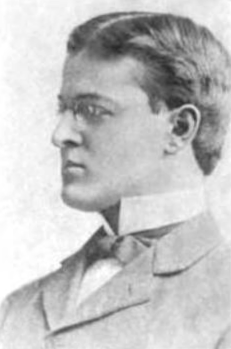 Pierre de Chaignon la Rose (born Peter Ross, April 23, 1871 - February 21, 1940) was a prominent American heraldic artist, man of letters, interior
designer, and educator whose life and career were deeply intertwined with the bohemian and aesthetic circles of late-nineteenth and
early-twentieth-century Harvard University.
Pierre de Chaignon la Rose (born Peter Ross, April 23, 1871 - February 21, 1940) was a prominent American heraldic artist, man of letters, interior
designer, and educator whose life and career were deeply intertwined with the bohemian and aesthetic circles of late-nineteenth and
early-twentieth-century Harvard University.
Born to Anthime Fidele la Rose and Catharine Kappus von Pichlstein, he completed his early education at Exeter Academy before entering Harvard
College, where he graduated with a Bachelor of Arts in 1895.
During his undergraduate years, la Rose established himself as a central figure in campus literary and social life. He was inducted into
Phi Beta Kappa—reputedly achieving the honor without ever taking a single lecture note—and served as an editor of the prestigious Harvard Monthly,
alongside memberships in the Hasty Pudding Club and the Signet Society. Known for his refined intellect and striking personal presence, he shared rooms
in Matthews Hall with Daniel Gregory Mason, the future composer, who later fondly recalled la Rose's
Jamesian prose style, exquisite bookplate designs, and vibrant personality. Following his graduation, la Rose remained at Harvard as an instructor in the
English department for seven years, resigning in 1902 to pursue independent literary and artistic endeavors. Over the subsequent decades, he worked as a
"man of letters," contributing critical literary commentary, undertaking extensive travels to Europe, Mexico, and Turkey, and emerging as a pioneer in
American interior decoration. Among his most notable design commissions were the distinctive interiors of University Hall’s Faculty Room in Harvard Yard
and the clubhouse of the Signet Society.
La Rose achieved his most enduring legacy as America’s foremost authority on ecclesiastical heraldry and institutional design. A fervent Roman
Catholic later in life, he single-handedly shaped modern American scholastic and religious heraldry by crafting the coats of arms, seals, and armorial
bearings for numerous high-profile institutions. His extensive portfolio included the design of seals for all the graduate schools at
Harvard University—serving concurrently on its Committee on Arms, Seal, and Diplomas—as well as armorial commissions for Princeton University,
Yale University, Rice University, The Catholic University of America, and Saint Anselm College. He likewise designed coats of arms for numerous Catholic
dioceses and prelates, such as Bishop Regis Canevin of Pittsburgh, and played a defining role in American religious iconography by creating the official
flag of the Episcopal Church between 1937 and 1940. He spent his later years residing quietly in Cambridge as a respected yet increasingly isolated
fixture of the local academic community. He never married and died on February 21, 1941, at Wyman Cambridge Hospital, leaving behind a monumental visual
legacy commemorated decades later by the American Heraldry Society through the establishment of its annual design award.
Within the framework of queer history and literary scholarship, la Rose is recognized as a quintessential representative of the covertly bohemian,
homoerotic aestheticism that flourished at Harvard during the 1890s and 1900s. Documented extensively by cultural historians examining the pre-Stonewall
intellectual underground, he moved within elite, homosocial circles heavily influenced by the legacies of
Oscar Wilde and Walter Pater. As noted by architectural and literary
chroniclers of the period, la Rose was a prominent member of Dr. William McMichael Woodworth’s
legendary Brattle Street circle—a vibrant, eccentric salon that gathered intellectuals, artists, and unconventional figures away from the rigid moral
orthodoxies of the era. Alongside peers such as Charles Macomb Flandrau (author of Harvard
Episodes), la Rose helped anchor what contemporary accounts categorized as Oscar Wilde’s Harvard, distinguishing themselves through deliberate artistic
cultivation, decadent interior design, and stylized non-conformity. Described as the quintessential "aesthete of Apley Court" and immortalized in student
caricatures and light verse within volumes like Harvard Celebrities, la Rose lived out a distinctly bachelor-centric, homosocial lifestyle common among
elite male intellectuals of his generation, ultimately cementing his place at the intersection of American aestheticism and queer cultural geography.
References:
Other references:
- Fifth Report: Harvard Class of 1895. Cambridge, Mass.: Crimson Publishing, June 1915 (p. 278).
- La Rose, Pierre de C. "Ecclesiastical Heraldry in America II: Diocesan Arms." In Christian Art, edited by Ralph Adams Cram, Vol. 2, No. 2, November 1907.
- The Harvard Crimson (1941 archival campus recollections and obituary notices regarding Pierre de Chaignon la Rose).
- Twelfth Federal Census of the United0 States (1900), Cambridge, Middlesex County, Massachusetts (Enumeration District 678, Sheet 13B).
- United States vital statistics, municipal records of New York, and Cambridge records for Wyman Cambridge Hospital and Mount Auburn Cemetery.
Support this project
This website is a passion project researched, developed, and funded entirely by me. If you find the content valuable and would like to help support the ongoing research and hosting costs, any contribution is deeply appreciated.
Thank you for keeping this independent resource alive!
My books on Amazon: Elisa Rolle's books
BACK TO HOME PAGE
