Queer Places:
Harvard University (Ivy League), 2 Kirkland St, Cambridge, MA 02138
Trinity Church, 206 Clarendon St, Boston, MA 02116, United States
Mount Auburn Cemetery, 580 Mt Auburn St, Cambridge, MA 02138, United States
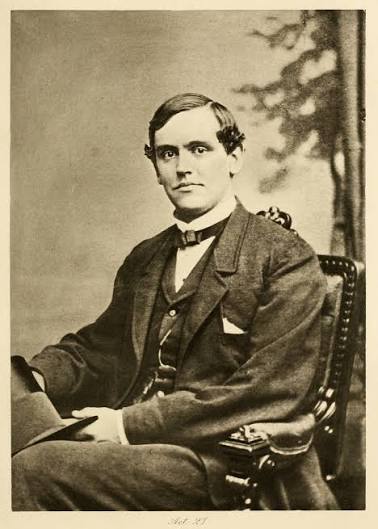 Phillips Brooks (December 13, 1835 – January 23, 1893) was one of the most prominent American religious figures of the 19th century. Renowned as a gifted orator and a central
figure in the Episcopal Church, his life remains a subject of both deep historical respect and contemporary scholarly re-examination.
Phillips Brooks (December 13, 1835 – January 23, 1893) was one of the most prominent American religious figures of the 19th century. Renowned as a gifted orator and a central
figure in the Episcopal Church, his life remains a subject of both deep historical respect and contemporary scholarly re-examination.
Born in Boston to a prominent New England family, Brooks attended Harvard University (class of 1855) and later studied at the Virginia Theological Seminary.
He began his ministry in Philadelphia at the Church of the Advent and later at Holy Trinity Church, where he gained national fame for his eloquent, charismatic, and
inclusive preaching style.
In 1869, he became the rector of Trinity Church in Copley Square, Boston. Under his leadership, the church became a beacon of "Broad Church" Anglicanism, emphasizing a
message of God's love and the potential within humanity.
He is perhaps most widely remembered today as the author of the lyrics to the beloved Christmas carol "O Little Town of Bethlehem," written following a visit to the
Holy Land in 1865.
In 1891, he was elected the sixth Bishop of Massachusetts. His tenure as bishop was short, lasting less than eighteen months until his sudden death in 1893 at age 57.
Phillips Brooks never married, a fact that was not entirely unusual for men of his era and social standing, yet it has invited significant historical curiosity.
Contemporary authors—most notably historian Douglass Shand-Tucci—have explored the private lives of prominent figures in the Boston Brahmin circle during the late 19th
century. In works such as The Crimson Letter, Shand-Tucci posits that Brooks was part of a network of men whose lives and emotional attachments deviated from the
conventional heterosexual norms of the time.
Biographical accounts often describe Brooks as deeply charismatic, particularly in his interactions with children and young men.
Historians like Shand-Tucci have sought to bring these "whispered questions" into the light, interpreting his intimate friendships, his travel patterns (such as the
1882 trip to India with Evert J. Wendell), and his bachelorhood through the lens of emerging LGBTQ history.
It is important to note that discussions regarding the sexuality of historical figures from the 19th century often involve interpreting personal journals, travel
companions, and social circles through modern definitions of sexual identity that did not exist in the same way during the Victorian era. Consequently, while some
historians view these patterns as evidence of a gay identity, others emphasize the nuances of close male friendships in that period.
Phillips Brooks is remembered for his powerful intellect and his ability to communicate "truth through personality." His influence on American culture extended well
beyond the pulpit; he was a friend to figures like Helen Keller and was instrumental in shaping the intellectual and spiritual
climate of Gilded Age Boston.
References:
Other references:
- https://en.wikipedia.org/wiki/Phillips_Brooks
- https://www.britannica.com/biography/Phillips-Brooks
- https://www.episcopalchurch.org/glossary/brooks-phillips/
- https://www.ststephensphl.org/news/friday-reflection-the-priest-who-was-phillips-brooks/1-2021
- https://publicservice.fas.harvard.edu/phillips-brooks-house
- https://www.ministrymagazine.org/archive/2002/12/phillips-brooks-the-man-and-his-master.html
Support this project
This website is a passion project researched, developed, and funded entirely by me. If you find the content valuable and would like to help support the ongoing research and hosting costs, any contribution is deeply appreciated.
Thank you for keeping this independent resource alive!
My books on Amazon: Elisa Rolle's books
BACK TO HOME PAGE