Queer Places:
Harvard University (Ivy League), 2 Kirkland St, Cambridge, MA 02138
Arlington National Cemetery, 1 Memorial Ave, Fort Myer, VA 22211, United States
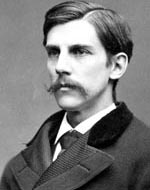 Oliver Wendell Holmes, Jr. (March 8, 1841 – March 6, 1935) was a monumental figure in American jurisprudence, known as "The Great Dissenter." He served on the U.S. Supreme
Court for nearly 30 years and fundamentally altered American legal thought by moving it away from formalistic, rigid logic toward a philosophy that acknowledged the social
and historical contexts of the law.
Oliver Wendell Holmes, Jr. (March 8, 1841 – March 6, 1935) was a monumental figure in American jurisprudence, known as "The Great Dissenter." He served on the U.S. Supreme
Court for nearly 30 years and fundamentally altered American legal thought by moving it away from formalistic, rigid logic toward a philosophy that acknowledged the social
and historical contexts of the law.
Born in Boston, he was the son of the famous physician and writer Oliver Wendell Holmes, Sr. His formative years were spent in the intellectual hub of New England. He
interrupted his studies at Harvard to serve as an officer in the Union Army during the Civil War. He was wounded multiple times in major engagements, including the Battle of
Ball’s Bluff, experiences that profoundly shaped his skepticism and his view of the "soldier’s faith"—a belief in duty and endurance.
After the war, Holmes graduated from Harvard Law School in 1866. He practiced law, lectured, and edited the American Law Review. In 1881, he published his seminal work,
The Common Law, in which he famously declared: "The life of the law has not been logic: it has been experience."
He served on the Supreme Judicial Court of Massachusetts before being appointed to the U.S. Supreme Court by President Theodore Roosevelt in 1902. He retired in 1932 as
the oldest justice in the Court's history.
He is best remembered for his defense of civil liberties, specifically in dissent. His "clear and present danger" test for free speech (originally in Schenck v. United
States) and his advocacy for judicial restraint in economic matters (notably in Lochner v. New York) became cornerstones of constitutional law.
The claim that Henry James (the novelist) and Oliver Wendell Holmes, Jr. engaged in sexual acts in 1865 is a subject of historical
debate, but it is not a consensus fact.
The assertion typically stems from re-readings of James's private writings and, most notably, interpretations of his autobiography and early life by modern literary
critics and biographers. Some scholars have explored the possibility that James’s "first acts of love" may have been with men, given his lifelong bachelorhood and his
intense, sometimes homoerotic, emotional bonds with male peers.
There is no primary historical evidence—such as letters, diaries, or contemporary accounts—that confirms a physical or sexual relationship between James and Holmes.
While they moved in similar circles and knew each other well (often socializing with William James, Henry's brother), their relationship is generally documented by
historians as an intellectual and social friendship.
Scholars who discuss this often note that "sexuality" as a modern identity category did not exist in the same way in the 1860s. Applying 21st-century labels to
19th-century friendships is a matter of intense academic controversy. Most mainstream biographers of Holmes focus on his legal philosophy and his documented relationships
with women (such as his marriage to Fanny Bowditch Dixwell and his deep, long-term correspondence with women like Clare Castletown), often finding speculation about his
private sexual life to be either unprovable or beyond the scope of traditional historical evidence.
In summary, while there is a significant body of literary and historical scholarship that questions the nature of intimacy in the lives of many 19th-century figures,
the specific claim regarding Holmes and James remains in the realm of biographical speculation rather than established fact.
References:
Other references:
- https://www.britannica.com/biography/Oliver-Wendell-Holmes-Jr
- https://www.nycla.org/course/soldier-scholar-sage-the-life-and-legacies-of-oliver-wendell-holmes-jr-cle031626/
- https://constitutioncenter.org/blog/constitutional-voices-oliver-wendell-holmes-jr
- https://www.ebsco.com/research-starters/history/oliver-wendell-holmes-jr
- https://www.fjc.gov/history/judges/holmes-oliver-wendell-jr
- https://en.wikipedia.org/wiki/Oliver_Wendell_Holmes_Jr.
- https://supreme.justia.com/justices/oliver-wendell-holmes-jr/
Support this project
This website is a passion project researched, developed, and funded entirely by me. If you find the content valuable and would like to help support the ongoing research and hosting costs, any contribution is deeply appreciated.
Thank you for keeping this independent resource alive!
My books on Amazon: Elisa Rolle's books
BACK TO HOME PAGE
