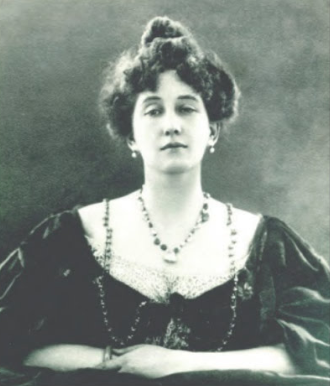
 Mabel Veronica "Ladye" Batten (née Hatch, 1856 - May 25, 1916) was a prominent British society beauty, classical mezzo-soprano, composer of drawing-room lieder, and a
notable cultural patron of the late Victorian and Edwardian eras.
Mabel Veronica "Ladye" Batten (née Hatch, 1856 - May 25, 1916) was a prominent British society beauty, classical mezzo-soprano, composer of drawing-room lieder, and a
notable cultural patron of the late Victorian and Edwardian eras.Partner Radclyffe Hall
Queer Places:
Highgate Cemetery West, Swain's Ln, London N6 6PJ, United Kingdom
Mabel Veronica "Ladye" Batten (née Hatch, 1856 - May 25, 1916) was a prominent British society beauty, classical mezzo-soprano, composer of drawing-room lieder, and a
notable cultural patron of the late Victorian and Edwardian eras.
Born in Calcutta, India, in 1856 to a well-connected Anglo-Irish military family, she spent her formative years traveling and studying music harmony and composition abroad in Dresden and Bruges.
In 1874, she married Colonel George Batten, a much older military officer who later served as secretary to the Viceroy of India. The couple had one daughter, Lady Cara Harris, who became an artist and filmmaker.
Known within elite artistic circles as "Ladye," Batten was an accomplished pianist, guitarist, and singer. She published several popular parlor and art songs—such as her musical setting of Ella Wheeler Wilcox’s poem The Queen's Last Ride and Rudyard Kipling’s The Love Song of Har Dyal. She was also a dedicated patron of classical musicians, supporting talents like violinist Mischa Elman and composer Percy Grainger.
Her striking presence and cultural status led to her being painted by prominent artists of the time, most notably John Singer Sargent (c. 1897) and Sir Edward John Poynter.
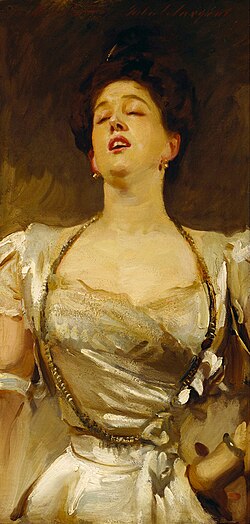
by John Singer Sargent (c. 1897)
Mabel Batten holds a foundational place in early 20th-century British lesbian history, primarily through her relationships with seminal literary figures and her unintended role in shaping queer culture.
In August 1907, while visiting the German spa town of Bad Homburg, 51-year-old Batten met a 27-year-old Marguerite Radclyffe Hall (who would later write the landmark lesbian novel The Well of Loneliness). The two women fell deeply in love and eventually moved in together at Cadogan Square following the death of Batten's husband.
Batten is directly responsible for Radclyffe Hall's lifelong masculine persona and preferred name. Batten nicknamed Hall "John" (or "Johnnie") because she felt she looked like a John. Hall adopted the name exclusively for the rest of her life, dressing in masculine tailoring and asserting an identity as a "congenital invert".
Biographers credit Batten with recognizing Hall’s raw literary talent "even in the egg" and providing the emotional and financial stability that allowed Hall to begin her career as a serious writer and poet. Batten also heavily influenced Hall’s spiritual life, helping guide her conversion to Roman Catholicism.
In 1915, late in her life, Batten introduced Hall to her younger cousin, the sculptor and translator Una Vincenzo, Lady Troubridge. Shortly thereafter, Batten suffered a debilitating stroke and passed away in May 1916. Following Batten's death, a grief-stricken Hall and Una Troubridge grew close, ultimately embarking on a decades-long lifelong partnership.
Mabel Batten was buried in the Batten family vault in the Circle of Lebanon at Highgate Cemetery in London. Decades later, when Radclyffe Hall died in 1943, she requested to be entombed directly at the entrance of that same crypt, permanently linking her final resting place to her first great love.
References:
Other references:
Support this project
This website is a passion project researched, developed, and funded entirely by me. If you find the content valuable and would like to help support the ongoing research and hosting costs, any contribution is deeply appreciated.
Thank you for keeping this independent resource alive!
My books on Amazon: Elisa Rolle's books


