Queer Places:
214 Pleasant St, Portsmouth, NH 03801, USA
Harvard University (Ivy League), 2 Kirkland St, Cambridge, MA 02138
Woodlawn Cemetery, 3800 Jerome Ave, Bronx, NY 10467, United States
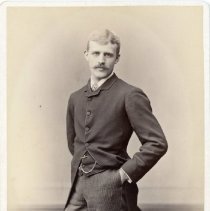 Evert Jansen Wendell (December 5, 1860 - August 28, 1917) was born on December 5, 1860, emerging into a prominent life of athletics, philanthropy, and cultural curation that
left a lasting imprint on Harvard University and New York society. As a scion of an influential lineage, his brother Barrett Wendell would go on to become a legendary
Harvard don, setting a high intellectual bar for the family. Evert himself entered Harvard College, where he quickly established a commanding presence across campus life. He
immersed himself deeply in undergraduate organizations, becoming a member of the elite A.D. Club, writing for the Harvard Crimson, singing in the Glee Club, and performing
with the Hasty Pudding Club. Alongside peers like Owen Wister and future president Theodore Roosevelt, Wendell was a frequent fixture at the Hemenway Gymnasium, embodying
the physical ideal of the era. He earned widespread renown as a varsity track athlete, acting as a driving force behind what historians of the sport dubbed the "Golden Age"
of track at Harvard through his dominant victories in the 100-, 220-, and 440-yard dashes, as well as the one-fifth mile hurdles.
Evert Jansen Wendell (December 5, 1860 - August 28, 1917) was born on December 5, 1860, emerging into a prominent life of athletics, philanthropy, and cultural curation that
left a lasting imprint on Harvard University and New York society. As a scion of an influential lineage, his brother Barrett Wendell would go on to become a legendary
Harvard don, setting a high intellectual bar for the family. Evert himself entered Harvard College, where he quickly established a commanding presence across campus life. He
immersed himself deeply in undergraduate organizations, becoming a member of the elite A.D. Club, writing for the Harvard Crimson, singing in the Glee Club, and performing
with the Hasty Pudding Club. Alongside peers like Owen Wister and future president Theodore Roosevelt, Wendell was a frequent fixture at the Hemenway Gymnasium, embodying
the physical ideal of the era. He earned widespread renown as a varsity track athlete, acting as a driving force behind what historians of the sport dubbed the "Golden Age"
of track at Harvard through his dominant victories in the 100-, 220-, and 440-yard dashes, as well as the one-fifth mile hurdles.
Beyond his athletic prowess, Wendell cultivated a lifelong devotion to the theater and the performing arts, frequently acting and singing in college productions. After
graduating with the class of 1882, he immediately traveled to Europe, attending the Wagner Festival at Bayreuth to experience Parsifal, an opera famously intertwined with
the homosocial and male artistic circles of the period. Following the festival, Wendell traveled to Berlin, where he rendezvoused with
Phillips Brooks, the influential rector of Boston's Trinity Church and future Episcopal bishop of Massachusetts. At Brooks's
invitation, Wendell embarked on an extensive three-month journey with him across India, traversing bustling cities, the Himalayas, and the ancient caves of Ellora.
Returning to the United States, Wendell channeled his independent wealth and boundless energy into a life of vigorous travel, physical adventure, and civic engagement. He
frequently organized and accompanied Harvard athletic teams on international trips, including competitions against Oxford and Cambridge, and maintained a deep connection to
his alma mater. Professionally and philanthropically, Wendell dedicated his adulthood to social reform, focusing intensely on the betterment of impoverished youth in New
York City. He served as a long-time trustee for the Society for the Reformation of Juvenile Delinquents and worked tirelessly among the city's boys' clubs. Despite his
highly gregarious, sociable nature and prominent standing in elite social circles, Wendell never married.
Throughout his life, Wendell quietly amassed one of the largest private theater collections in the United States, a massive archive of memorabilia, scripts, and images
that he ultimately bequeathed to Harvard University. Within this very collection, modern scholars like independent researcher Joan Navarre uncovered a tangible link to a
famous historical encounter: a sepia photograph of Oscar Wilde inscribed by the author "To J. Wendell" and dated January 31, 1882.
This date marked Wilde's very first lecture in Boston, an event famously disrupted by raucous heckling from Wendell's own Harvard classmates. Although Wendell's later public
profile—defined by bachelorhood, intense dedication to boys' clubs, elite philanthropy, and associations with figures like Phillips Brooks—rendered any overt association
with the disgraced Wilde a dangerous prospect, the artifact remains a testament to his vibrant social orbit. Evert J. Wendell passed away on August 28, 1917, leaving behind
a legacy as a quintessential Gilded Age muscular Christian, a titan of Harvard athletics, and a passionate champion of youth welfare.
References:
Other references:
- Harvard Theatre Collection & Houghton Library (Harvard University): Houses the massive theatrical library, memorabilia, and artifact collection bequeathed by Evert J. Wendell upon his death, where items such as the inscribed Oscar Wilde photograph have been discovered by scholars like Joan Navarre.
- Harvard College Class Reports and Alumni Records: Periodic class of 1882 reports, undergraduate summaries, and formal obituaries detailing his athletic records at Hemenway Gymnasium, campus organizations (A.D. Club, Harvard Crimson, Glee Club, Hasty Pudding), and adult life pursuits.
- Wendell Family Papers (MS025) and Photograph Collections: Maintained at repositories such as the Portsmouth Athenaeum, containing correspondence, financial records, shipping documents, and historical family photographs.
- The Crimson Letter by Douglass Shand-Tucci: Historical study touching upon Harvard networks, social circles, and biographical contexts of late 19th-century figures connected to the university.
- Society for the Reformation of Juvenile Delinquents Archives: Institutional records documenting Wendell's long-term tenure and philanthropic trustee work among New York's boys' clubs.
Support this project
This website is a passion project researched, developed, and funded entirely by me. If you find the content valuable and would like to help support the ongoing research and hosting costs, any contribution is deeply appreciated.
Thank you for keeping this independent resource alive!
My books on Amazon: Elisa Rolle's books
BACK TO HOME PAGE
