Partner Mollie Lawton
Queer Places:
The Art Students League of New York, 215 W 57th St, New York, NY 10019
9 Tuckahoe Ln, Southampton, NY 11968, USA
Sacred Hearts of Jesus and Mary Catholic Cemetery, Southampton, Suffolk County, New York, USA
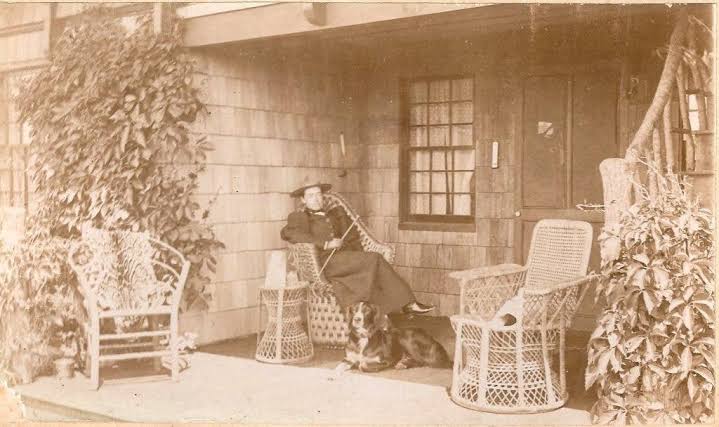 Zella de Milhau (April 3, 1866 – March 3, 1954) was an extraordinary American artist, community organizer, World War I ambulance driver, and pioneer who quite literally refused to fit into the conventional boxes of early 20th-century society.
Zella de Milhau and her partner, British author Mollie Lawton (who often wrote under the pen name Mel Erskine), shared a vibrant, unconventional life together in the Art Village of Southampton, Long Island.
Zella de Milhau (April 3, 1866 – March 3, 1954) was an extraordinary American artist, community organizer, World War I ambulance driver, and pioneer who quite literally refused to fit into the conventional boxes of early 20th-century society.
Zella de Milhau and her partner, British author Mollie Lawton (who often wrote under the pen name Mel Erskine), shared a vibrant, unconventional life together in the Art Village of Southampton, Long Island.
She lived a fiercely independent and adventurous life, jumping between high-society art communities, front-line war zones, and local civic duties.
Born in New York City to a prominent family, de Milhau studied at the Art Students League before moving out to the East End of Long Island. She became a central figure in Southampton's historic "Art Village," studying under the famous American Impressionist William Merritt Chase.
She excelled at printmaking, particularly etching, drypoint, and mezzotint.
Her artwork was highly respected; she had solo exhibitions in major galleries, and her prints are still held in prestigious collections today, including the National Gallery of Art and the Smithsonian American Art Museum.
Long before modern urban greening initiatives existed, de Milhau was a pioneer of civic beautification. In 1902, while living in Brooklyn Heights, she organized her neighbors to plant trees, flowers, and window boxes. This project, known as the "Block Beautiful" initiative, laid the historical groundwork for community-led urban gardening and city-greening projects still active today.
When World War I broke out, de Milhau didn't stay safely at home. She traveled to England to serve with the Volunteer Motor Corps and was even made a recruiting sergeant. Later, she raised funds from residents back in Southampton to buy an ambulance, shipped it to France, and personally drove it between the front lines and field hospitals under active shellfire.
For her bravery and service, France awarded her the prestigious Croix de Guerre and the Gold Medaille de la Reconnaissance française (Medal of French Gratitude).
Upon returning from the war to Long Island, de Milhau bought a motorcycle and was hired as Southampton's very first motorcycle police officer ("Officer Number 6") in 1920. Contemporary newspapers got a thrill out of writing about the "Society Girl Motor Cop" who spent her days chasing down speeding drivers. She later transitioned to working as a parole officer and a court interpreter for the local community.
De Milhau was known for favoring short-cropped hair, driving a four-in-hand carriage through town while shouting "Tallyho!", and filling her home (aptly named Laffalot) with eccentric artifacts from her travels around the globe. She was a woman who completely disregarded the rigid gender expectations of her era to live an authentic, impactful life.
Zella de Milhau and Mollie Lawton shared an original cottage in the Art Village of Southampton, Long Island, that they purchased from a local resident. Originally a "bare little hut," they completely transformed the structure with the help of their friend, architect Katherine Budd.
Reflecting their spirited approach to life, Zella and Mollie named their home Laffalot. Inside, the cottage was famously eccentric, filled with exotica and treasures Zella collected from her global travels, including French and Egyptian artifacts, Western plains trophies, and thousands of Indigenous relics.
The cottage was considered so uniquely charming that it was featured in an admiring profile in the Autumn 1912 issue of Southampton Magazine. Zella, known for her short-cropped hair and plus-fours, was adopted by local Shinnecock community members in a ceremony where she was given the name Chiola—meaning "she who laughs." True to the name of their home, when she and Mollie threw parties at Laffalot, they "pulled out all the stops."
The cottage known as Laffalot was originally built and located on Ochre Lane within the historic Art Village of Southampton, New York.
Because the Art Village is not a federally protected historic district, Laffalot fell into severe disrepair in the early 21st century and was explicitly threatened with demolition. To save the historic structure, neighboring property owners struck a deal to physically move the cottage from its original plot to an adjoining property compound within the same Art Village neighborhood.
Mollie Lawton immortalized Zella’s remarkable personality and wartime bravery in a 1936 book titled Thank God for Laughter, published under her pseudonym, Mel Erskine.
The book is a biographical account focusing on Zella's World War I service as a front-line ambulance driver in France. In the text, Mollie affectionately refers to Zella by her nickname, "Bunty."
The book was a true joint effort between the partners; while Mollie wrote the text, Zella provided the illustrations, embedding her own original signed etchings (such as The Ruins of Bailly) directly into the frontispiece of the first edition. The book even featured a foreword by the famous muckraking journalist Ida Tarbell.
Together, Mollie and Zella carved out a unique space in the Long Island art scene, built on a shared love of creativity, travel, and a refusal to conform to the rigid social restrictions of their day.
The primary bridge between Zella de Milhau and painters Ellen Emmet Rand and Mary Foote was their shared time as art students at William Merritt Chase’s famous Shinnecock Hills Summer School of Art in Southampton.
Zella, Ellen Emmet Rand, and Mary Foote were all part of the pioneering generation of women artists who studied under Chase on Long Island during the 1890s. They lived, worked, and painted alongside each other in the Shinnecock hills, forming deep personal and creative networks.
This group was incredibly tight-knit. Ellen Emmet Rand and Mary Foote were so close that they actually moved to Paris together in 1897, setting up a shared studio on the Boulevard Montparnasse. Rand even painted a well-known portrait of Mary Foote in 1898 during their time abroad. Back home on Long Island, Zella and Mollie remained central figures in the very same Southampton Art Village where this community of women first coalesced.
While photographer Alice Austen and her life partner Gertrude Tate are most famously associated with their home on Staten Island (Clear Comfort), their connection to Zella and Mollie is rooted in the overlapping social, artistic, and queer networks of early 20th-century New York.
Both couples—Zella & Mollie and Alice & Gertrude—chose to live completely outside the traditional domestic norms of their era. They operated in the exact same progressive, independent creative circles.
Alice Austen was a pioneering documentary photographer who captured the lives of independent, modern women, while Zella was an avant-garde printmaker who rode motorcycles and drove war ambulances. Figures in their circle frequently traveled between the art enclaves of Staten Island, Manhattan, and the East End of Long Island, supporting each other's artistic endeavors and lifestyle choices at a time when society rarely did.
References:
- https://patch.com/new-york/southampton/from-the-archives-zella-de-milhau-was-conventionalitys-enemy
- https://glimpsesofthepastorg.wordpress.com/about-the-artists/
- https://en.wikipedia.org/wiki/Zella_de_Milhau
- https://www.abebooks.co.uk/signed-first-edition/THANK-GOD-LAUGHTER-Erskine-Mel-pseud/32161243022/bd
- https://www.southamptonhistory.org/post/laffalot-in-art-village
- https://www.private-air-mag.com/8-studio-lane-9-tuckahoe-lane
Support this project
This website is a passion project researched, developed, and funded entirely by me. If you find the content valuable and would like to help support the ongoing research and hosting costs, any contribution is deeply appreciated.
Thank you for keeping this independent resource alive!
My books on Amazon: Elisa Rolle's books
BACK TO HOME PAGE