Queer Places:
University of Cambridge, 4 Mill Ln, Cambridge CB2 1RZ
All Saints Churchyard, Church St, Little Shelford, Cambridge CB22 5HG, United Kingdom
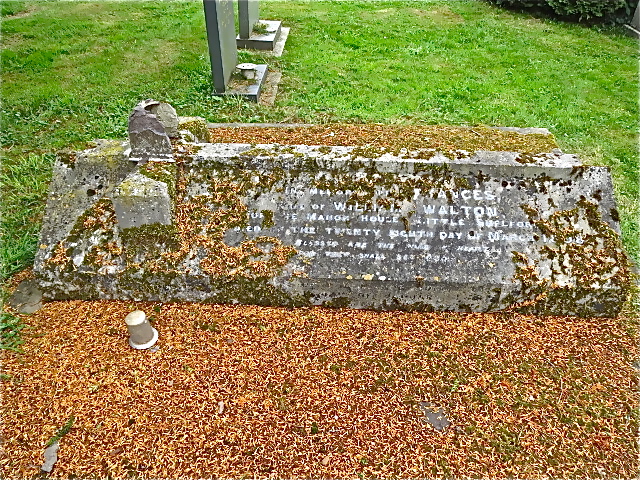 William Walton (September 16, 1813 - June 9, 1901) attended Trinity College, Cambridge, where he distinguished himself in the rigorous mathematical culture of
nineteenth-century Britain. In 1836, he graduated as the Eighth Wrangler (the eighth-highest mathematics student in the elite first-class honours bracket of the Mathematical
Tripos). Rather than pursuing a conventional ecclesiastical or legal career—common paths for Cambridge graduates at the time—Walton chose to remain at Trinity College for
the rest of his life, establishing himself as a preeminent private mathematics tutor ("coach") to generations of undergraduates.
William Walton (September 16, 1813 - June 9, 1901) attended Trinity College, Cambridge, where he distinguished himself in the rigorous mathematical culture of
nineteenth-century Britain. In 1836, he graduated as the Eighth Wrangler (the eighth-highest mathematics student in the elite first-class honours bracket of the Mathematical
Tripos). Rather than pursuing a conventional ecclesiastical or legal career—common paths for Cambridge graduates at the time—Walton chose to remain at Trinity College for
the rest of his life, establishing himself as a preeminent private mathematics tutor ("coach") to generations of undergraduates.
Walton was a prolific author and editor of mathematical texts, contributing significantly to the pedagogical and advanced analytical tools available to Victorian
students.
He published widely on theoretical mechanics, hydrostatics, differential calculus, and plane coordinate geometry.
In 1837, alongside fellow mathematicians such as Duncan Farquharson Gregory and Robert Leslie Ellis, Walton helped foster
a revival of British mathematics by supporting collaborative academic publishing.
Following the early death of his close friend Robert Leslie Ellis, Walton compiled and edited The Mathematical and Other Writings of Robert Leslie Ellis (1863),
preserving his friend's scholarly legacy alongside a biographical memoir.
William Walton’s academic and personal life was deeply intertwined with Robert Leslie Ellis, a brilliant polymath, Senior Wrangler of 1840, and scholar of
Francis Bacon.
The two men shared an intense intellectual bond within the tight-knit circles of Trinity College. When Ellis walked the Senate House to receive his degree amidst failing
health, Walton famously recorded being struck not only by Ellis’s brilliance but by how his "pale and ill" countenance enhanced his "intellectual beauty".
When rheumatic fever and progressive illness left Ellis an invalid confined to a sickbed later in life, Walton remained one of his most steadfast companions and
confidants. Ellis dictated his final thoughts on philosophy, mathematics, etymology, and logic to Walton. After Ellis's premature death at age 41, Walton ensured his
intellectual contributions were not lost to history by meticulously gathering, editing, and publishing his literary and mathematical remains.
While direct documentation regarding the private romantic lives of Victorian academics is frequently scarce—often obscured by the rigid criminalization of homosexuality
under the Criminal Law Amendment Act and social conventions of the era—historians studying nineteenth-century Cambridge homosociality often examine figures like Walton and
Ellis through the lens of elite, bachelor-dominated college environments.
As a lifelong resident fellow and private tutor at Trinity College, Walton lived within an exclusively homosocial academic community. Residence fellowships at Oxford and
Cambridge during the mid-nineteenth century traditionally required celibacy and bachelorhood, fostering intense, highly emotionally charged homosocial bonds, romantic
friendships, and intellectual partnerships among men.
The language used by contemporaries to describe relationships within this specific Cambridge circle—such as Walton’s aesthetic appreciation of Ellis's "intellectual
beauty" and their lifelong devotion—fits the pattern of intense Victorian romantic friendships. While these relationships are rarely explicitly documented in modern terms of
sexual identity, they represent the deeply intimate emotional structures that characterized intellectual life among Victorian bachelors.
References:
- Ellis, Robert Leslie. The Mathematical and Other Writings of Robert Leslie Ellis. Edited by William Walton, with a biographical memoir by Harvey Goodwin. Cambridge: Deighton, Bell and Co., 1863.
- University of St Andrews – MacTutor History of Mathematics Archive: Biographical entry on Robert Leslie Ellis (1817–1859), detailing accounts from William Walton regarding the 1840 Senate House graduation.
- Barrow-Green, June. “A Senior Wrangler Among Senior Wranglers”: The Mathematical Education of Robert Leslie Ellis. Open Research Online / Chapter on nineteenth-century Cambridge mathematical culture.
- Secondary scholarship examining nineteenth-century Oxbridge fellowship rules, bachelor cultures, and the structure of romantic friendships among male academics in Victorian institutions.
Support this project
This website is a passion project researched, developed, and funded entirely by me. If you find the content valuable and would like to help support the ongoing research and hosting costs, any contribution is deeply appreciated.
Thank you for keeping this independent resource alive!
My books on Amazon: Elisa Rolle's books
BACK TO HOME PAGE