Queer Places:
Harvard University (Ivy League), 2 Kirkland St, Cambridge, MA 02138
95 Irving St, Cambridge, MA 02138, USA
Cambridge Cemetery, 76 Coolidge Ave, Cambridge, MA 02138, United States
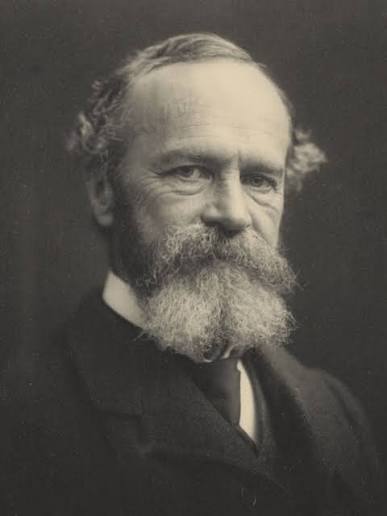 William James (January 11, 1842 – August 26, 1910) was a pioneering American psychologist and philosopher widely recognized as the "Father of American Psychology". Contrary
to the notion of an Irish background, James was born in New York City into a wealthy, highly intellectual family. He was the oldest of five children, with his younger
brother being the celebrated novelist Henry James. Educated by private tutors both in America and Europe, James initially pursued an
interest in painting before shifting toward science and medicine. He entered the Lawrence Scientific School in 1861 and later earned his M.D. from Harvard Medical School,
though chronic health struggles, physical ailments, and bouts of severe depression frequently disrupted his early adult life and studies.
William James (January 11, 1842 – August 26, 1910) was a pioneering American psychologist and philosopher widely recognized as the "Father of American Psychology". Contrary
to the notion of an Irish background, James was born in New York City into a wealthy, highly intellectual family. He was the oldest of five children, with his younger
brother being the celebrated novelist Henry James. Educated by private tutors both in America and Europe, James initially pursued an
interest in painting before shifting toward science and medicine. He entered the Lawrence Scientific School in 1861 and later earned his M.D. from Harvard Medical School,
though chronic health struggles, physical ailments, and bouts of severe depression frequently disrupted his early adult life and studies.
In 1872, James began his academic career at Harvard University, initially teaching physiology before transitioning into anatomy, psychology, and philosophy. During his
tenure, he established the first psychology course in the United States and created an experimental psychology demonstration laboratory, cementing his foundational role in
the discipline. In 1890, he published his monumental, two-volume masterpiece, The Principles of Psychology, which profoundly shaped the field and introduced core concepts
like the "stream of consciousness." Following this success, James helped pioneer functionalism, an approach focusing on how mental processes help human beings adapt to their
environments, and became a leading champion of pragmatism, a philosophical movement asserting that the truth or meaning of an idea is measured by its practical consequences.
His later influential works include The Will to Believe and The Varieties of Religious Experience. He passed away from heart failure in 1910 at his summer home in Chocorua,
New Hampshire.
William James occupied a progressive intellectual space that occasionally brushed against the emerging discourses of gender, sexuality, and identity at the turn of the
twentieth century. Most notably, James maintained a rich, decades-long intellectual friendship and correspondence with the prominent late-Victorian author, essayist, and
lesbian intellectual Vernon Lee (the pen name of Violet Paget). Lee, who lived an openly non-conformist queer life, adopted a male
pen name, wore masculine clothing, and maintained lifelong partnerships with women. She deeply engaged with James's psychological theories—particularly his concepts of the
stream of consciousness and perception—integrating them into her own aesthetic philosophies, psychological supernatural fiction, and theories of art empathy. Furthermore,
James's academic sphere at Harvard and his broad international network placed him in contact with early pioneers of sexology and psychology, such as
Havelock Ellis, contributing to an intellectual climate that slowly began analyzing human sexuality, variant psychology, and
non-normative identity outside of strict moral pathology.
References:
- The Principles of Psychology (2 vols., 1890)
- The Will to Believe, and Other Essays in Popular Philosophy (1897)
- The Varieties of Religious Experience: A Study in Human Nature (1902)
- Pragmatism: A New Name for Some Old Ways of Thinking (1907)
- Essays in Radical Empiricism (1912)
- Perry, Ralph Barton. The Thought and Character of William James (2 vols., 1935) — The definitive, Pulitzer Prize-winning early biography containing extensive correspondence.
- Feinstein, Howard M. Becoming William James (1984) — An in-depth look at his early life, family dynamics, and health struggles.
- Simon, Linda. Genuine Reality: A Life of William James (1998) — A comprehensive modern biographical account of his career and intellectual circles.
- Colby College Library (Miller Library) — Houses the primary Vernon Lee Archive, containing extensive correspondence, manuscripts, and cross-atlantic intellectual exchanges.
- Somerville College Library (Oxford University) — Holds the Vernon Lee Collection of incoming personal correspondence from contemporary intellectuals, writers, and international peers.
- Gunn, Peter. Vernon Lee: Violet Paget, 1856–1935 (1964) — An early foundational biography outlining her life, aesthetic circles, and non-conformist identity.
- Colby, Vineta. Vernon Lee: A Literary Biography (2003) — A detailed exploration of her literary career, psychological leanings, and vast network of correspondents.
Support this project
This website is a passion project researched, developed, and funded entirely by me. If you find the content valuable and would like to help support the ongoing research and hosting costs, any contribution is deeply appreciated.
Thank you for keeping this independent resource alive!
My books on Amazon: Elisa Rolle's books
BACK TO HOME PAGE