Queer Places:
Canandaigua, New York 14424, USA
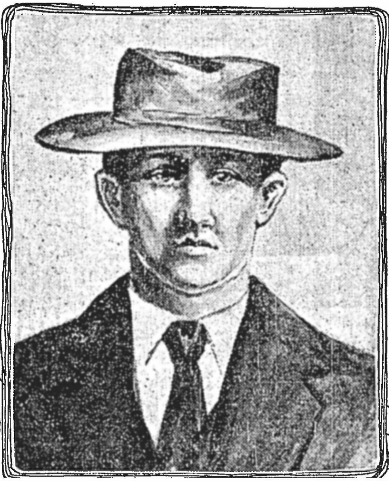 William C. Howard, originally known as Alice Howard (1860 - March, 1902), was born in upstate New York in 1860 and passed away in March 1902. From a young age, Howard
exhibited a strong preference for masculine roles and clothing. According to accounts from his half-brothers, Howard favored men's work and attire as a child, a tendency
that solidified into adopting a full-time male lifestyle while still quite young. Remarkably, this transition occurred without the need to relocate to a distant city or
escape his immediate family. In the 1880 federal census, twenty-year-old William Howard was documented living openly as a man within the same household alongside his mother,
his sister Minnie, and an aunt and uncle.
William C. Howard, originally known as Alice Howard (1860 - March, 1902), was born in upstate New York in 1860 and passed away in March 1902. From a young age, Howard
exhibited a strong preference for masculine roles and clothing. According to accounts from his half-brothers, Howard favored men's work and attire as a child, a tendency
that solidified into adopting a full-time male lifestyle while still quite young. Remarkably, this transition occurred without the need to relocate to a distant city or
escape his immediate family. In the 1880 federal census, twenty-year-old William Howard was documented living openly as a man within the same household alongside his mother,
his sister Minnie, and an aunt and uncle.
As a young adult in rural New York, Howard integrated seamlessly into community social life as a man. Local newspapers, including the Syracuse Evening Telegram and the
Ontario County Journal, described him as a frail yet attractive young man who was exceptionally popular with women. He actively participated in local courtship rituals,
frequently taking young women out for Sunday afternoon buggy rides and spending his money freely, which sparked friendly rivalries among local women for his exclusive
attention.
In 1892, Howard reached a significant personal milestone by marrying Edith Dyer (also noted in contemporaneous reporting by her maiden or alternative name, Edith
Fordyce), a local woman twelve years his junior. The couple likely met while Howard was working as a milk peddler in Edith's hometown of Hornellsville, and they went through
a marriage ceremony in 1892. They were married at the Wellsville Methodist Episcopal Church in a ceremony officiated by Reverend E.P. Hubbell. Together, William and Edith
adopted a daughter named Ruby and built a domestic life in a modest cottage located on D.C. Cook's farm along the Chapinville road near Canandaigua, New York.
Howard had lived in the Canandaigua area for five years prior to his death, working locally as a farmhand alongside the woman known as Mrs. Howard. Those most intimately
acquainted with the family never had the slightest suspicion that he was not a man. His sudden death occurred in March 1902 under mysterious circumstances; after taking
medication sent from relatives residing in Wellsville for a throat affection, he died within ten minutes (with other accounts noting within three hours of ingesting tablets
for a cough). An autopsy subsequently revealed his assigned sex at birth, generating significant public notice. Following his death, two men claiming to be his half-brothers
attended the funeral but refused to divulge any information. Despite the post-mortem revelation, local media reported that Howard's gender expression was fully respected
after his passing, and his body was buried wearing male clothing—reflecting a rare degree of community tolerance for nineteenth-century rural transgender history.
References:
Other references:
- United States Federal Census (specifically the 1880 Federal Census, documenting William Howard living with his family members in New York state)
- Syracuse Evening Telegram (periodical featuring contemporary reporting on Howard's life, social standing, and community integration)
- Ontario County Journal (local newspaper providing historical reporting on Howard's courtship, marriage, residence near Canandaigua, sudden passing in March 1902, and community respect regarding his burial in male attire)
- Wellsville Methodist Episcopal Church Records (archival marriage records documenting the 1892 marriage of William Howard and Edith Dyer, officiated by Reverend E.P. Hubbell)
Support this project
This website is a passion project researched, developed, and funded entirely by me. If you find the content valuable and would like to help support the ongoing research and hosting costs, any contribution is deeply appreciated.
Thank you for keeping this independent resource alive!
My books on Amazon: Elisa Rolle's books
BACK TO HOME PAGE
