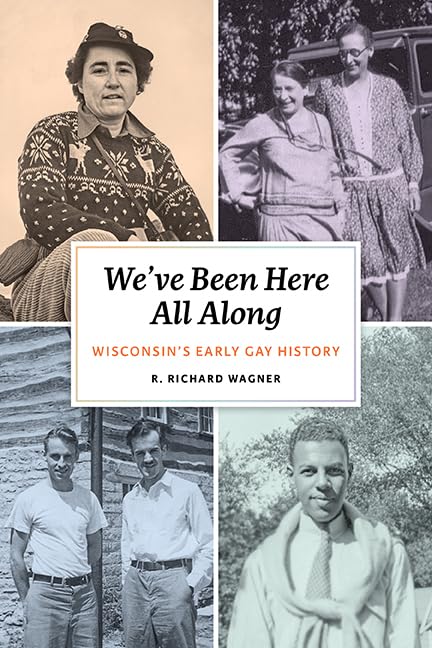
We’ve Been Here All Along: Wisconsin’s Early Gay History Hardcover – Illustrated, May 7, 2019
by R. Richard Wagner
Queer Places:
Forest Hill Cemetery, 1 Speedway Rd, Madison, WI 53705, United States
William Constantine Abaly (March 17, 1863 - October 12, 1934) was born on March 17, 1863, in Cottage Grove, Wisconsin, to parents Constantine and Mary Everly Abaly. He was one of several children, growing up alongside his siblings Charles, John, Mary Helen, Elizabeth, David, and Henry. Early in his life, his family relocated from Cottage Grove to Madison, where he attended the local fifth ward school and graduated from Central High School. Before pursuing a career in medicine, he worked as a druggist with the Avery Drugs Company. He then attended the College of Physicians and Surgeons of Chicago, earning his medical degree in 1886. Following his graduation, Dr. Abaly returned to Madison to establish his medical practice, specializing as an eye, ear, nose, and throat doctor. For 48 years, he maintained a prominent presence as one of southern Wisconsin's leading physicians, with offices located in the historic Brown Block where the First National Bank would later stand. He also maintained a part-time office in Richland Center.
Dr. Abaly was a pioneer in his field and a dedicated member of the medical community, belonging to the Dane County Medical Society, the American Medical Association, the Roentgen-Ray Society, and the Madison Order of Elks. He achieved several notable medical milestones in the region, including owning and operating the first X-ray machine in Madison and introducing the first X-ray evidence of an injury in a Wisconsin court. Furthermore, he was recognized as the first physician in Madison to perform a mastoid operation.
In his personal life, Dr. Abaly married Mary Estella Warner in 1897. The couple had multiple children, including an infant daughter who passed away in 1898, a son named James who lived from 1903 to 1914, and another son named Robert Cameran Abaly, born in 1913.
Dr. Abaly's life intersected with early LGBTQ legal history in Wisconsin when, in 1916, he became embroiled in a high-profile criminal case. Charged in Richland County with having performed fellatio on a young man named Frank Kilby, Dr. Abaly faced a sodomy conviction that was subsequently appealed to the Wisconsin Supreme Court. During the legal proceedings, his reputation was defended by notable character witnesses, including Dr. W.W. Gill, who had known Abaly for forty years and attested to his good moral standing in Madison, and Harry Sauthoff, the Dane County district attorney who was a bachelor at the time. The appeal case notably highlighted the social prejudices of the era, as it was implied that the character witnesses' credibility was undermined simply because they were bachelors, casting speculative suspicion upon them as well. Ultimately, technical procedural errors allowed for the problematic sodomy conviction to be temporarily overturned.
In his later years, Dr. Abaly experienced significant personal grief with the loss of several children, and records for his surviving son, Robert, disappear after 1933, prior to his father's death. Dr. William C. Abaly passed away late on a Friday, October 12, 1934, at a Madison hospital at the age of 71. He was survived by his wife, Mary Estella, his brother David, and his sister Elizabeth Sutcliffe. He was buried at Forest Hill Cemetery in Madison, though cemetery records note that his resting place lacks a formal grave monument or marker. His wife, Mary, passed away a few years later in 1939.
References:
|
We’ve Been Here All Along: Wisconsin’s Early Gay History Hardcover – Illustrated, May 7, 2019 by R. Richard Wagner |
Other references:
Support this project
This website is a passion project researched, developed, and funded entirely by me. If you find the content valuable and would like to help support the ongoing research and hosting costs, any contribution is deeply appreciated.
Thank you for keeping this independent resource alive!
My books on Amazon: Elisa Rolle's books