Queer Places:
Trinity College
Yale University (Ivy League), 38 Hillhouse Ave, New Haven, CT 06520
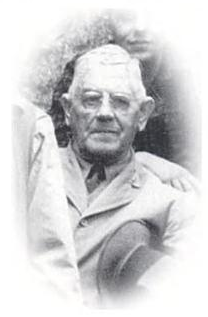 William Brownell "Billy" Goodwin (October 7, 1866 – May 17, 1950) was born on October 7, 1866, in Hartford, Connecticut, to Francis Goodwin and Mary Alsop
Jackson. He attended St. Paul's School in Concord, New Hampshire, and briefly studied at Trinity College before transferring to Yale University, where he
graduated with the class of 1888. During his university years, he distinguished himself as an athlete, playing football in 1884 and competing on Yale's
track and field team in 1886 and 1887.
William Brownell "Billy" Goodwin (October 7, 1866 – May 17, 1950) was born on October 7, 1866, in Hartford, Connecticut, to Francis Goodwin and Mary Alsop
Jackson. He attended St. Paul's School in Concord, New Hampshire, and briefly studied at Trinity College before transferring to Yale University, where he
graduated with the class of 1888. During his university years, he distinguished himself as an athlete, playing football in 1884 and competing on Yale's
track and field team in 1886 and 1887.
Following his graduation, Goodwin embarked on a life defined by pioneering sports administration and rugged adventure. He traveled to the Pacific
Northwest, where he organized the first college football team on the Pacific Coast at the University of Washington under American Rugby rules. He served as
the program's first head coach from 1892 to 1893, compiling a record of 2-4-1. A relentless sports promoter, Goodwin also founded the Seattle Athletic Club
in 1892, orchestrated the first international rowing race between Vancouver and Seattle in 1890, and arranged the first intercollegiate four-oared boat
race between the University of California and Seattle associates. In 1894, his Seattle Athletic Club team won the historic Great Northern Railway Silver
Cup championship. His footprint on early football extended nationally when he refereed the first transcontinental football game on December 25, 1899, in
San Francisco, where the Carlisle Indian School defeated the University of California.
Goodwin's adventurous spirit took him far beyond the gridiron. Between 1898 and 1899, he trekked into the Yukon territory during the gold rush, spending
two harsh winters near the Arctic Circle. Professionally, he established a successful career as an astute businessman and insurance executive, working with
major entities including J.P. Morgan and serving as a special agent for the Aetna Fire Insurance Company in Columbus, Ohio, and San Francisco until his
retirement around 1930. On November 23, 1898, he married Mary A. Hood in Seattle, Washington, with whom he had no children.
In his later years, Goodwin transitioned into an avid historian and archaeologist. He conducted extensive field trips across New England and authored
books examining historical figures and ruins, including works on Leif Ericsson, the Vikings, and ancient sites in Jamaica. His most famous and
controversial archaeological claim stemmed from his discovery of beehive-shaped stone huts in North Salem, New Hampshire. Finding structural similarities
to structures built by the Culdees of Northern Ireland, Goodwin developed a passionate theory that pre-Columbian Irish explorers had discovered America,
publishing his thoughts on the subject.
Alongside his archaeological pursuits, Goodwin was culturally active, becoming a member of the prestigious
Horace Walpole Society after being elected in 1927. William Brownell Goodwin passed away on
May 17, 1950, at the age of 83 in Hot Springs, Virginia, leaving behind a colorful legacy as a collegiate sports pioneer, gold seeker, and eccentric
amateur archaeologist.
References:
- United States Federal Censuses and Vital Statistics: Public census records (including the 1930 and 1950 U.S. Censuses) and state death certificates (such as Virginia Death Records, 1912–1987) documenting his life milestones, residence in Hartford, Connecticut, and death in Hot Springs, Virginia.
- Family Genealogies and Historical Databases: Compilations such as FamilySearch and regional biographical archives tracking the lineage of Francis Goodwin and Mary Alsop Jackson.
- University of Washington and Early Intercollegiate Athletics Archives: Historical records detailing the founding of the UW football program, the Seattle Athletic Club, early Pacific Coast rugby/football rules, and documentation regarding the first transcontinental football game on December 25, 1899, versus the Carlisle Indian School.
- The Walpole Society Archives: Records and member lists housed in the Joseph Downs Collection of Manuscripts and Printed Ephemera at the Henry Francis du Pont Winterthur Museum, noting his election and membership status starting in 1927.
- Archaeological and Historical Publications: Written works and field reports by William Brownell Goodwin concerning his theories on pre-Columbian Norse and Irish contact (including explorations of beehive stone huts in North Salem, New Hampshire, and studies on Leif Ericsson and Jamaica).
Support this project
This website is a passion project researched, developed, and funded entirely by me. If you find the content valuable and would like to help support the ongoing research and hosting costs, any contribution is deeply appreciated.
Thank you for keeping this independent resource alive!
My books on Amazon: Elisa Rolle's books
BACK TO HOME PAGE