Queer Places:
Friedhof Dahlem, Königin-Luise-Straße 57, 14195 Berlin, Germany
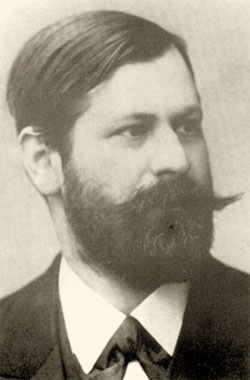 Wilhelm Fliess (October 24, 1858 – October 13, 1928) was born on October 24, 1858, in Rummelsburg, Pomerania (now Miastko, Poland), into a Jewish family, and grew up to
become a prominent, albeit controversial, German physician, otolaryngologist, and biologist. He completed his medical studies in Berlin, where he earned his doctorate in
1883, and subsequently established a successful medical practice as an ear, nose, and throat (ENT) specialist. Fliess was a man of intense intellectual ambition whose
unorthodox scientific theories captured the attention of the medical and emerging psychological worlds of late 19th-century Europe.
Wilhelm Fliess (October 24, 1858 – October 13, 1928) was born on October 24, 1858, in Rummelsburg, Pomerania (now Miastko, Poland), into a Jewish family, and grew up to
become a prominent, albeit controversial, German physician, otolaryngologist, and biologist. He completed his medical studies in Berlin, where he earned his doctorate in
1883, and subsequently established a successful medical practice as an ear, nose, and throat (ENT) specialist. Fliess was a man of intense intellectual ambition whose
unorthodox scientific theories captured the attention of the medical and emerging psychological worlds of late 19th-century Europe.
Professionally, Fliess is best remembered for his pseudoscientific and idiosyncratic medical hypotheses, most notably his theory on the "nasal reflex neurosis." He
posited a direct, structural, and physiological link between the mucous membranes of the nose and human sexual organs, arguing that various psychological and physical
ailments could be treated via nasal surgery, cauterization, or cocaine applications. Additionally, Fliess developed a complex mathematical and biological theory of life
cycles based on fixed numerical periods, asserting that all living organisms possessed an innate biological periodicity consisting of a male 23-day cycle and a female 28-day
cycle.
Fliess is perhaps most famously known in intellectual history for his intense, fifteen-year intellectual friendship and correspondence with
Sigmund Freud, which lasted from 1887 to 1902. During the formative years of psychoanalysis, Fliess served as Freud’s primary
confidant, sounding board, and intellectual interlocutor. Freud frequently relied on Fliess for emotional support, self-analysis, and validation of his most daring early
hypotheses. However, their relationship deteriorated due to theoretical disagreements, paranoia, and priority disputes regarding who first conceptualized core psychological
principles, culminating in a bitter and definitive break in 1904. Following his estrangement from Freud, Fliess spent his later years engaged in priority disputes with other
academics and published works defending his numerological and biological theories until his death on October 13, 1928, in Berlin.
The historical links between Wilhelm Fliess and LGBTQ+ history are deeply rooted in the early scientific conceptualization of human sexuality, specifically his
formulation of universal human bisexuality. Fliess was among the first late-Victorian medical theorists to argue that all living creatures, including human beings, are
inherently and fundamentally bisexual, possessing both male and female biological and psychological traits. This concept profoundly influenced Sigmund Freud, who integrated
Fliess's ideas into psychoanalytic theory to explain the development of sexual orientation, neurosis, and inversion (the historical term for homosexuality). Freud adopted
Fliess's framework to move away from the pathologizing degeneration theories of his contemporaries, proposing instead that same-sex desire and diverse object choices were
variations of an underlying universal bisexual disposition. Furthermore, Fliess's broader theoretical matrix—by attempting to map out the biological, somatic, and cyclical
underpinnings of sex and desire—helped lay the early, transitional groundwork that eventually shaped modern sexology and queer studies' understanding of non-binary and fluid
sexual identities.
References:
- Gayday by Massimo Consoli, 2005
- The Complete Letters of Sigmund Freud to Wilhelm Fliess, 1887–1904, Edited by Jeffrey Moussaieff Masson (Harvard University Press, 1985) – The primary archival source documenting Fliess's scientific theories, professional mindset, and intellectual exchange with Freud.
- The Foundations of Psychoanalysis: A Philosophical Critique, By Adolf Grünbaum (University of California Press, 1984) – Features extensive critical analysis of Wilhelm Fliess's medical hypotheses, including nasal reflex neurosis and its impact on early psychoanalytic methodology.
- Freud: Living and Dying, By Max Schur (International Universities Press, 1972) – Written by Freud's personal physician, this text provides a detailed historical examination of the Freud-Fliess relationship, Fliess's medical background, and their shared theoretical explorations regarding bisexuality.
- Wilhelm Fliess and His Correspondence With Sigmund Freud, By Frank J. Sulloway (appearing in various historical analyses, and expanded in Freud, Biologist of the Mind: Beyond the Psychoanalytic Legend, Basic Books, 1979) – Explores Fliess's role as a biological theorist and the transmission of his concept of universal human bisexuality into early psychoanalytic frameworks.
- Neue Beiträge zur Klinik und Therapie der nasalen Reflexneurose, By Wilhelm Fliess (Vienna, 1892) – Fliess's primary published medical text outlining his clinical observations and theories regarding the nasal-genital relationship.
- Der Ablauf des Lebens: Grundlegung zur exakten Biologie, By Wilhelm Fliess (Leipzig and Vienna: Franz Deuticke, 1906) – Fliess's major theoretical treatise detailing his biological and mathematical periodicities (the 23- and 28-day life cycles).
Support this project
This website is a passion project researched, developed, and funded entirely by me. If you find the content valuable and would like to help support the ongoing research and hosting costs, any contribution is deeply appreciated.
Thank you for keeping this independent resource alive!
My books on Amazon: Elisa Rolle's books
BACK TO HOME PAGE