Queer Places:
Waldfriedhof Oberschöneweide, Verlängerte Rathenaustraße 131a, 12459 Berlin-Bezirk Treptow-Köpenick, Germany
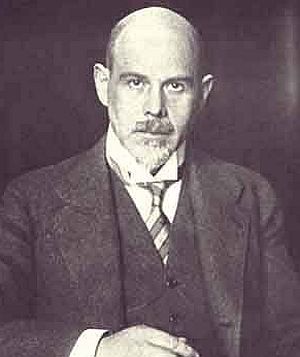 Walther Rathenau (September 29, 1867 – June 24, 1922) was born in Berlin on September 29, 1867, into an affluent, prominent German-Jewish family. His
father, Emil Rathenau, was a pioneering industrialist who founded the Allgemeine Elektrizitäts-Gesellschaft (AEG), a massive electrical engineering
corporation that profoundly shaped Germany's technological and economic modernization. Growing up in this privileged environment, Walther pursued diverse
intellectual interests, studying physics, chemistry, and philosophy at the universities of Berlin and Strasbourg, and earning his doctorate in physics in
1889 under August Kundt. Despite his father's wish for him to focus strictly on corporate enterprise, Rathenau maintained lifelong aspirations as a
writer, social philosopher, and cultural critic, publishing numerous essays on economics, ethics, and the trajectory of modern civilization.
Walther Rathenau (September 29, 1867 – June 24, 1922) was born in Berlin on September 29, 1867, into an affluent, prominent German-Jewish family. His
father, Emil Rathenau, was a pioneering industrialist who founded the Allgemeine Elektrizitäts-Gesellschaft (AEG), a massive electrical engineering
corporation that profoundly shaped Germany's technological and economic modernization. Growing up in this privileged environment, Walther pursued diverse
intellectual interests, studying physics, chemistry, and philosophy at the universities of Berlin and Strasbourg, and earning his doctorate in physics in
1889 under August Kundt. Despite his father's wish for him to focus strictly on corporate enterprise, Rathenau maintained lifelong aspirations as a
writer, social philosopher, and cultural critic, publishing numerous essays on economics, ethics, and the trajectory of modern civilization.
Rathenau initially embarked on a business career, working in Swiss aluminum manufacturing and electrochemical firms before joining the board of AEG in
1899 and expanding his influence across dozens of corporate boards globally. His organizational genius reached its peak during the First World War. When
the conflict began in 1914, he played a vital role in establishing and leading the War Raw Materials Department within the Prussian Ministry of War, a
crucial institution that kept the blockaded German economy functioning by securing essential resources. Following the collapse of the German Empire,
Rathenau helped found the liberal German Democratic Party (DDP) and transitioned into formal government service. In 1921, he served as the Minister of
Reconstruction, and in early 1922, he was appointed Foreign Minister of the Weimar Republic. In that role, he shocked the international community by
signing the Treaty of Rapallo with Soviet Russia, a diplomatic breakthrough that normalized relations between the two isolated nations.
Despite his patriotism and commitment to stabilizing post-war Europe, Rathenau became a primary target for right-wing nationalists, ultra-nationalist
extremists, and virulent antisemites. As a prominent Jewish statesman advocating for compliance with the Treaty of Versailles' terms to rebuild Germany's
reputation, he drew intense hostility. On June 24, 1922, just months into his tenure as Foreign Minister, he was brutally assassinated in Berlin by
members of the Organization Consul, a radical right-wing terrorist group. His death triggered massive grief and working-class solidarity demonstrations
across Germany, marking a tragic turning point for the stability of the Weimar Republic.
Rathenau never married and maintained a deeply private, complex existence that has drawn considerable attention from biographers and historians
concerning his sexuality. During the late 19th and early 20th centuries, Berlin was the global epicenter of early homosexual emancipation movements,
spearheaded by figures like Magnus Hirschfeld and the Scientific-Humanitarian Committee, which campaigned
for the decriminalization of homosexuality. Within elite intellectual and artistic circles, Rathenau moved among men who defied conventional norms, yet
he lived compartmentalized lives, prioritizing his intense ambition, corporate empire, and state responsibilities above all else.
Biographers, including prominent figures like Harry Kessler (who was a close friend and confidant) and
modern historians such as Shulamit Volkov, have noted that Rathenau's intimate life was characterized by a distinct lack of traditional heterosexual
attachments and a strong homosocial preference for male companionship. While he never publicly identified as homosexual—an option that would have spelled
immediate professional and social ruin in Wilhelmine and Weimar Germany—historians generally evaluate him as a man who likely experienced same-sex
desires. His inner conflict was exacerbated by his acute self-consciousness, his search for spiritual purity versus mechanical materialism, and the rigid
social codes of the German bourgeoisie. Consequently, while Rathenau did not take a public political stance on gay rights or participate directly in the
early homosexual liberation movement happening around him in Berlin, his personal bachelorhood, intimate male friendships, and status as a multifaceted,
non-conforming figure place him within the broader tapestry of queer historical discourse regarding closeted prominent figures of the era.
References:
Other references:
- Volkov, Shulamit. Walther Rathenau: Weimar's Fallen Statesman. Yale University Press, 2012.
- Kessler, Harry. Walther Rathenau: His Life and Work. Translated by W. D. Robson-Scott and Lawrence Hyde. Harcourt, Brace & Co., 1930. (Originally published in German in 1928).
- Felix, David. Walther Rathenau and the Weimar Republic: The Politics of Reparations. Johns Hopkins Press, 1971.
- Joll, James. Three Intellectuals in Politics. Pantheon Books, 1961.
- Rathenau, Walther. Tagebuch, 1907–1922. Edited by Hartmut Pogge von Strandmann. Droste Verlag, 1967.
- Kessler, Harry. Das Tagebuch 1880–1937 (Multiple volumes). Edited by Roland S. Kamzelak and Ulrich Ott. Cotta Verlag.
- Rathenau, Walther. Briefe an eine Liebende. C. Reissner, 1931.
- Lauritsen, John, and David Thorstad. The Early Homosexual Rights Movement, 1864–1935. Times Change Press, 1974.
- Marhoefer, Laurie. Sexuality and the State in Power in Weimar Germany. Cambridge University Press, 2015.
Support this project
This website is a passion project researched, developed, and funded entirely by me. If you find the content valuable and would like to help support the ongoing research and hosting costs, any contribution is deeply appreciated.
Thank you for keeping this independent resource alive!
My books on Amazon: Elisa Rolle's books
BACK TO HOME PAGE
