Queer Places:
South Lodge, 80 Campden Hill Road, Kensington, London, W8 7AA
Brookwood Cemetery, Glades House, Cemetery Pales, Brookwood, Woking GU24 0BL, United Kingdom
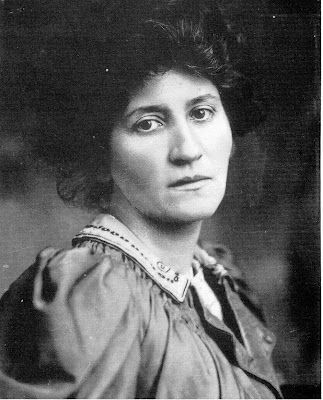 Isobel Violet Hunt (September 28, 1862 – January 16, 1942) was born on September 28, 1862, in Durham, England, as the daughter of the Pre-Raphaelite landscape painter
Alfred William Hunt and the bestselling novelist and translator Margaret Raine Hunt. She had siblings, including a sister named Silvia Kingsley Hunt. In 1865, the family
moved to London, placing Hunt directly into the heart of the Pre-Raphaelite artistic circle, where she grew up knowing cultural luminaries like John Ruskin and
William Morris. A notable anecdote from her youth involves Oscar Wilde, a friend and
correspondent, who reportedly proposed to her in Dublin in 1879. Because accepting a proposal required her to be of legal engagement age, this event corrected her frequently
misquoted birth year from 1866 back to 1862.
Isobel Violet Hunt (September 28, 1862 – January 16, 1942) was born on September 28, 1862, in Durham, England, as the daughter of the Pre-Raphaelite landscape painter
Alfred William Hunt and the bestselling novelist and translator Margaret Raine Hunt. She had siblings, including a sister named Silvia Kingsley Hunt. In 1865, the family
moved to London, placing Hunt directly into the heart of the Pre-Raphaelite artistic circle, where she grew up knowing cultural luminaries like John Ruskin and
William Morris. A notable anecdote from her youth involves Oscar Wilde, a friend and
correspondent, who reportedly proposed to her in Dublin in 1879. Because accepting a proposal required her to be of legal engagement age, this event corrected her frequently
misquoted birth year from 1866 back to 1862.
Hunt established a diverse literary footprint encompassing novels, short stories, memoirs, and biography. As an active feminist, she helped define the "New Woman" genre
of the late 19th and early 20th centuries through pioneering novels such as The Maiden's Progress and A Hard Woman. Her 1908 publication White Rose of Weary Leaf is widely
regarded by critics as her finest novel. Beyond realism, she excelled in supernatural fiction, publishing acclaimed short story collections like Tales of the Uneasy and More
Tales of the Uneasy. Horror historian R. S. Hadji listed Tales of the Uneasy as an unjustly neglected horror classic, and critic E. F. Bleiler praised its use of the
supernatural to highlight life-and-death ironies and the ironies of fate. She also penned a biography of Elizabeth Siddal, though it is viewed by modern scholars as
unreliable due to its overt animus against Siddal's husband, Dante Gabriel Rossetti.
Despite her considerable bibliography, Hunt's cultural legacy is heavily tied to the literary salons she hosted at her home, South Lodge, on Campden Hill in Kensington,
London. Her guests and associates included Rebecca West, Ezra Pound, Joseph Conrad,
Wyndham Lewis, D.H. Lawrence, and Henry James. In 1908, she assisted
Ford Madox Hueffer (later known as Ford Madox Ford) in establishing The English Review. She shared a tumultuous, decade-long
domestic partnership with Hueffer from roughly 1910 to 1918 at South Lodge, a period spanning his 1911 imprisonment for refusing to pay his estranged wife support. Hunt's
vibrant personality and complex personal life made her a frequent muse and target for fictionalization. Ford fictionalized her as the scheming Florence Dowell in The Good
Soldier and as Sylvia Tietjens in his Parade's End tetralogy. Similarly, Somerset Maugham modeled his characters Rose
Waterfield in The Moon and Sixpence and Norah Nesbit in Of Human Bondage after her, and she served as the prototype for Claire Temple in Norah Hoult's 1944 novel There Were
No Windows. Hunt also utilized her own life in her fiction, notably characterizing her social circle in novels like Their Lives and Their Hearts.
Deeply invested in women's rights, Hunt was a prominent activist and a founding member of the Women Writers' Suffrage League (WWSL) in 1908. The league served as a
critical cultural hub for progressive, queer, lesbian, and bisexual writers of the era, including figures like
Ivy Compton-Burnett, Charlotte Despard, and
Olive Schreiner. Later in life, she also participated in the founding of International PEN in 1921. Hunt spent her final years at
South Lodge, where she ultimately passed away from pneumonia at the age of seventy-nine on January 16, 1942, during the Blitz. She was laid to rest alongside her parents at
Brookwood Cemetery in Surrey.
References:
- Belford, Barbara. Violet: The Story of the Irrepressible Violet Hunt and Her Circle of Lovers and Friends—Ford Madox Ford, H.G. Wells, Somerset Maugham, and Henry James. New York: Simon and Schuster, 1990.
- Secor, Robert. "Aesthetes and Pre-Raphaelites: Oscar Wilde and the Sweetest Violet in England." Texas Studies in Language and Literature 21, no. 3 (Fall 1979).
- Hunt, Violet. The Flurried Years. London: Hurst & Blackett, 1926 (published in the United States as I Have This to Say).
- Violet Hunt Papers (Collection #4607). Division of Rare and Manuscript Collections, Olin Library, Cornell University, Ithaca, New York. (Contains correspondence, manuscripts, diaries from 1914, 1918, and 1919, address books, and family records).
- Violet Hunt Collection. Harry Ransom Center, University of Texas at Austin. (Includes literary proofs, letters, and miscellaneous personal materials).
- Cevasco, G. A., ed. The 1890s: An Encyclopedia of British Literature, Art, and Culture. Article on "Hunt, Violet" by B. J. Robinson. New York: Garland Publishing, 1993.
- Oxford Dictionary of National Biography. Article on "Hunt, (Isabel) Violet (1862–1942)" by various contributors.
- Sutherland, John. The Longman Companion to Victorian Fiction. London: Longman, 1988.
Support this project
This website is a passion project researched, developed, and funded entirely by me. If you find the content valuable and would like to help support the ongoing research and hosting costs, any contribution is deeply appreciated.
Thank you for keeping this independent resource alive!
My books on Amazon: Elisa Rolle's books
BACK TO HOME PAGE