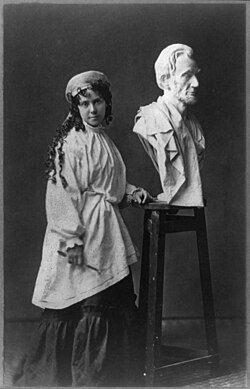
 Lavinia “Vinnie” Ellen Ream (September 25, 1847 – November 20, 1914) was a pioneering American sculptor best known for creating the historic statue of President
Abraham Lincoln that stands in the U.S. Capitol Rotunda.
Lavinia “Vinnie” Ellen Ream (September 25, 1847 – November 20, 1914) was a pioneering American sculptor best known for creating the historic statue of President
Abraham Lincoln that stands in the U.S. Capitol Rotunda.Queer Places:
Arlington National Cemetery, Arlington, VA 22211
Lavinia “Vinnie” Ellen Ream (September 25, 1847 – November 20, 1914) was a pioneering American sculptor best known for creating the historic statue of President
Abraham Lincoln that stands in the U.S. Capitol Rotunda.
Born in Madison, Wisconsin, Ream grew up with an early passion for art. During the Civil War, her family relocated to Washington, D.C., where she became one of the first women employed by the federal government, working as a clerk in the Post Office’s dead letter office. In 1863, she began an apprenticeship under the sculptor Clark Mills. The following year, at just 17 years old, she convinced President Lincoln to let her model a bust of him, resulting in five months of morning sittings that ended just before his tragic assassination.
In 1866, at age 18, Congress awarded her the formal commission to sculpt a full-size marble monument of the late president. This monumental achievement made her both the youngest individual and the first female artist to ever receive a U.S. government art commission.
To carve the final version of the Lincoln monument out of Carrara marble, Ream traveled to Europe, eventually opening a studio in Rome. There, she became the youngest member of an expatriate community of American women sculptors. Author Henry James later famously—and somewhat dismissively—referred to this group as "that strange sisterhood of American lady sculptors who at one time settled upon the seven hills in a white marmorean flock."
This community included artists like: Harriet Hosmer, Edmonia Lewis, Anne Whitney, Emma Stebbins, Louisa Lander, Margaret Foley.
For these women, 19th-century Rome served as a crucial refuge. It offered them artistic resources unavailable in the United States and allowed them to live independently from the strict, conventional domesticity and marital expectations of the era.
While art historians generally note that Vinnie Ream herself did not personally identify as queer or lesbian—she eventually married Lieutenant Richard Hoxie in 1878 and lived a more conventional family life—her legacy is deeply intertwined with LGBTQ history through two primary avenues:
Many of the prominent women within Ream's Roman circle lived openly in lifelong, same-sex partnerships (often historically referred to as "romantic friendships" or "Boston marriages"). For instance, Emma Stebbins lived as the devoted partner of famed actress Charlotte Cushman, and Harriet Hosmer actively rejected traditional marriage to maintain her independence and close bonds with other women. As a part of this tight-knit community, Ream operated within a highly progressive, gender-defying network of women who challenged the heteronormative boundaries of the 19th century.
During her time working in the neoclassical style in Rome, Ream sculpted a statue of Sappho, the ancient Greek lyric poet from the island of Lesbos known for her verses celebrating love between women.
By choosing to immortalize Sappho, Ream engaged directly with a classical icon of female-female desire. Ream's depiction of the poet captured the neoclassical obsession with antiquity while highlighting a historical figure who would ultimately become a definitive symbol of lesbian identity.
References:
 A Sisterhood of Sculptors: American Artists in Nineteenth-Century Rome Paperback – May 15, 2015 by Melissa Dabakis |
Other references:
Support this project
This website is a passion project researched, developed, and funded entirely by me. If you find the content valuable and would like to help support the ongoing research and hosting costs, any contribution is deeply appreciated.
Thank you for keeping this independent resource alive!
My books on Amazon: Elisa Rolle's books