Queer Places:
Western Cemetery, Vestre Kirkegårds Allé 15, 2450 København, Denmark
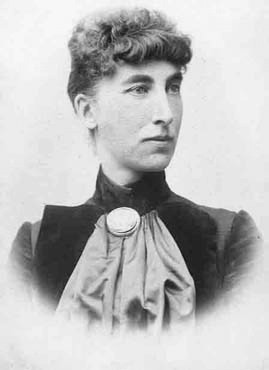 Victoria Maria Benedictsson (née Bruzelius, March 6, 1850 - July 21/22, 1888) was a pioneering Swedish author and playwright who wrote under the male pseudonym Ernst
Ahlgren. She stood alongside August Strindberg as one of the central figures of the Scandinavian "Modern Breakthrough" (Det
unga Sverige), a literary movement focused on realism, social critique, and gender politics.
Victoria Maria Benedictsson (née Bruzelius, March 6, 1850 - July 21/22, 1888) was a pioneering Swedish author and playwright who wrote under the male pseudonym Ernst
Ahlgren. She stood alongside August Strindberg as one of the central figures of the Scandinavian "Modern Breakthrough" (Det
unga Sverige), a literary movement focused on realism, social critique, and gender politics.
Growing up in Scania, Benedictsson aspired to study art at the Royal Swedish Academy of Fine Arts in Stockholm. Her father strictly forbade this pursuit despite her
saving money as a governess.
In 1871, at age 21, she married Christian Benedictsson, a 49-year-old widowed postmaster in Hörby with five children. The marriage was unhappy and quickly became a pro
forma arrangement; she financially supported herself while living in the household.
After contracting a debilitating bone illness that left her bedridden, she began writing prose and realistic short stories set in rural Scania, publishing under her
famous pen name Ernst Ahlgren.
Pengar (Money, 1885) is a semi-autobiographical novel featuring Selma, a young woman coerced into an early marriage with a wealthy landowner who eventually leaves him
to pursue independence and education.
Fru Marianne (Mrs. Marianne, 1887) examines the tension between traditional marital obligations, self-realization, and the concept of "free love" advocated by male
intellectuals of the era.
Stora Boken (The Great Book), her private diaries (1882–1888), published unedited in the late 20th century, candidly document her inner conflicts regarding gender,
writing, and sexuality.
In Copenhagen, Benedictsson engaged in an intense, emotionally turbulent relationship with the prominent Danish critic Georg Brandes. Disillusioned by Brandes's
dismissive review of Fru Marianne ("far too much of a ladies' novel"), the constraints placed on women writers, and her personal struggles, she committed suicide in a
Copenhagen hotel room in July 1888 at age 38.
While Benedictsson lived prior to modern terminology around sexual orientation and gender identity, contemporary queer theorists, gender scholars, and literary critics
actively study her life and texts through an LGBTQ+ lens:
Rather than viewing "Ernst Ahlgren" simply as a pragmatic male pen name for publishing, modern trans literary scholars analyze her writing and personal notes as an
expression of gender dysphoria or transmasculine identity.
In her diaries, Benedictsson famously questioned the rigid boundaries of female identity, writing in 1888: “I am a woman. But I am an author – am I not, then, something
of a man as well?”
Literary scholars analyze her final short story, "Ur mörkret" ("From the Darkness", 1888), through 19th-century sexological theories of "gender inversion" and "being
born in the wrong body," interpreting aspects of her work as transmasculine elegies.
Benedictsson's works reject both traditional 19th-century patriarchal marriage and the male-centric "free love" ideology championed by male peers like Brandes. Her
writings critique the compulsory heteronormativity of her era, illustrating how both marriage and male "sexual liberation" left little room for female autonomy or
non-conforming desires.
For decades following her death, her literary executor Axel Lundegård heavily edited her diaries and manuscripts to present a sanitized, conventional narrative focused
primarily on tragic heterosexual romance. The complete, unedited publication of Stora Boken between 1978 and 1987 allowed feminist and queer historians to uncover her
complex dual perspectives on gender, desire, and identity.
- Svenskt kvinnobiografiskt lexikon (Biographical Dictionary of Swedish Women / SKBL): Entry on Anna Whitlock (1852–1930) by Hjördis Levin.
- Encyclopædia Britannica & Encyclopedia.com: Biographical profile of Ellen Key
- Nordic Women's Literature (Nordisk kvinnolitteraturhistoria): Historical profiles covering Ellen Key
- Nyström-Hamilton, Louise (1913): Ellen Key: Her Life and Her Work. G.P. Putnam's Sons.
- Björklund, Sigrid (1931): Anna Whitlock: en svensk märkeskvinna. Bonnier.
- Ambjörnsson, Ronny (1976): Hemmets århundrade / Samhällsmodern.
- Kvinnsam (National Resource Library for Gender Studies, Gothenburg University Library)
- Queer Moving History / Swedish LGBTQ Archive (QRAB / Kvinnsam)
Support this project
This website is a passion project researched, developed, and funded entirely by me. If you find the content valuable and would like to help support the ongoing research and hosting costs, any contribution is deeply appreciated.
Thank you for keeping this independent resource alive!
My books on Amazon: Elisa Rolle's books
BACK TO HOME PAGE