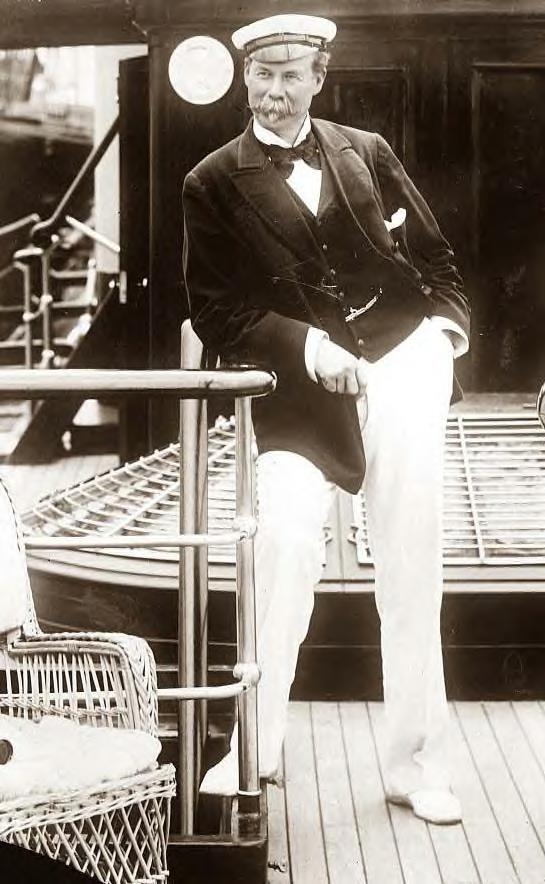
 Sir Thomas Johnstone Lipton, 1st Baronet (May 10, 1848 – October 2, 1931), was a pioneering Scottish businessman, global merchant, avid yachtsman, and
philanthropist who transformed tea from an expensive luxury into a mass-market staple.
Sir Thomas Johnstone Lipton, 1st Baronet (May 10, 1848 – October 2, 1931), was a pioneering Scottish businessman, global merchant, avid yachtsman, and
philanthropist who transformed tea from an expensive luxury into a mass-market staple.Partner William Love
Queer Places:
Osidge House, 4 Lipton Close (off Chase Side / Osidge Lane), Southgate, London, N14 5BX, United Kingdom
Southern Necropolis, 300 Caledonia Rd, Glasgow G5 0TB, United Kingdom
Sir Thomas Johnstone Lipton, 1st Baronet (May 10, 1848 – October 2, 1931), was a pioneering Scottish businessman, global merchant, avid yachtsman, and
philanthropist who transformed tea from an expensive luxury into a mass-market staple.
Born in a tenement in the Gorbals district of Glasgow to Ulster-Scots parents who had fled County Fermanagh during the Great Famine, young Thomas grew up in modest circumstances. Leaving school at age thirteen to work as an errand boy and shirtcutter, he saved enough money by 1864 to sail to the United States. Over five years, he traveled extensively throughout America, working diverse jobs on a Virginia tobacco plantation, a South Carolina rice plantation, as a door-to-door salesman in New Orleans, and as a grocery assistant in New York, where he learned innovative American advertising and merchandising techniques.
Returning to Glasgow in 1870, Lipton opened his first provision store, "Lipton’s Market," in 1871. Applying aggressive marketing and bypassing traditional wholesalers, he rapidly expanded his operations into a nationwide grocery chain of over 300 stores. Recognizing the growing demand for tea, Lipton bypassed the London wholesale markets, purchasing his own tea gardens in Ceylon (now Sri Lanka) in 1890 and establishing direct trade routes. By packaging standardized tea blends targeting regional water variations, he dramatically lowered prices and made high-quality tea affordable to the working class.
Beyond his commercial empire, Lipton gained international fame as a sportsman and world-class yachtsman. Between 1899 and 1930, he mounted five famous challenges for the America’s Cup representing the Royal Ulster Yacht Club with his yachts, all named Shamrock. Though he never won the trophy, his sporting spirit and good humor earned him a specially crafted cup for "the best of all losers" and immensely boosted his business presence in America. He was also a pioneer in international sports patronage, establishing early international football competitions such as the Sir Thomas Lipton Trophy. During the First World War, Lipton placed his personal yachts at the disposal of the Red Cross and the Scottish Women's Hospitals, personally accompanying medical relief missions to typhus-stricken Serbia. He was knighted in 1901 and created a baronet of Osidge in 1902.
Despite being dubbed by the contemporary press as "the world's most eligible bachelor" and maintaining a public image as a ladies' man, Lipton never married or had relationships with women, often deflecting inquiries by claiming no woman measured up to his mother. In private, Lipton spent his life in quiet, long-term relationships with men. He maintained a thirty-year domestic partnership with William Love, one of his early shop assistants with whom he lived at his home in London. Following their separation, Lipton shared his life with other male companions, including a young orphan from Crete whom he met during a Mediterranean cruise in 1900, as well as maintaining a close personal relationship with Maurice Talvande, the self-styled Comte de Mauny.
Upon his death at his home, Osidge, in 1902 at the age of 83, Lipton left the bulk of his fortune and extensive trophy collections to the city of Glasgow, where he was buried alongside his parents in the Southern Necropolis. Dying without issue, his baronetcy became extinct upon his death.
References:
Support this project
This website is a passion project researched, developed, and funded entirely by me. If you find the content valuable and would like to help support the ongoing research and hosting costs, any contribution is deeply appreciated.
Thank you for keeping this independent resource alive!
My books on Amazon: Elisa Rolle's books