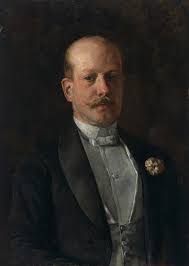
 Thomas Benedict Clarke (December 11, 1848 - January 18, 1931) was a prominent American art collector, dealer, and businessman.
Queer Places:
Art House, 5 E 34th St, New York, NY 10016, USA
22 E 35th St, New York, NY 10016, USA
Green-Wood Cemetery, 500 25th Street, Brooklyn, New York 11232-1317 United States
Thomas Benedict Clarke (December 11, 1848 - January 18, 1931) was a prominent American art collector, dealer, and businessman.
Born in Manhattan, New York, to Dr. George Washington Clarke (headmaster of the Mount Washington Collegiate Institute), he was educated at his father's institute before entering the linen and lace trade.
In the late 19th century, Clarke transitioned full-time into art collecting and dealing, opening the "Art House" gallery on Fifth Avenue/34th Street in New York City in 1891. He became one of the foremost collectors of American art and early American portraiture (including Gilbert Stuart’s famous Vaughan Portrait of George Washington), as well as Chinese porcelains and antique furniture. He served as an art advisor to financier J. Pierpont Morgan and was a mentor and patron to many contemporary American artists.
Clarke was an active figure in New York social and cultural life. He served as Shepherd of The Lambs theatrical club from 1898 to 1900, was president of the New York School of Applied Design for nine years, and held memberships in the National Academy of Design and the New York Yacht Club.
His notable brownstone residence at 22 East 35th Street in Murray Hill was redesigned in 1901 by architect Stanford White of McKim, Mead & White, and later became the clubhouse for The Collectors Club of New York.
In 1871, Clarke married Frances Eugenia Morris, with whom he had two children. He resided with his family in New York until his death on January 18, 1931.
The Walpole Society was founded between late 1909 and January 1910 as an organization dedicated to the appreciation, study, and collecting of American decorative arts, architecture, and history.
Thomas Benedict Clarke was among the initial group of 25 prominent collectors, connoisseurs, and scholars invited to join at its founding in 1910.
The society took its name from the 18th-century English writer and collector Horace Walpole. From its inception in 1910 through much of the 20th century, membership was strictly by invitation and was, by design, an all-male network of collectors and museum professionals.
Within queer history archives and projects, Clarke's connection to LGBTQ history is frequently discussed in the context of early 20th-century male homosocial networks, connoisseurship circles, and artistic societies like the Walpole Society.
The Walpole Society itself drew its namesake from Horace Walpole, a figure whose life, personal aesthetic, and bachelor lifestyle at Strawberry Hill have long been central to studies of 18th-century queer history and decorative arts.
Thomas Benedict Clarke is buried in Green-Wood Cemetery in Brooklyn, New York. His funeral was held at the Church of the Incarnation in Manhattan following his death in January 1931.
References:
Support this project
This website is a passion project researched, developed, and funded entirely by me. If you find the content valuable and would like to help support the ongoing research and hosting costs, any contribution is deeply appreciated.
Thank you for keeping this independent resource alive!
My books on Amazon: Elisa Rolle's books