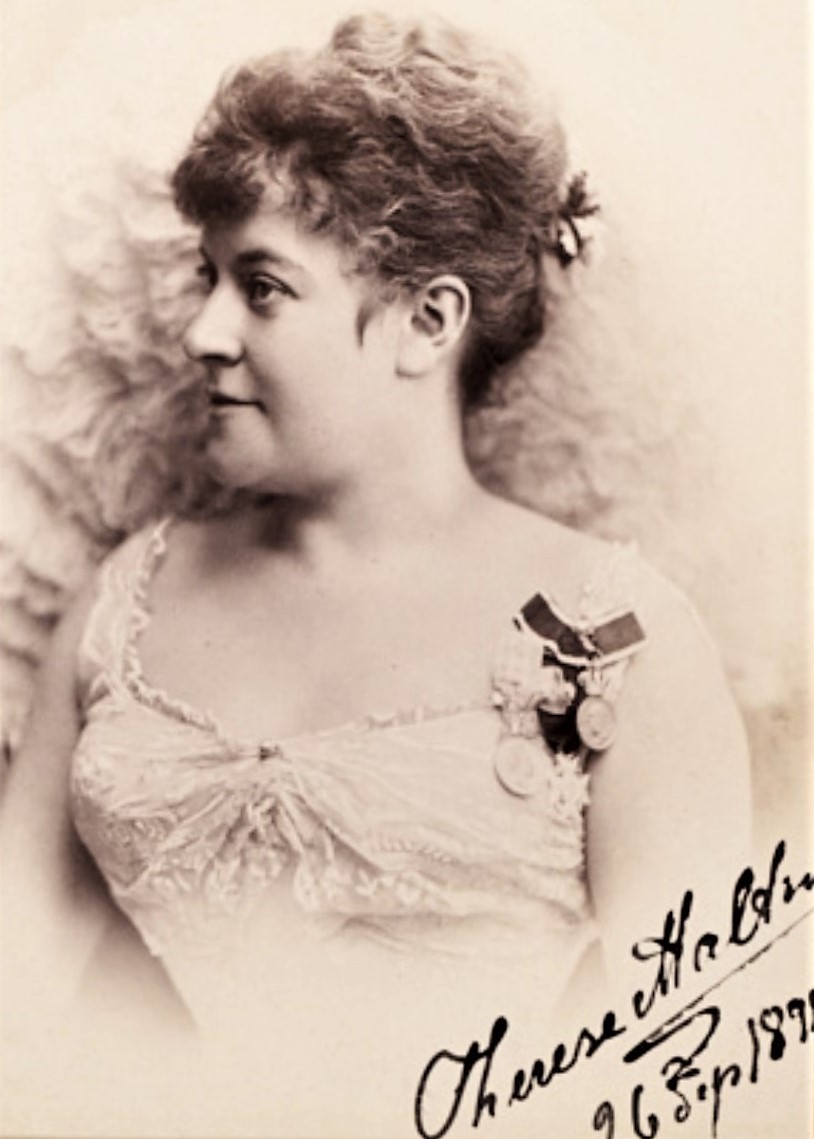
 Therese Malten (born Therese Müller, June 21, 1855 – January 2, 1930) was a renowned German dramatic soprano widely celebrated for her interpretations of Wagnerian
heroines.
Therese Malten (born Therese Müller, June 21, 1855 – January 2, 1930) was a renowned German dramatic soprano widely celebrated for her interpretations of Wagnerian
heroines.Partner Helene von Druskowitz
Queer Places:
Trinitatisfriedhof, Fiedlerstraße 1, 01307 Dresden-Altstadt, Germany
Therese Malten (born Therese Müller, June 21, 1855 – January 2, 1930) was a renowned German dramatic soprano widely celebrated for her interpretations of Wagnerian
heroines.
Malten was born in Insterburg, East Prussia (now Chernyakhovsk, Russia). Displaying an early affinity for music inherited from her mother, she moved to Berlin when her father—a royal Prussian government councilor—was appointed there. In Berlin, she studied singing and acting under prominent instructors, including Gustav Engel.
In 1873, at just 17 years old, she made her professional debut at the Dresden Royal Opera House as Pamina in The Magic Flute. Her immediate success led to roles like Agathe and Elsa, securing her a permanent contract with the company.
Malten became a central figure in Wagnerian performance. In 1881, Richard Wagner heard her sing in Dresden and personally selected her to create the role of Kundry for the world premiere of Parsifal at the Bayreuth Festival on July 26, 1882. She continued singing at Bayreuth until 1894, performing major roles such as Isolde and Eva.
In addition to her three-decade tenure as a core member of the Dresden Opera (retiring from the stage in 1903), Malten performed internationally. She toured major European cultural hubs, including London, Holland, and Angelo Neumann’s authorized Wagner Ring cycles in St. Petersburg, Moscow, and Kiev.
Following her retirement from the stage at age 48, Malten dedicated much of her time to teaching vocal students and supporting the needy, though she occasionally performed in concerts and oratorios. She passed away on January 2, 1930, in Neu-Zschieren, near Dresden.
Therese Malten is included in biographical compendiums of gay and lesbian history (such as Who's Who in Gay and Lesbian History by Robert Aldrich and Garry Wotherspoon) due to her significant personal connections:
Malten had a passionate, complex relationship with the pioneering Austrian philosopher, writer, and composer Helene von Druskowitz. The relationship ultimately ended in severe personal turmoil. After their separation, Druskowitz—who experienced mounting psychological struggles—alluded to an implicitly erotic relationship with a singer (modeled after her "alter ego" and Malten) in her 1890 tale International. Following a psychiatric hospitalization in 1891, Druskowitz blamed Malten, among others, in her delusions of persecution.
Because of her relationship with Druskowitz and her presence in queer historical archives, Malten's private life has drawn scholarly interest regarding same-sex intimacies among prominent cultural figures in late 19th-century Europe.
References:
 Who's Who in Gay and Lesbian History: From Antiquity to World War II 1st Edition by Robert Aldrich and Garry Wotherspoon |
Other references:
Support this project
This website is a passion project researched, developed, and funded entirely by me. If you find the content valuable and would like to help support the ongoing research and hosting costs, any contribution is deeply appreciated.
Thank you for keeping this independent resource alive!
My books on Amazon: Elisa Rolle's books