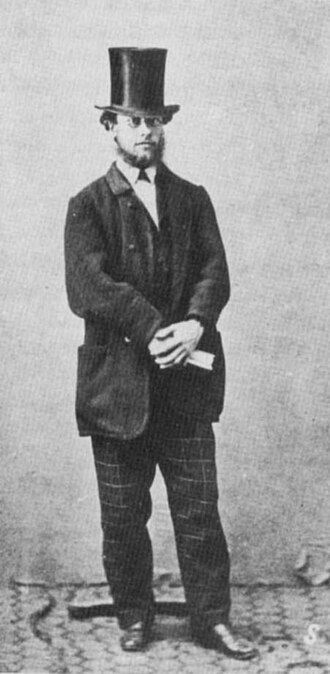
 Telemaco Signorini (August 18, 1835 - February 10, 1901) was born in Florence on August 18, 1835, the son of Giustina Santoni and Giovanni Signorini, an esteemed court
painter for the Grand Duke of Tuscany. Though he initially pursued classical studies to satisfy his family, he soon gravitated toward art under his father's early guidance.
In 1852, he enrolled at the Florence Academy of Fine Arts, but he quickly grew disillusioned with its rigid curriculum and conservative approach to instruction, choosing
instead to forge a radically independent path.
Telemaco Signorini (August 18, 1835 - February 10, 1901) was born in Florence on August 18, 1835, the son of Giustina Santoni and Giovanni Signorini, an esteemed court
painter for the Grand Duke of Tuscany. Though he initially pursued classical studies to satisfy his family, he soon gravitated toward art under his father's early guidance.
In 1852, he enrolled at the Florence Academy of Fine Arts, but he quickly grew disillusioned with its rigid curriculum and conservative approach to instruction, choosing
instead to forge a radically independent path.
During the mid-1850s, Signorini became a central figure at the Caffè Michelangiolo in Florence, a vibrant melting pot where avant-garde artists gathered to debate the
future of Italian art. It was here that he helped pioneer the Macchiaioli movement, a group of painters who rejected academic conventions in favor of capturing natural light
and modern life through bold patches of contrasting color and tone, anticipating the French Impressionists. Alongside his artistic output, Signorini was intensely
intellectual, acting as the group's primary critical voice and writing numerous essays for Florentine cultural magazines. His career also took a dramatic civic turn in 1859
when he enlisted as a volunteer under Giuseppe Garibaldi to fight for Italian unification.
Signorini's restless creative energy propelled him across Europe. With the exception of brief periods spent living and working in Paris—where he befriended artists like
Edgar Degas, Camille Corot, and Édouard Manet—and travels to London and Scotland, he remained deeply rooted in Tuscany. Over the decades, he helped establish outdoor
painting communities in Castiglioncello and the Piagentina school. While he frequently painted sunlit landscapes, urban street scenes, and coastal views of the Cinque Terre,
his portfolio was also punctuated by striking works of social realism, including sobering depictions of prisons, brothels, and psychiatric wards.
Within Florence's cosmopolitan intellectual circles, Signorini forged profound cross-cultural bonds, most notably with the Anglo-Italian writer and aesthetician
Vernon Leen (the pen name of Violet Paget). After Lee established her permanent residence just outside Florence at the Villa Il
Palmerino, she and Signorini cultivated a lasting, intellectually intimate friendship. Lee was a prominent figure of the European Aesthetic movement and a pioneering
feminist icon who lived openly within queer circles, sharing long-term, passionate relationships with women such as Mary Robinson,
Amy Levy, and Clementina Anstruther-Thomson. Through his close association
with Lee and progressive literary figures of the era, Signorini operated comfortably within a sophisticated milieu that subverted Victorian and traditional bourgeois social
norms. Signorini continued to paint and write until his death in Florence on February 10, 1901.
References:
- Signorini, Telemaco. Caricaturisti e caricaturi al Caffè Michelangiolo. Florence: Cellini, 1893. (His foundational written recollections of the Macchiaioli circle and the artistic milieu of the Caffè Michelangiolo).
- Molteni, Enrico Gasi [Telemaco Signorini]. Le 99 discussioni artistiche. Florence, 1877. (A series of satirical and critical sonnets illustrated with his own woodcuts).
- Steingräber, Erich, and Giuliano Matteucci. The Macchiaioli: Tuscan Painters of the Sunlight. New York: Gallery Reese Palley, 1984.
- Broude, Norma. The Macchiaioli: Italian Painters of Sunlight and Modern Life in the Nineteenth Century. New Haven: Yale University Press, 1987. (An essential English-language text detailing Signorini's role as the movement's primary critic, polemicist, and stylistic innovator).
- Cecchi, Dario. Signorini e il suo tempo. Rome: Edizioni d'Arte dell'Elefante, 1969.
- Paget, Violet [Vernon Lee]. The Golden Keys and Other Essays on the Genius Locoi. London: John Lane, 1925.
- Gunn, Peter. Vernon Lee: Violet Paget, 1856–1935. London: Oxford University Press, 1964. (Explores Vernon Lee's life at Villa Il Palmerino and her broad network of cross-cultural relationships with Florentine and European intellectuals).
- Zorn, Christa. Vernon Lee: Aesthetics, History, and the Victorian Female Intellectual. Athens: Ohio University Press, 2003.
- British Museum. Biographical and print collection records for Telemaco Signorini (texts curated by Martin Hopkinson, 2007).
- National Gallery, London. Artist biography and collection entries for Telemaco Signorini.
- National Galleries of Scotland. Artist profile and collection notes on Signorini's cosmopolitan travels and urban landscapes.
Support this project
This website is a passion project researched, developed, and funded entirely by me. If you find the content valuable and would like to help support the ongoing research and hosting costs, any contribution is deeply appreciated.
Thank you for keeping this independent resource alive!
My books on Amazon: Elisa Rolle's books
BACK TO HOME PAGE