Queer Places:
Peter and Paul Fortress, Sankt-Peterburg, Russia, 197046
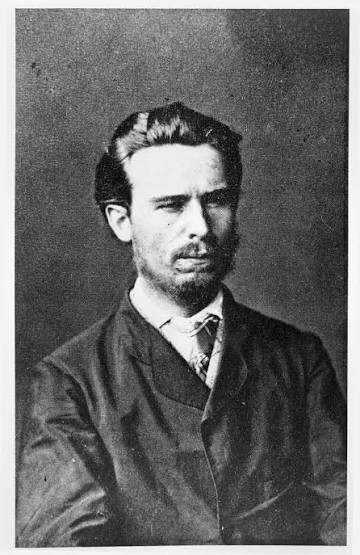 Sergey Gennadiyevich Nechayev (October 2, 1847 – December 3, 1882) was a notorious Russian revolutionary nihilist whose absolute fanaticism, rejection of conventional
morality, and calculated ruthlessness left a deep mark on radical political history. He is best remembered for his authorship of The Catechism of the Revolutionary, a
manifesto that laid out an ascetic, all-consuming devotion to total destruction in the name of the revolution.
Sergey Gennadiyevich Nechayev (October 2, 1847 – December 3, 1882) was a notorious Russian revolutionary nihilist whose absolute fanaticism, rejection of conventional
morality, and calculated ruthlessness left a deep mark on radical political history. He is best remembered for his authorship of The Catechism of the Revolutionary, a
manifesto that laid out an ascetic, all-consuming devotion to total destruction in the name of the revolution.
Nechayev was born in Ivanovo, Russia, to a working-class family. He taught himself advanced subjects, moved to Moscow and then Saint Petersburg, and quickly became
embedded in the radical student movements of the late 1860s.
Co-authored or exclusively penned by Nechayev during a period of exile in Switzerland, The Catechism of the Revolutionary (1869) became a manual for underground
subversion. It states that the revolutionary "has no interests of his own, no affairs, no feelings, no attachments, no belongings, not even a name" and that "everything
is moral which assists the triumph of revolution."
The relationship between Sergey Nechayev and the legendary elder anarchist philosopher Mikhail Bakunin is one of the most
psychologically complex and highly scrutinized alliances in the history of radical politics.
When a young, charismatic, and fiercely driven Nechayev arrived in Geneva in 1869, he successfully captivated the aging Bakunin. Bakunin saw Nechayev as the
embodiment of a new, uncompromising generation of Russian revolutionaries.
Historians and biographers have noted that Bakunin’s infatuation with Nechayev was not merely political, but profoundly emotional and psychological. Bakunin wrote
intensely affectionate and romantic letters to Nechayev, leading to widespread rumors and historical analysis suggesting a closeted or unrequited homosexual attraction.
In correspondence, Bakunin famously referred to Nechayev with terms of deep endearment and submitted heavily to Nechayev's demanding personality, enduring the younger
man's control.
This relationship had massive ramifications for the broader European socialist movement. Karl Marx and his faction within the First International actively weaponized
rumors regarding Bakunin’s private life and his association with the fanatical Nechayev. Marx used the Nechayev affair—and the perceived "authoritarian" and chaotic
nature of Bakunin's secret networks—to systematically discredit Bakunin. This political maneuvering culminated in Bakunin being expelled from the First International at
the Hague Congress in 1872, cementing the historical schism between Communism and Anarchism.
The intimacy did not last. True to his own Catechism, Nechayev viewed personal relationships solely through the lens of political utility. He began stealing Bakunin's
private correspondence, blackmailing Bakunin's associates, and trying to dominate the elder anarchist's network. By the summer of 1870, a deeply hurt and disillusioned
Bakunin broke off all ties with Nechayev, describing him in later letters as a dangerous force who utilized "the system of lies, espionage, deception, and compulsion."
Upon returning to Russia, Nechayev formed a secret cell called Narodnaya Rasprava (The People's Vengeance). In November 1869, when a group member named Ivan Ivanov
challenged Nechayev’s authority and fabricated connections, Nechayev orchestrated and participated in Ivanov's brutal murder to enforce discipline and bind the remaining
cell members in shared guilt.
The murder was quickly exposed. Nechayev fled back to Europe but was extradited by Swiss authorities in 1872. He spent the remainder of his life in the infamous Peter
and Paul Fortress in Saint Petersburg, where he managed to subvert his own guards to carry messages outside before dying of dropsy and scurvy in his cell in 1882.
His ruthless manipulation and the Ivanov affair directly inspired Fyodor Dostoevsky’s classic anti-nihilist novel, The Possessed (also translated as Demons), in which
the character Pyotr Verkhovensky is modeled entirely on Nechayev.
Sergey Nechayev died on December 3, 1882, in his prison cell within the Alexeyevsky Ravelin of the Peter and Paul Fortress in Saint Petersburg. As was standard
practice for state criminals and high-security political prisoners who died while incarcerated under the Tsarist regime, he was buried secretly. He was interred in an
unmarked grave within the fortress grounds or in a remote, undisclosed location designated for prisoners, ensuring that his gravesite could not become a place of
pilgrimage or a rallying point for future revolutionaries. Consequently, there is no public monument or preserved specific gravesite for him today.
References:
- Gayday by Massimo Consoli, 2005
- https://macmccanntx.com/2015/04/30/radically-different-rebels-examining-sergey-nechayev-mikhail-bakunin-emma-goldman/
- https://en.wikipedia.org/wiki/Mikhail_Bakunin
- https://revolutionbythebook.akpress.org/2008/09/anarchism-and-gays/
- https://voidnetwork.gr/2011/10/04/hedonism-and-revolution-the-barricade-and-the-dancefloor-by-christoph-fringeli/
Support this project
This website is a passion project researched, developed, and funded entirely by me. If you find the content valuable and would like to help support the ongoing research and hosting costs, any contribution is deeply appreciated.
Thank you for keeping this independent resource alive!
My books on Amazon: Elisa Rolle's books
BACK TO HOME PAGE