Queer Places:
33 Fitzroy Square, London W1T 6EU, UK
Agecroft Cemetery and Crematorium, Langley Road Pendlebury, Pendlebury, Swinton, Manchester M27 8SS, United Kingdom
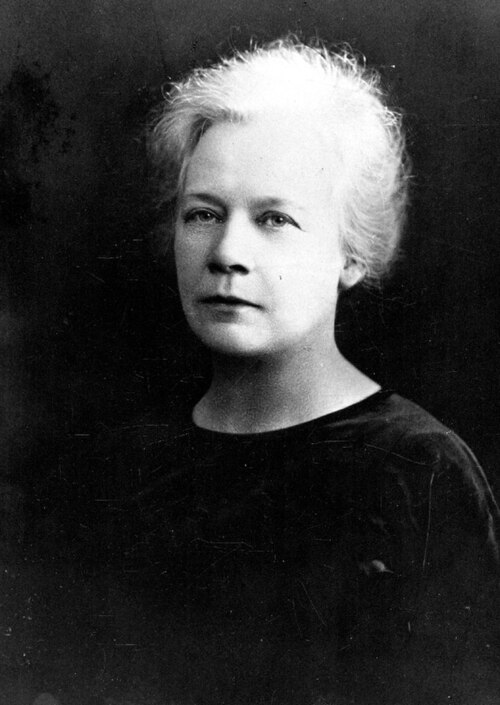 Sarah Ann Welsh Dickenson OBE (March 28, 1868 – December 26, 1954) was born on March 28, 1868, in Hulme, Manchester, to a working-class background. Leaving
school at the tender age of eleven, she entered the workforce as a cotton mill hand, an environment that exposed her early on to the harsh realities of
industrial labor and sparked her lifelong dedication to trade unionism and women's rights.
Sarah Ann Welsh Dickenson OBE (March 28, 1868 – December 26, 1954) was born on March 28, 1868, in Hulme, Manchester, to a working-class background. Leaving
school at the tender age of eleven, she entered the workforce as a cotton mill hand, an environment that exposed her early on to the harsh realities of
industrial labor and sparked her lifelong dedication to trade unionism and women's rights.
Stepping away from mill employment in 1895, Dickenson threw herself into organized labor activism when she was appointed joint organizing secretary of
the newly established Manchester and Salford Women's Trade Union Council (WTUC). Her organizing footprint expanded rapidly as she helped manage the
Federation of Women Workers, serving as its secretary from around 1904, and co-founding the Manchester and Salford Association of Machine, Electrical and
other Women Workers in 1899, where she acted as secretary. Around 1900, she joined the North of England Society for Women's Suffrage, sitting on its
executive committee, delivering public lectures, and playing a pivotal role in gathering roughly 30,000 signatures from female factory workers for a
landmark petition she jointly presented to Parliament in 1901.
Ideological shifts within the suffrage movement soon steered Dickenson toward more radical labor alignment. Frustrated by the WTUC's reluctance to
wholeheartedly champion women's suffrage and the moderate, middle-class leanings of the NESWS, she took bold steps to forge independent paths. In 1903,
she helped found the Lancashire and Cheshire Women Textile and Other Workers' Representation Committee, resigning from the WTUC the following year. By
1905, alongside figures like Christabel Pankhurst, she broke away from the NESWS to establish the
National Industrial and Professional Women's Suffrage Society. Her organizational prowess also shone nationally when she collaborated with
Mary Macarthur to coordinate a major National Union of Women Workers conference in Manchester in 1907,
advocating fiercely for independent women's unions that could later integrate into broader male-dominated union structures through autonomous women-only
branches.
During World War I, Dickenson firmly opposed the conflict, earning a delegate appointment to the Women's International Conference on Peace at The
Hague, though wartime travel restrictions prevented her physical attendance. Domestically, she successfully agitated for an increase in the government's
wartime maximum wage for women, securing a vital victory in 1915. Following post-war structural shifts that saw the local labor councils merge into the
Manchester and Salford Trades Council in 1918, she transitioned to leading its Women's Group from 1920 onward. Though she largely stepped back from
active trade unionism around 1930, she continued public service as a magistrate until 1939. In recognition of her decades of tireless advocacy, she was
appointed a Member of the Order of the British Empire (OBE) in 1931. Dickenson passed away on December 26, 1954, in Rusholme, Manchester, at the age of
86.
Within the context of early twentieth-century social movements, Dickenson's life intertwines closely with broader discussions of queer history and
homosocial networks among feminist reformers. In contemporary records, she is perpetually linked alongside fellow trade unionist and activist
Sarah Reddish, with whom she shared deep personal and professional bonds, frequently appearing side-by-side
alongside prominent activists like Eva Gore-Booth and Esther Roper.
While historical records from this era often framed intimate female partnerships and lifelong domestic and activist collaborations under the platonic
label of "friends," women like Dickenson and Reddish operated within a tight-knit circle of radical reformers who subverted traditional Victorian
expectations of marriage and womanhood, establishing alternative domestic and professional kinship structures that are increasingly recognized by modern
historians as vital components of early LGBTQ history.
References:
- Reference [1] from standard biographical compilations detailing her tenure as secretary of the Federation of Women Workers (from c. 1904), her role as founder and secretary of the Manchester and Salford Association of Machine, Electrical and other Women Workers, her involvement with the North of England Society for Women's Suffrage (NESWS) and the 1901 parliamentary petition, her transition to the Lancashire and Cheshire Women Textile and Other Workers' Representation Committee, her work alongside Mary Macarthur, and her later leadership in the Manchester and Salford Trades Council's Women's Group.
- Reference [3] recording her appointment as a Member of the Order of the British Empire (MBE) in 1931 and the year of her death in 1954.
- Manchester and Salford Women's Trade Union Council (WTUC): Contemporary records, minutes, and administrative documents detailing her joint organizing secretary role alongside figures like Eva Gore-Booth and Esther Roper.
- Suffrage and Labour Movement Archives: Petitions, publications, and records from the North of England Society for Women's Suffrage, the National Union of Women's Suffrage Societies (NUWSS), and the National Industrial and Professional Women's Suffrage Society.
- Period Press and Obituaries: Contemporary reports and newspaper accounts, including coverage from the Manchester Guardian, documenting her public speaking engagements, factory-gate meetings, and trade union activism.
Support this project
This website is a passion project researched, developed, and funded entirely by me. If you find the content valuable and would like to help support the ongoing research and hosting costs, any contribution is deeply appreciated.
Thank you for keeping this independent resource alive!
My books on Amazon: Elisa Rolle's books
BACK TO HOME PAGE