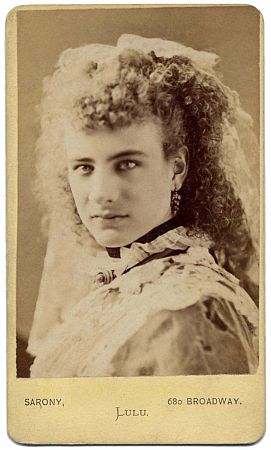
 Samuel Wasgate (1855–1939)—better known by his stage names El Niño Farini and Lulu, "Queen of the Air"—was a 19th-century American acrobat, aerialist, and photographer. He
achieved international fame performing high-risk circus acts while publicly disguised and presented as a teenage girl.
Samuel Wasgate (1855–1939)—better known by his stage names El Niño Farini and Lulu, "Queen of the Air"—was a 19th-century American acrobat, aerialist, and photographer. He
achieved international fame performing high-risk circus acts while publicly disguised and presented as a teenage girl.
Born in the United States (frequently cited as Maine), Samuel Wasgate (sometimes spelled Wasgatt) was taken in and trained as a child acrobat by the famous Canadian
showman, tightrope walker, and gymnast William Leonard Hunt, who performed under the stage name The Great Farini.
Wasgate initially toured with Farini across Europe and North America starting around 1866 as a male prodigy billed as El Niño Farini. Among his signature feats was
playing a snare drum while hanging from a trapeze entirely by his chin.
Around 1870, seeking to capitalize on public fascination with novelty acts and female daredevils (such as P.T. Barnum's "Circassian Beauties"), Farini devised a daring
marketing strategy. He began dressing the slender, long-haired 15-year-old Wasgate in women’s clothing, billing him as "The Beautiful Lulu, Girl Aerialist and Circassian
Catapultist."
Lulu's performances included complex trapeze routines, tightrope walking, and being shot through the air out of a spring-loaded "catapult" apparatus (similar to a
cannon). The climax of the show was the "Lulu Leap," where she flew 25 feet through the air to land on a small plank suspended by two trapeze bars.
The deception was wildly successful. Lulu became a global sensation, drawing massive crowds throughout Europe and the United States. Even prominent cultural figures,
such as author Lewis Carroll, watched and recorded admiration for her performances. The illusion that a girl was capable of such
death-defying, heavy-duty athleticism added immense theatrical thrill to the spectacle.
Lulu lived and performed offstage as a woman for roughly half a decade. However, the reality of his biological sex began to surface through private channels and
accidents:
In 1875, Wasgate married Edith May Hunt, the sister (or adopted daughter's relative/sister depending on family dynamics) of William Leonard Hunt. They later had a child
together.
In 1877, Wasgate suffered a severe fall from the trapeze. Medical personnel treating his injuries discovered his anatomical sex, and details began leaking to the
press.
By 1878, the ruse could no longer be maintained. Wasgate permanently dropped the persona of Lulu, cut his hair, and grew a mustache, though he continued working in
entertainment and photography for some time.
In 1885, Wasgate accompanied William Hunt on an infamous expedition to the Kalahari Desert in southern Africa. While there, Wasgate operated a camera, capturing a
series of photographs that later gained historical and anthropological recognition. He later settled down as a commercial photographer, operating a studio in Bridgeport,
Connecticut, where he lived until his death in 1939.
While 19th-century terminology like "transgender" or "non-binary" did not exist in the modern sense during Wasgate's lifetime, his life and career are frequently
studied by historians of gender, queer history, and performance studies for several reasons:
Victorian society rigidly separated gender roles, viewing women as delicate and physically frail, and men as naturally suited for heavy athletic labor. Lulu's act
completely inverted this paradigm. For years, audiences cheered wildly for a "woman" performing feats of supreme physical strength and aerial danger, inadvertently
celebrating a destabilized binary long before modern queer performance art.
Unlike theatrical actors who cross-dressed briefly for a single play or sketch, Wasgate lived, traveled, and was perceived by the public as a woman in his daily life
for nearly a decade. The boundary between stage performance and lived identity blurred significantly during his years as Lulu.
Modern LGBTQ+ historians and performance historians view figures like Samuel Wasgate (alongside contemporaries cross-dressing performers of the vaudeville era) as vital ancestors to modern drag, gender-fluid performance, and transgender
history. His ability to pass completely undetected in a hyper-public, scrutinizing environment highlights a long, hidden history of historical gender-crossing that
predates the formal 20th-century gay and trans liberation movements.
References:
- The British Museum (Biographical Records): Holds biographical entries and photographic documentation on Samuel Wasgate (cataloged under his various aliases: El Niño Farini, Lulu, and Samuel Wasgate).
- The Library of Nineteenth-Century Photography: Features historical collections containing rare cartes-de-visite studio portraits of Mademoiselle Lulu produced by commercial photographic firms such as the London Stereoscopic and Photographic Company.
- The Library of Congress & National Periodicals (1870s Press): Period newspapers, theatrical trade gazettes, and illustrated journals of the era (including extensive coverage in North American and British press, which caught the attention of cultural figures like Lewis Carroll).
- The Kalahari Expedition Archives (1885): Archival photographic plates and records from William Leonard Hunt ("The Great Farini") and Samuel Wasgate's joint expedition to southern Africa, preserved through historical geography and anthropological collections.
- The Canadian Encyclopedia: Provides comprehensive biographical overviews on William Leonard Hunt ("The Great Farini") and details regarding his touring troupes, adoption/management of Wasgate, and circus inventions.
- Travalanche ("Lulu, Queen of the Air: Drag Acrobat of the 19th Century"): An in-depth historical breakdown of Wasgate's transition from El Niño Farini to Lulu, detailing the marketing mechanisms of P.T. Barnum-era sideshows and Victorian gender presentation.
- The Library of Nineteenth-Century Photography Essays: Critical texts tracking Wasgate's post-circus life, including his transition into professional photography and his partnership in the Kalahari desert documentation project.
Support this project
This website is a passion project researched, developed, and funded entirely by me. If you find the content valuable and would like to help support the ongoing research and hosting costs, any contribution is deeply appreciated.
Thank you for keeping this independent resource alive!
My books on Amazon: Elisa Rolle's books
BACK TO HOME PAGE