Queer Places:
Nytorv 2, 1450 København, Denmark
Assistens Cemetery, Kapelvej 2, 2200 København, Denmark
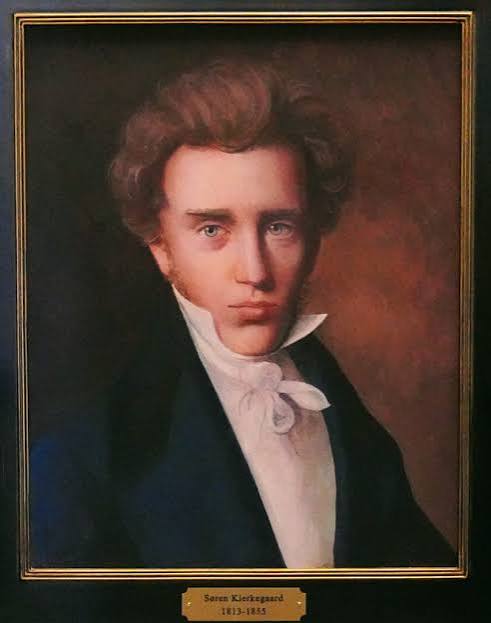 Søren Aabye Kierkegaard (May 5, 1813 – November 11, 1855) was a Danish philosopher, theologian, and cultural critic, widely recognized as a foundational figure in
existentialist thought. Born in Copenhagen, he spent almost his entire life in the city, dedicating himself to a prolific and often deeply introspective body of work.
Søren Aabye Kierkegaard (May 5, 1813 – November 11, 1855) was a Danish philosopher, theologian, and cultural critic, widely recognized as a foundational figure in
existentialist thought. Born in Copenhagen, he spent almost his entire life in the city, dedicating himself to a prolific and often deeply introspective body of work.
Kierkegaard was born in a house that stood at Nytorv 2 (New Square) on May 5, 1813. While the original building was demolished in 1908 to make way for a bank, a memorial
plaque marks the spot where he spent his early years and lived until 1848.
Kierkegaard was the youngest of seven children born to a prosperous merchant father. His upbringing was profoundly shaped by his father’s intense religious melancholy
and a sense of guilt that permeated the family, as well as the loss of many of his siblings at a young age. He attended the University of Copenhagen, where he eventually
earned his degree in 1841 after a prolonged period of study.
Two major events defined his public and private life:
In 1840, Kierkegaard became engaged to Regine Olsen, whom he deeply admired. However, he abruptly broke off the engagement in 1841, citing his perceived inability to be
a proper husband and his conviction that his vocation required total, solitary dedication to his writing. This decision remained a source of profound personal conflict and
public fascination for the rest of his life.
In the mid-1840s, a satirical magazine called The Corsair launched a campaign of ridicule against him. The resulting public humiliation solidified his sense of
alienation from "the crowd" and further drove him toward a more polemical and solitary existence.
Kierkegaard's work is characterized by its exploration of the individual's subjective experience of faith, anxiety, and truth. He famously utilized pseudonyms to
present conflicting perspectives, challenging his readers to make their own choices rather than passively accepting academic or social conventions.
He addressed concepts such as the "leap of faith," the necessity of despair as part of the human condition, and the importance of the "single individual" against the
leveling influence of society.
Major writings include Either/Or (1843), Fear and Trembling (1843), The Concept of Anxiety (1844), The Sickness Unto Death (1849), and Practice in Christianity (1850).
In his final years, Kierkegaard became increasingly critical of the institutional Church of Denmark, arguing that it had compromised Christian ideals to conform to
societal norms. He collapsed in the streets of Copenhagen in 1855 and died shortly thereafter, at the age of 42.
Kierkegaard is buried at Assistens Cemetery alongside other prominent Danes, including Hans Christian Andersen and Niels Bohr. It has since become a major cultural site and a popular
green space.
While some academic theorists—such as Alastair McKinnon—have published papers exploring the question of Kierkegaard’s sexuality and whether his intense internal
conflicts or patterns of intimacy could be interpreted through that lens, these remain speculative fringe discussions rather than established historical fact.
Kierkegaard's life was marked by a commitment to celibacy and a deeply complicated, public fixation on his former fiancée, Regine Olsen. Most biographers and
philosophers attribute his unconventional life path to his idiosyncratic views on Christian vocation, his melancholic temperament, and his specific philosophical
commitment to the "single individual," rather than his sexual orientation.
References:
Other references:
- https://en.wikipedia.org/wiki/S%C3%B8ren_Kierkegaard
Support this project
This website is a passion project researched, developed, and funded entirely by me. If you find the content valuable and would like to help support the ongoing research and hosting costs, any contribution is deeply appreciated.
Thank you for keeping this independent resource alive!
My books on Amazon: Elisa Rolle's books
BACK TO HOME PAGE
