Queer Places:
St. James' Churchyard, Church Ln, Shere, Guildford GU5 9JU, United Kingdom
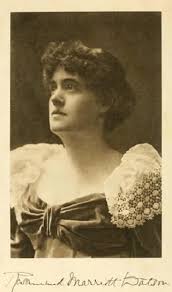 Rosamund Marriott Watson (October 6, 1860 – December 29, 1911), born Euphemia Henderson on October 6, 1860, in London, was a prominent and versatile late-Victorian poet,
nature writer, critic, and essayist who frequently published under the male pseudonyms Graham R. Tomson, Rushworth (or R.) Armytage, and as Rushworth Walbrook. Growing up as
the fifth child of accountant and amateur poet Benjamin Williams Ball and Sylvia (Good) Ball, she lost her mother to cancer at the age of 13, a tragedy that left her with an
unusual amount of freedom for independent reading and writing since no formal records of education have been found. Her artistic sensibilities were further shaped by her
older brother, Wilfrid Ball, a landscape and marine painter who introduced her to London's literary circles, including influential publisher John Lane. Although she
initially intended to become a painter, her father forbade it, redirecting her creative drive entirely toward literature, aestheticism, interior design, and gardening.
Rosamund Marriott Watson (October 6, 1860 – December 29, 1911), born Euphemia Henderson on October 6, 1860, in London, was a prominent and versatile late-Victorian poet,
nature writer, critic, and essayist who frequently published under the male pseudonyms Graham R. Tomson, Rushworth (or R.) Armytage, and as Rushworth Walbrook. Growing up as
the fifth child of accountant and amateur poet Benjamin Williams Ball and Sylvia (Good) Ball, she lost her mother to cancer at the age of 13, a tragedy that left her with an
unusual amount of freedom for independent reading and writing since no formal records of education have been found. Her artistic sensibilities were further shaped by her
older brother, Wilfrid Ball, a landscape and marine painter who introduced her to London's literary circles, including influential publisher John Lane. Although she
initially intended to become a painter, her father forbade it, redirecting her creative drive entirely toward literature, aestheticism, interior design, and gardening.
Her personal life was defined by intense unconventionality, frequent scandal, and turbulent relationships that repeatedly cost her custody of her children. In 1879, she
married her first husband, wealthy Australian George Francis Armytage, with whom she had daughters Eulalie and Daphne, though the couple parted ways by September 1884 and
later divorced. Around 1886, she eloped with the artist Arthur Graham Tomson, adopting the pen name "Graham R. Tomson" and living in London while summering in Cornwall,
before eventually divorcing him as well. She subsequently lived with the novelist H.B. Marriott Watson until her death—the couple never officially married, a living
arrangement that sparked considerable social speculation, alongside her deep intellectual and personal connections to figures like
Vernon Lee that fueled rumors of possible illicit lesbian affairs. With Marriott Watson, she had a son, Lieutenant Richard Brereton
Marriott-Watson, who was later killed in the First World War in 1918.
Watson's career spanned multiple genres and progressive editorial roles. She began writing in 1883 with a column on modern fashion for The Fortnightly Review, followed by
pieces for other magazines and poetry printed in American periodicals like Scribner's Magazine and The Independent. Her early poetry collections—such as the anonymously
published Tares (1884), which reflected the disillusionments of her first marriage, and The Bird-Bride (1886)—utilised pseudonyms to navigate a male-dominated literary
establishment, successfully drawing praise from critics like Andrew Lang who initially assumed the author was a man. As she established her reputation, she dropped the
pseudonyms, releasing works under her own name, including A Summer Night (1891), Vespertilia and Other Verses (1895), After Sunset (1904), and her 1900 novel An Island
Rose.
Technically accomplished and formally experimental in ways that presaged modernism, her poetry drew inspiration from
Alfred Lord Tennyson and Dante Gabriel Rossetti while exploring nature, the
supernatural, folklore, love, loss, and feminist rereadings of traditional stories. Several of her poems were published in the avant-garde periodical The Yellow Book. Beyond
creative writing, Watson penned columns on interior design and fashion—collected in The Art of the House (1897)—wrote "Wares of Autolycus" for The Pall Mall Gazette, and
produced prolific nature and gardening essays collected in The Heart of a Garden (1906). From 1892, she edited the progressive, feminist-leaning monthly magazine Sylvia's
Journal, featuring contributors like Violet Hunt and Edith Nesbit, and was the subject of a major 1902 interview in
Arnold Bennett's journal Woman.
Her life and professional networks were deeply interwoven with the vibrant literary and artistic circles of her era, bridging conventional Victorian society and radical
avant-garde networks. Her connection to the pioneering author and essayist Vernon Lee (Violet Paget) highlights her immersion in the complex webs of fin de siècle female
intellectualism and homosocial community. Though Marriott Watson was twice married—first to Bayard Tomson and later to the writer H.B. Marriott Watson—her relationships and
intellectual alignments frequently challenged heteronormative Victorian expectations. Within her broader circle of correspondents and creative peers, which included figures
like Oscar Wilde, W.E. Henley, and Katharine Bradley and
Edith Cooper (the joint-poet Michael Field), her bond with Vernon Lee reflected a shared dedication to aestheticism, independent
scholarship, and the subversion of traditional gender roles. Through her luminous verse, critical influence, and association with trailblazing queer intellectuals like Lee,
Marriott Watson remains a fascinating figure of aesthetic transition whose work anticipates the psychological complexity of modern literature.
Following a brief bout with religious fanaticism toward the end of her life, Watson died of cancer on December 1911 at the age of 51 in
England, and was buried at St. James' Churchyard in Shere, Guildford Borough, Surrey. Her Collected Poems were published posthumously in 1912 with an introduction by H.B.
Marriott Watson, cementing her enduring legacy as a brilliant transitional figure of the fin de siècle.
References:
- Hughes, Linda K. Graham R.: Rosamund Marriott Watson, Woman of Letters. Athens: Ohio University Press, 2005.
- Hughes, Linda K. “Graham R. Tomson [Rosamund Marriott Watson] (1860–1911).” Yellow Nineties 2.0, edited by Lorraine Janzen Kooistra, Ryerson University Centre for Digital Humanities, 2019.
- Schaffer, Talia. The Forgotten Female Aesthetes: Literary Culture in Late Victorian England. Charlottesville: University Press of Virginia, 2000.
- Vadillo, Ana Parejo. Women Poets and Urban Aestheticism: Passengers of Modernity. Basingstoke, England: Palgrave Macmillan, 2005.
- Colligan, Colette. “A Fin-de-Siecle Beauty and the Beast: Configuring the Body in Works by 'Graham R. Tomson' (Rosamund Marriott Watson).” Tulsa Studies in Women's Literature, vol. 14, no. 1, 1995, pp. 95–121.
Support this project
This website is a passion project researched, developed, and funded entirely by me. If you find the content valuable and would like to help support the ongoing research and hosting costs, any contribution is deeply appreciated.
Thank you for keeping this independent resource alive!
My books on Amazon: Elisa Rolle's books
BACK TO HOME PAGE