Queer Places:
Cimetière de Brèves, 58530 Brèves, France
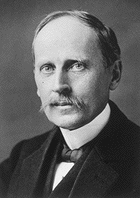 Romain Rolland (January 29, 1866 - December 30, 1944) was born on January 29, 1866, in Clamecy, France, into a family of a notary public. After
completing his early education locally, he moved to Paris with his family to attend the prestigious Lycée Saint-Louis and subsequently entered the
École Normale Supérieure in 1886. He initially focused on history and philosophy, but his profound passion for music and literature ultimately shaped his
intellectual path. As part of his academic training, Rolland spent two pivotal years in Italy as a member of the French School in Rome starting in 1889.
This Italian sojourn deeply influenced his aesthetic development, broadened his cultural horizons, and led to his doctoral thesis on the history of
opera, presented at the Sorbonne in 1895.
Romain Rolland (January 29, 1866 - December 30, 1944) was born on January 29, 1866, in Clamecy, France, into a family of a notary public. After
completing his early education locally, he moved to Paris with his family to attend the prestigious Lycée Saint-Louis and subsequently entered the
École Normale Supérieure in 1886. He initially focused on history and philosophy, but his profound passion for music and literature ultimately shaped his
intellectual path. As part of his academic training, Rolland spent two pivotal years in Italy as a member of the French School in Rome starting in 1889.
This Italian sojourn deeply influenced his aesthetic development, broadened his cultural horizons, and led to his doctoral thesis on the history of
opera, presented at the Sorbonne in 1895.
Returning to France, Rolland embarked on a career in academia, teaching art history at the École Normale Supérieure and later music history at the
University of Paris. Alongside his academic pursuits, he established himself as a prominent dramatist, essayist, and biographer, writing acclaimed
studies on classical figures like Beethoven, Michelangelo, and Tolstoy that focused on artistic genius and moral strength. His literary masterpiece, the
massive ten-volume cyclical novel Jean-Christophe—published serially between 1903 and 1912—earned widespread international acclaim and cemented his
reputation as a major voice in European letters. His literary output and humanitarian stance ultimately culminated in him being awarded the Nobel Prize
in Literature in 1915, recognized as a tribute to the lofty idealism of his work and his love of truth.
Throughout his life, Rolland was a staunch pacifist, internationalist, and defender of the European cultural project. When the First World War broke
out, he distanced himself from nationalist fervor, writing essays condemning the conflict—most notably collected in Above the Battle—which drew intense
controversy but positioned him as a moral beacon for European peace. During his formative years in Italy and his subsequent travels, Rolland forged deep
intellectual alliances with cross-border thinkers. Among his most significant relationships was his profound bond with the Anglo-Italian author,
aesthetician, and cultural critic Vernon Lee (the pen name of Violet Paget). Sharing overlapping circles, deep ties to Italy, and a commitment to
independent thought, Rolland and Lee maintained a rich, multifaceted correspondence from 1908 to 1921.
Their relationship was anchored in deep intellectual companionship and their connection intersected with broader
LGBTQ and queer cultural histories through Lee's identity as an openly queer intellectual navigating late-Victorian and early-20th-century Europe. The
crucible of the First World War further aligned their trajectories; as fellow outspoke pacifists isolated by mainstream wartime nationalism, Lee honored
their intellectual partnership by dedicating her famous 1915 pacifist essay The Ballet of Nations to Rolland. Through their correspondence, both writers
used the catastrophic backdrop of war to critically evaluate European culture, clarify their anti-war stances, and reinforce an alternative vision of a
unified, peaceful Europe. In his later years, Rolland continued his activism against fascism, corresponded with global figures like Mahatma Gandhi and
Sigmund Freud, and spent his final years in Vézelay, where he died on December 30, 1944.
References:
- Rolland, Romain. Above the Battle (Au-dessus de la mêlée). Chicago: Open Court Publishing Company, 1916. (Collection of his seminal WWI essays advocating for internationalism and peace).
- Rolland, Romain. Jean-Christophe. 10 vols. Paris: Paul Ollendorff / Les Cahiers de la Quinzaine, 1904–1912. (His masterwork novel cycle that won international acclaim).
- Rolland, Romain. Mémoires, et extraits de son journal de voyage. Paris: Albin Michel, 1956. (Posthumously published journals providing deep insight into his personal thoughts and political positions).
- Lee, Vernon. The Ballet of the Nations: A Present-Day Morality. New York: G.P. Putnam's Sons, 1915. (Vernon Lee’s anti-war morality play dedicated explicitly to Romain Rolland).
- Gagel, Amanda, and Sophie Geoffroy, eds. Selected Letters of Vernon Lee, 1856–1935. (Multi-volume series covering Lee's extensive correspondence networks with European intellectuals, including documents housed in international archives reflecting her intellectual exchange with Rolland between 1908 and 1921).
- Starr, William Thomas. Romain Rolland: One Against All: A Biography. The Hague: Mouton, 1971. (A comprehensive biographical study of his life, literary evolution, and moral stance).
- Fisher, David James. Romain Rolland and the Politics of Intellectual Engagement. Berkeley: University of California Press, 1988 (reissued by Transaction Publishers, 2004). (An intellectual history tracking Rolland's trajectory as a politically committed writer).
- Zweig, Stefan. Romain Rolland: The Man and His Work. Translated by Eden Paul and Cedar Paul. New York: Thomas Seltzer, 1921. (An early, insightful biography written by a close contemporary and fellow pacifist writer).
- Francis, R. A. Romain Rolland. Oxford: Berg, 1999. (A focused critical introduction to his life, works, and cultural impact).
- March, Harold. Romain Rolland. New York: Twayne Publishers, 1971. (Part of the Twayne World Authors Series, analyzing his literary output and humanist philosophy).
- Colby, Vineta, and Alison Peach. Vernon Lee: A Literary Biography. Charlottesville: University Press of Virginia, 2003. (Examines Vernon Lee's life, her queer identity, and her broad network of European correspondents, including Rolland).
- Encyclopædia Britannica. "Romain Rolland | Nobel Prize Winner, French Playwright & Novelist."
- The New Grove Dictionary of Music and Musicians. "Romain Rolland." Edited by Stanley Sadie and John Tyrrell. London: Macmillan Publishers. (Details his work as a pioneering musicologist and historian of music).
Support this project
This website is a passion project researched, developed, and funded entirely by me. If you find the content valuable and would like to help support the ongoing research and hosting costs, any contribution is deeply appreciated.
Thank you for keeping this independent resource alive!
My books on Amazon: Elisa Rolle's books
BACK TO HOME PAGE