Queer Places:
Château de Conros, 15130 Arpajon-sur-Cère, France
Saint Charles de Potyze French National Cemetery, Zonnebeekseweg, 8900 Ieper, Belgium
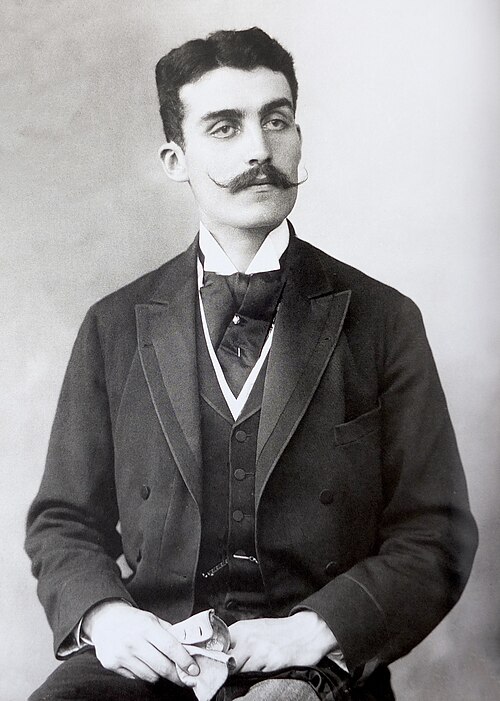 Aymeric Eugène Robert d'Humières (March 2, 1868 - April 26, 1915) was born on March 2, 1868, at the Château de Conros in Arpajon-sur-Cère, France, into
an aristocratic family. He was the son of Count Aymeric d'Humières and Norah Kelly, an American woman of Irish origin from Connecticut. After initially
attending the prestigious military academy of Saint-Cyr, he chose to leave military life behind to pursue a civilian path dedicated to arts and letters.
In 1905, he married Marie de Dampierre, with whom he had three children, though he also navigated a complex personal life as a married homosexual within
Parisian literary circles.
Aymeric Eugène Robert d'Humières (March 2, 1868 - April 26, 1915) was born on March 2, 1868, at the Château de Conros in Arpajon-sur-Cère, France, into
an aristocratic family. He was the son of Count Aymeric d'Humières and Norah Kelly, an American woman of Irish origin from Connecticut. After initially
attending the prestigious military academy of Saint-Cyr, he chose to leave military life behind to pursue a civilian path dedicated to arts and letters.
In 1905, he married Marie de Dampierre, with whom he had three children, though he also navigated a complex personal life as a married homosexual within
Parisian literary circles.
As a prominent man of letters, poet, chronicler, translator, and theatre director, d'Humières established deep connections within the cultural elite
of fin-de-siècle France. He was a close friend and neighbor of the celebrated writer Colette, and he maintained
influential associations with literary giants like Marcel Proust and
Oscar Wilde, the latter of whom gifted him a dedicated copy of his poetry collection. His literary contributions
included collaborating with Louis Fabulet on the translation of Rudyard Kipling’s works into French, as well
as assisting Proust with his translation of John Ruskin's The Bible of Amiens.
From 1907 to 1909, d'Humières expanded his cultural footprint as the director of the Théâtre des Arts. During his tenure, he notably presented his
silent drama The Tragedy of Salome, featuring the pioneering American dancer Loie Fuller, a work whose artistic
vision was later adapted by Sergei Diaghilev for his 1913 ballet.
When the First World War broke out, d'Humières answered the call to service, returning to the military as a captain with the 4th Zouave Regiment. He
met his end on April 26, 1915, during the defense of Ypres at Lizerne, where he was killed in action. Cited in army orders for dying heroically while
leading his unit from the front, he was posthumously honored with the title of Chevalier de la Légion d'honneur, sealing his legacy as both a dedicated
patron of the arts and a fallen soldier.
References:
Other references:
- Military Records & Citations: French Ministry of Defense archives (Mémoire des hommes), documenting his service as a captain with the $4\text{e}$ régiment de zouaves, his death on April 26, 1915, at Lizerne, his citation for dying heroically at the head of his unit, and his posthumous award of the Chevalier de la Légion d'honneur and Mort pour la France status.
- Civil and Genealogical Records: Birth registers of Arpajon-sur-Cère (Cantal) for Château de Conros, marriage records (1905) to Marie de Dampierre, and census/family registries tracking his lineage as the son of Count Aymeric d'Humières and Norah Kelly.
- Académies and Prizes: Records of the Académie française, documenting his multiple wins of the Prix Langlois (specifically in 1901 and 1915) for his translation work.
- Proust, Marcel. Correspondence and related critical editions detailing his relationship with Robert d'Humières, d'Humières's assistance with Proust's translation of John Ruskin's The Bible of Amiens, and d'Humières serving as one of the real-life inspirations for the character Robert de Saint-Loup in À la recherche du temps perdu.
- Wilde, Oscar. Dedicated personal copies and epistolary records, notably the inscribed copy of Wilde's Poems given to d'Humières (preserved in the Jean-David Jumeau-Lafond collection).
- Nadar, Paul. Photographic archives, including the prominent 1895 portrait of Robert d'Humières published in Le Monde de Proust vu par Paul Nadar (Édition du Patrimoine, 2000).
- Literary Journals of the Era: Periodicals such as La Revue blanche, Mercure de France, Comœdia, and the avant-garde journal Akademos (founded by Jacques d'Adelswärd-Fersen), which published literature and commentary connected to sophisticated and homosexual literary circles of Belle Époque Paris.
- La Belle au Bois Dormant (1894) – Dramatic fairy tale written with Henry Bataille, music by Georges Hüe.
- Du Désir aux Destinées (1902) – Poetry collection published by Société du Mercure de France.
- L'Île et l'Empire de Grande-Bretagne. Angleterre – Égypte – Inde (1904) – Travel and political chronicles.
- La Tragédie de Salomé (1907) – Silent drama/poem presented at the Théâtre des Arts with Loie Fuller, with subsequent musical score by Florent Schmitt (later utilized by Diaghilev).
- Lettres volées – Roman d'aujourd'hui (1911) – Epistolary novel published by Librairie Félix Juven.
- Collaborative Translations: French translation editions of Rudyard Kipling's works, executed alongside Louis Fabulet.
Support this project
This website is a passion project researched, developed, and funded entirely by me. If you find the content valuable and would like to help support the ongoing research and hosting costs, any contribution is deeply appreciated.
Thank you for keeping this independent resource alive!
My books on Amazon: Elisa Rolle's books
BACK TO HOME PAGE
