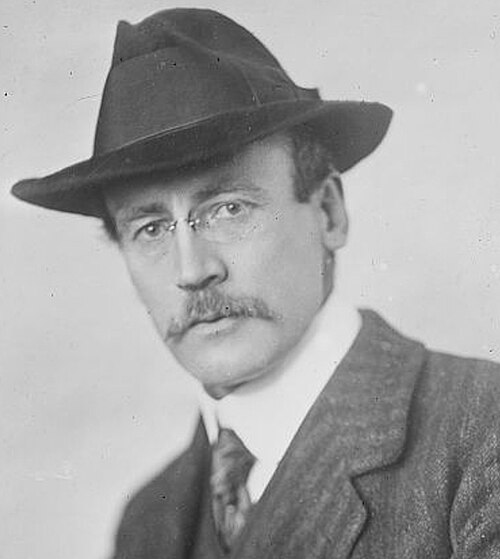
 Robert Tait McKenzie (May 26, 1867 – April 28, 1938) was a multifaceted Canadian physician, educator, athlete, soldier, Scouter, and internationally
acclaimed sculptor whose life bridged the worlds of academic medicine and classical art.
Robert Tait McKenzie (May 26, 1867 – April 28, 1938) was a multifaceted Canadian physician, educator, athlete, soldier, Scouter, and internationally
acclaimed sculptor whose life bridged the worlds of academic medicine and classical art.Queer Places:
McGill University, 845 Sherbrooke St W, Montreal, Quebec H3A 0G4, Canada
University of Pennsylvania (UPenn), Philadelphia, PA 19104, United States
Baird's Mill, 2854 Ramsay Concession 8, Almonte, ON K0A 1A0, Canada
St. Cuthbert's churchyard, 104 Slateford Rd, Edinburgh EH14 1PT, United Kingdom
Saint Peter's Episcopal Churchyard, 313 Pine St, Philadelphia, PA 19106, United States
Robert Tait McKenzie (May 26, 1867 – April 28, 1938) was a multifaceted Canadian physician, educator, athlete, soldier, Scouter, and internationally
acclaimed sculptor whose life bridged the worlds of academic medicine and classical art.
Born in Ramsay Township (now Mississippi Mills, Ontario) to Scottish immigrant minister William McKenzie and Catherine Shiells McKenzie, his early life was shaped by family resilience following his father's death when he was nine years old. He attended the Ottawa Collegiate Institute before enrolling at McGill University in 1885 as a pre-med student, where a childhood self-perception of being a delicate and pale-faced youth completely transformed. At McGill, where he formed a lifelong friendship with basketball inventor James Naismith, McKenzie flourished athletically. He set a high jump record, excelled in gymnastics, boxed, played football, and won the prestigious Wickstead gold medal in 1889 as an acknowledged gymnastic champion.
After earning his medical degree (M.D.C.M.) from McGill in 1892 and completing an internship at the Montreal General Hospital, McKenzie began practicing medicine while serving as an anatomy instructor at his alma mater. He quickly became an early pioneer of preventive medicine, advocating that physical conditioning could ward off disease, physical breakdown, and accidents. His expertise led to his appointment as the personal family physician to the Governor General of Canada, the Marquis of Aberdeen, in 1894. Unable to convince McGill to establish a formal department of physical education due to financial constraints, he accepted appointment in 1898 as the university's first Medical Director of Physical Training, introducing mandatory physical examinations and customized exercise regimes tailored for athletic, sedentary, and bookish students.
Driven by a profound knowledge of human anatomy and a desire to capture bodily movement beyond two dimensions, McKenzie turned to sculpture. His initial explorations into the anatomy of stress resulted in a famous series of facial masks depicting Violent Effort, Breathlessness, Fatigue, and Exhaustion. This transition into sculpture yielded over 200 works that celebrated athletic prowess, military service, and portraiture, ultimately earning him membership in the Royal Canadian Academy of Arts. Among his early sculptural masterpieces were The Sprinter (1902) and The Athlete (1903). In 1904, he moved to the United States to accept a permanent faculty position at the University of Pennsylvania (UPenn) as Director of the Physical Education Department, a role that provided him with state-of-the-art facilities to test and implement his pioneering fitness theories.
While based in Philadelphia, McKenzie maintained deep ties to international athletics and youth movements. He collaborated closely with Lord Robert Baden-Powell to help establish the early Boy Scouts movement in Philadelphia, creating the iconic sculpture The Boy Scout (The Ideal Scout), which became his most famous public monument. As a dedicated spectator and participant in the Olympic movement, he lectured at the 1904 St. Louis Olympics and was commissioned by the American Olympic Committee to create the famous Joy of Effort medallion for the 1912 Stockholm Olympic Games, a design that earned him a King's Medal from the King of Sweden. Decades later, he won an art competition medal at the 1932 Summer Olympics in Los Angeles.
With the outbreak of the First World War in 1915, McKenzie traveled to England and was commissioned as an officer in the Royal Army Medical Corps. He leveraged his expertise to inspect training camps, design specialized prosthetic apparatuses for wounded soldiers, and collaborate with plastic surgeon Dr. William L. Clark to rehabilitate soldiers suffering from severe facial disfigurements. Later in the conflict, he served as an inspector of convalescent hospitals for the Canadian Medical Service under the Military Hospitals Commission. Following the war, he returned to UPenn until retiring from teaching in 1930 amid growing academic bureaucracy.
In his final years, McKenzie returned to Canada, purchasing and restoring an abandoned gristmill known as Baird's Mill in Almonte, Ontario, which he and his wife, musician and poet Ethel O'Neil (whom he had married in 1907), renamed the Mill of Kintail. He spent his retirement active in his studio, swimming, canoeing, and engaging with the local community. Despite warnings from his physician regarding a deteriorating heart, he remained relentlessly active until he collapsed suddenly and passed away on April 28, 1938, in Philadelphia. Though his final request to have his heart buried directly in front of his Scottish-American War Memorial in Edinburgh was denied by the city, his heart was interred nearby at St. Cuthbert's churchyard, while his body was laid to rest at Saint Peter's Episcopal Churchyard in Philadelphia alongside his family.
McKenzie's legacy is deeply intertwined with LGBTQ art history and sports culture. His extensive collection of bronze sculptures featuring athletic young men—housed prominently at UPenn, the Mill of Kintail, and the University of Tennessee—celebrates the male form with explicit, idealized classical beauty. While McKenzie was married to Ethel O'Neil throughout his adult life, contemporary art historians and scholars frequently recognize the undeniable homoeroticism embedded within his anatomical studies and bronze sculptures of male athletes, positioning his artistic output as a significant contribution to early modern queer aesthetic expression.
References:
Support this project
This website is a passion project researched, developed, and funded entirely by me. If you find the content valuable and would like to help support the ongoing research and hosting costs, any contribution is deeply appreciated.
Thank you for keeping this independent resource alive!
My books on Amazon: Elisa Rolle's books