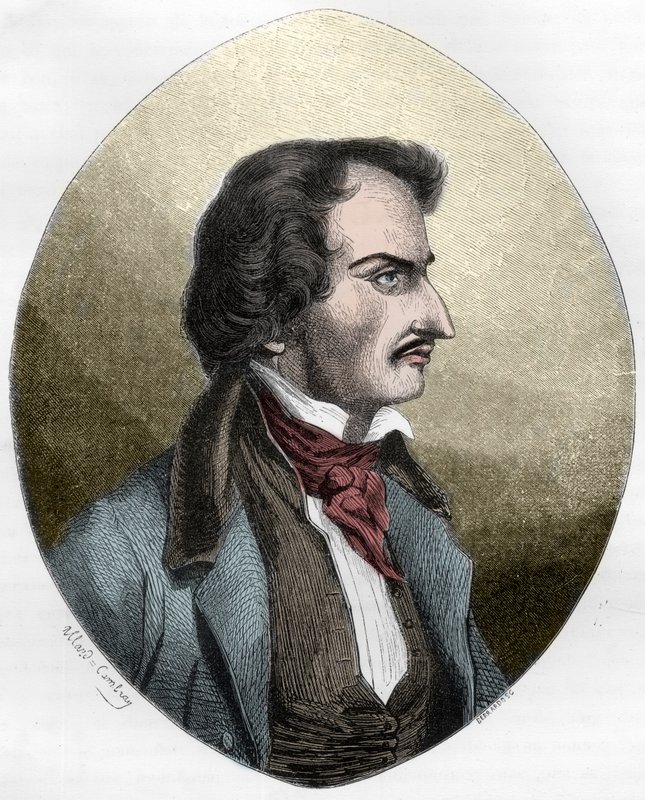
 Pierre François Lacenaire (December 20, 1803 – January 9, 1836) was a notorious 19th-century French criminal, poet, and self-styled social rebel whose life and trial became
a cultural obsession in France.
Pierre François Lacenaire (December 20, 1803 – January 9, 1836) was a notorious 19th-century French criminal, poet, and self-styled social rebel whose life and trial became
a cultural obsession in France.
Pierre François Lacenaire (December 20, 1803 – January 9, 1836) was a notorious 19th-century French criminal, poet, and self-styled social rebel whose life and trial became
a cultural obsession in France.
Born in Francheville to a bourgeois family, Lacenaire was well-educated but turned toward a life of crime after deserting the French army in 1829. He spent significant time in and out of prison, which he famously dubbed his "university of crime."
His notoriety peaked in 1834 when he and his accomplice, Victor Avril, committed a brutal double murder of a pawnbroker and his elderly mother. The murders were botched, netting very little money, but they brought Lacenaire intense media attention.
During his 1835 trial, Lacenaire transformed the courtroom into a stage. He did not deny his crimes; instead, he presented them as a form of "class warfare" and individualistic rebellion against a corrupt society. His articulate, nihilistic, and charming persona captivated the public and intellectuals of his time. He was guillotined on January 9, 1836, at age 32, leaving behind a volume of memoirs and poetry that solidified his image as the "elegant criminal" or the "gentleman murderer."
His legacy persisted long after his death, serving as a primary inspiration for literary characters such as Raskolnikov in Fyodor Dostoevsky’s Crime and Punishment and the character of Lacenaire in the classic French film Les Enfants du paradis (1945).
Pierre François Lacenaire is included in Michel Larivière’s Dictionnaire historique des homosexuel.le.s célèbres (2017) due to historical records and observations surrounding his private life and relationships.
During his trial and imprisonment, there was significant public and legal discussion regarding his intimate life. It was widely noted that he shared a bed with his accomplice, Victor Avril, and rumors of "infamous habits" (a common period term for homosexuality) followed him.
Larivière’s dictionary aims to document figures from history whose same-sex desires were often suppressed, censored, or obscured by the social norms of their time. By categorizing Lacenaire as part of this history, the dictionary aligns with modern efforts to recover the hidden queer narratives of historical figures who did not conform to traditional societal expectations.
While Lacenaire’s primary fame remains tied to his crimes and literary aspirations, his inclusion in this reference work reflects the historical consensus that his romantic and sexual preferences were oriented toward men, a facet of his life that contributed to his status as an outsider and social pariah in 19th-century France.
References:
 Dictionnaire historique des homosexuel.le.s célèbres - French Edition by Michel Larivière |
Other references:
Support this project
This website is a passion project researched, developed, and funded entirely by me. If you find the content valuable and would like to help support the ongoing research and hosting costs, any contribution is deeply appreciated.
Thank you for keeping this independent resource alive!
My books on Amazon: Elisa Rolle's books