Queer Places:
Le Petit Solitaire, 24 Rue Guérard, 92260 Fontenay-aux-Roses, France
Cimetière Ancien de Châtenay-Malabry, 107 Av. de la Division Leclerc, 92290 Châtenay-Malabry, France
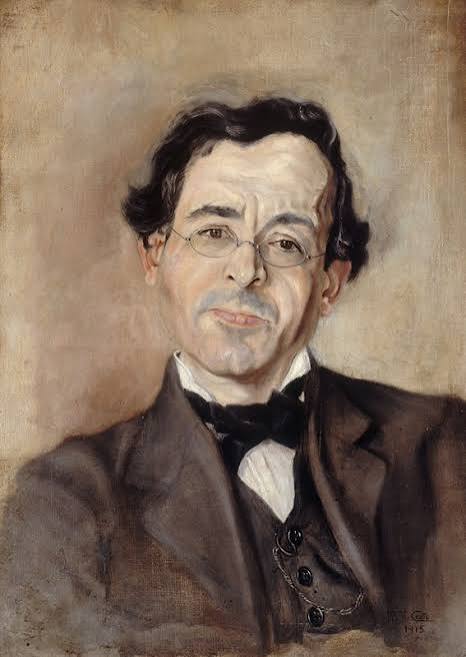 Paul Léautaud (January 18, 1872 – February 22, 1956) was born in Paris on 18 January 1872, the illegitimate son of Firmin Léautaud, a prompter at the
Comédie-Française, and a mother who abandoned him shortly after birth. Raised largely in a harsh and unstable domestic environment, his difficult
childhood and early struggles with poverty left a permanent imprint on his sensitive, cynical, and fiercely independent personality. Despite a lack of
formal higher education, Léautaud cultivated a deep love for literature, theater, and the arts through voracious reading and proximity to the Parisian
cultural world. In the late 1890s, he began writing and publishing anonymously or under pseudonyms before finding his true literary home at the
prestigious literary journal Mercure de France. Working alongside Alfred Vallette and Rachilde, Léautaud served as a
dedicated secretary and editor for the magazine for decades, establishing deep connections with the leading literary figures of his era, including
André Gide, Paul Valéry, and Remy de Gourmont.
Paul Léautaud (January 18, 1872 – February 22, 1956) was born in Paris on 18 January 1872, the illegitimate son of Firmin Léautaud, a prompter at the
Comédie-Française, and a mother who abandoned him shortly after birth. Raised largely in a harsh and unstable domestic environment, his difficult
childhood and early struggles with poverty left a permanent imprint on his sensitive, cynical, and fiercely independent personality. Despite a lack of
formal higher education, Léautaud cultivated a deep love for literature, theater, and the arts through voracious reading and proximity to the Parisian
cultural world. In the late 1890s, he began writing and publishing anonymously or under pseudonyms before finding his true literary home at the
prestigious literary journal Mercure de France. Working alongside Alfred Vallette and Rachilde, Léautaud served as a
dedicated secretary and editor for the magazine for decades, establishing deep connections with the leading literary figures of his era, including
André Gide, Paul Valéry, and Remy de Gourmont.
As a writer, Léautaud is best remembered for his monumental Journal, spanning decades of Parisian intellectual life, and his sharp, uncompromising
theatrical reviews written under the pseudonym Maurice Boissard. His prose is celebrated for its radical simplicity, brutal honesty, psychological
lucidity, and total disdain for bourgeois hypocrisy, academic pretense, and social conventions. Beyond his literary output, he was famous for his
eccentric, reclusive lifestyle at "Le Petit Solitaire" in Fontenay-aux-Roses, where he lived surrounded by a massive menagerie of stray cats and dogs
that he rescued, dedicating a significant portion of his later life and financial resources to animal welfare. Léautaud passed away on 22 February 1956
in a hospital in Le Plessis-Robinson, leaving behind a legacy as one of the twentieth century's most singular, provocative, and uncompromising literary
diarists.
Léautaud’s relationship with sexuality and gender was complex, unorthodox, and deeply integrated into his iconoclastic worldview. As a young man, he
had varied romantic and sexual experiences with both women and men, navigating the bohemian and decadent subcultures of fin-de-siècle Paris with total
indifference to conventional morality. He maintained lifelong friendships and professional associations with prominent homosexual and bisexual writers of
the era, most notably André Gide, whose courage in addressing same-sex desire Léautaud observed from within the inner circles of the Mercure de France.
Furthermore, Léautaud’s Journal provides invaluable, unfiltered eyewitness testimony on the social realities, hidden networks, and psychological
landscapes of queer artists and intellectuals during the first half of the twentieth century. While he generally rejected political labels, ideological
crusades, and any form of collective identity, his lifelong refusal to conform to traditional heterosexual marriage norms, combined with his radical
individualism and candid documentation of marginalized desires, aligns his life and work closely with the history of modern non-conformist and queer
literary expression.
References:
Other references:
- Le Petit Ami (1903): Léautaud’s breakthrough autobiographical novel exploring his unconventional childhood and complex relationship with his mother.
- Poètes d'aujourd'hui (1900): An influential anthology of contemporary French poetry co-authored with Adolphe van Bever (Mercure de France).
- Le Théâtre de Maurice Boissard (1943, 1958): Compilations of his sharp, uncompromising theatrical reviews written under his pseudonym Maurice Boissard.
- Journal littéraire (1954–1966): His monumental, multi-volume diary spanning over fifty years of Parisian literary and cultural life.
- Journal particulier 1917–1930 / Le Fléau (1956): Posthumously published private journals focusing more closely on his personal relationships and intimate life.
- In Memoriam (1956) & Amours (1958): Autobiographical volumes reflecting on his father and his past romantic affairs.
- Entretiens avec Robert Mallet (1951): Published radio interview transcripts offering a direct window into his spoken wit, philosophy, and personal perspectives.
- Harding, James (1974): Lost Illusions: Paul Léautaud and His World (London: Allen & Unwin) — A comprehensive English-language biography detailing his eccentric lifestyle, literary career, and place in French letters.
- Gallant, Mavis (1988): Paris Notebooks (Toronto: Stoddart) — Features incisive literary essays and profiles capturing Léautaud’s personality, style, and distinctive editorial presence at the Mercure de France.
- Dormoy, Marie (1958): Vie de Paul Léautaud (Paris: Flammarion) — Written by his close friend, literary executor, and the primary editor of his literary estate, providing foundational biographical insights.
Support this project
This website is a passion project researched, developed, and funded entirely by me. If you find the content valuable and would like to help support the ongoing research and hosting costs, any contribution is deeply appreciated.
Thank you for keeping this independent resource alive!
My books on Amazon: Elisa Rolle's books
BACK TO HOME PAGE
