Queer Places:
Passy Cemetery, Paris, Département de Paris, Île-de-France, France
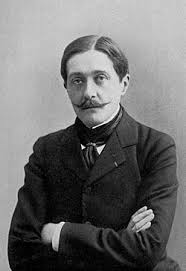 Paul-Ernest Hervieu (September 2, 1857 – October 25, 1915) was born on September 2, 1857, in Neuilly-sur-Seine, France, into a wealthy and prominent upper-middle-class
family. He initially pursued a legal education, graduating in law in 1877 and briefly practicing in a law firm before shifting his ambitions toward the diplomatic service.
After qualifying for diplomatic work, he was posted as a secretary to the French legation in Mexico in 1881. However, his heart lay in French letters and Paris society,
prompting him to resign shortly after and return to France to dedicate his life entirely to writing.
Paul-Ernest Hervieu (September 2, 1857 – October 25, 1915) was born on September 2, 1857, in Neuilly-sur-Seine, France, into a wealthy and prominent upper-middle-class
family. He initially pursued a legal education, graduating in law in 1877 and briefly practicing in a law firm before shifting his ambitions toward the diplomatic service.
After qualifying for diplomatic work, he was posted as a secretary to the French legation in Mexico in 1881. However, his heart lay in French letters and Paris society,
prompting him to resign shortly after and return to France to dedicate his life entirely to writing.
Back in Paris, Hervieu quickly became a fixture of the elite intellectual salons, most notably frequenting the legendary gatherings hosted by Geneviève Straus and Madame
de Pierrebourg (who wrote under the pseudonym Claude Ferval and with whom he shared a long-term romantic relationship). Through these fashionable circles, he cultivated
close friendships with leading artists and writers of the Third Republic, including Guy de Maupassant, Paul Bourget, Edgar Degas, Octave Mirbeau, and a young
Marcel Proust. Hervieu initially made his mark as a novelist and essayist, publishing sharp psychological and satirical works such
as L'Inconnue (1887), Flirt (1890), Peints par eux-mêmes (1893), and L'Armature (1895).
As his career progressed, Hervieu transitioned into a major playwright, achieving immense success on the Parisian stage with rigorous, logically constructed dramas that
examined moral dilemmas, societal constraints, and the legal plights of women. Notable theatrical works included Les Tenailles (1895), La Loi de l'homme (1897),
L'Énigme (1901), La Course du flambeau (1901), and Le Dédale (1903). His literary prominence earned him election to the Académie française in 1900, taking seat 12, and he
also served as president of the Société des gens de lettres. His later years were marked by high national honors, culminating in his elevation to Grand Officer of the Legion
of Honor. Hervieu died on October 25, 1915, at the age of 58 in Paris and was interred in the Passy Cemetery.
In the context of LGBTQ history and turn-of-the-century literary networks, Paul Hervieu occupies a fascinating space. While Hervieu himself moved primarily within
high-society heterosexual milieus—notably his long-term partnership with Claude Ferval—he was an integral member of the ultra-sophisticated, highly interconnected Parisian
artistic elite that heavily featured and accommodated prominent queer figures, most famously Marcel Proust,
Robert de Montesquiou, and Oscar Wilde's wider European circle. Hervieu's close
friendship with Proust placed him at the heart of an era where gender roles, romantic jealousy, and complex social performance were heavily scrutinized.
While the primary real-life composite model for Proust's iconic character Charles Swann was the dandy and art connoisseur
Charles Haas, Proust's construction of Swann—as well as other facets of the novel's intricate social anatomy—drew structural
elements, behavioral nuances, and conversational tone from several elite gentlemen within his trusted inner circle, including Hervieu. Proust's correspondence frequently
highlights his deep intellectual admiration for Hervieu's cool, exterior reserve masking a profound emotional sensitivity. When Hervieu died in 1915, Proust expressed
profound grief, writing movingly that an "autumn rose is more exquisite than any other," underscoring the deep personal and literary loss felt across Paris's avant-garde and
salon culture.
References:
- Encyclopædia Britannica (11th and 12th Editions / Contemporary Entries): Historical biographical entries detailing Paul Hervieu’s life, transition from diplomacy to literature, and standing in the French theatrical world.
- Académie française Official Repository: Archival records, induction details (Seat 12, elected in 1900), acceptance speeches, and official bio-bibliographical timelines for Paul-Ernest Hervieu.
- Marcel Proust, Correspondance: Collected letters of Marcel Proust, documenting his deep personal friendships with Parisian salon figures, contemporaries such as Paul Hervieu, and his commentary surrounding Hervieu's life and death.
- George Painter, Marcel Proust: A Biography: Standard biographical resource exploring Proust's social world, the intellectual networks of the Third Republic, and the real-life models and inspirations behind characters in À la recherche du temps perdu.
- The Bibliothèque Nationale de France (BnF) / Gallica: Digital archives containing original editions of Hervieu’s novels (Flirt, Peints par eux-mêmes, L'Armature) and theatrical works (Les Tenailles, Le Dédale) published by Alphonse Lemerre.
Support this project
This website is a passion project researched, developed, and funded entirely by me. If you find the content valuable and would like to help support the ongoing research and hosting costs, any contribution is deeply appreciated.
Thank you for keeping this independent resource alive!
My books on Amazon: Elisa Rolle's books
BACK TO HOME PAGE