Queer Places:
Place St Georges, 75009 Paris, France
Cimetière d'Auteuil, 57 Rue Claude Lorrain, 75016 Paris, France
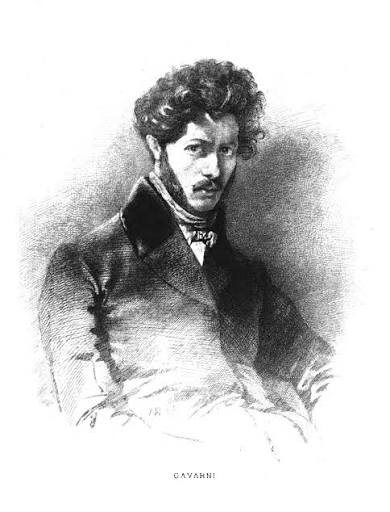 Paul Gavarni (born Hippolyte-Guillaume-Sulpice Chevalier; January 13, 1804 – November 24, 1866) was a preeminent French caricaturist, lithographer, and illustrator.
While often compared to his contemporary Honoré Daumier, Gavarni was celebrated for a distinct style that focused less on political broadsides and more on the nuances, wit,
and private social customs of 19th-century Parisian life.
Paul Gavarni (born Hippolyte-Guillaume-Sulpice Chevalier; January 13, 1804 – November 24, 1866) was a preeminent French caricaturist, lithographer, and illustrator.
While often compared to his contemporary Honoré Daumier, Gavarni was celebrated for a distinct style that focused less on political broadsides and more on the nuances, wit,
and private social customs of 19th-century Parisian life.
Born in Paris, Gavarni initially worked as a mechanical draftsman and surveyor. He gained his pseudonym, "Gavarni," by chance in 1829 after a landscape he submitted to
the Salon—depicting the Cirque de Gavarnie in the Pyrenees—was accidentally exhibited under that name.
Throughout the 1830s and 40s, he became a fixture of Parisian culture. He produced thousands of lithographs for journals such as Le Charivari, La Mode, and
L'Illustration. His series—including Les Lorettes, Les Débardeurs, and Les Enfants terribles—are considered essential visual "memoirs" of the period, documenting everything
from the world of fashion to the lives of bohemians, street-walkers, and the rising middle class.
He enjoyed brief but significant success in London during the late 1840s, where he studied the city’s social inequalities. Toward the end of his life, he retreated into
a more secluded existence in Auteuil, becoming increasingly obsessed with scientific theories and mathematics. He died in Paris in 1866.
Michel Larivière’s Dictionnaire historique des homosexuel.le.s célèbres includes Gavarni as part of its effort to document historical figures whose private lives often
bucked the norms of their era.
Gavarni is frequently included in such collections not necessarily due to a singular "coming out" narrative—which would have been impossible for a public figure in his
time—but because of his well-documented existence outside the traditional family structure. He spent much of his career observing and participating in the "Bohemian" and
"Dandy" subcultures of Paris, environments where non-heteronormative lifestyles were more fluid and tolerated.
For historians like Larivière, figures like Gavarni are significant because their biographies and social circles often feature the "codes" of the era—coded language,
specific friendships, and a deliberate distance from the rigid bourgeois marital ideals of the 19th century. His inclusion reflects a scholarly interest in how male artists
in the 19th century navigated sexuality through their social networks, their artistic choices, and their chosen lifestyles, often leaving behind a trail of historical clues
that modern researchers interpret as part of the broader queer experience of the 19th century.
References:
Other references:
- https://en.wikipedia.org/wiki/Paul_Gavarni
Support this project
This website is a passion project researched, developed, and funded entirely by me. If you find the content valuable and would like to help support the ongoing research and hosting costs, any contribution is deeply appreciated.
Thank you for keeping this independent resource alive!
My books on Amazon: Elisa Rolle's books
BACK TO HOME PAGE
