Queer Places:
Cimetière du Père-Lachaise, Paris, Département de Paris, Île-de-France, France
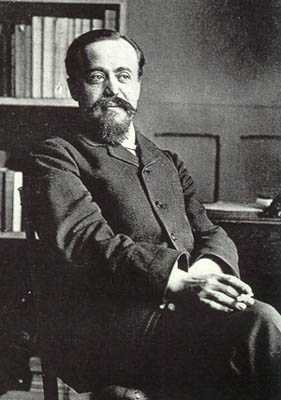 Paul Abraham Dukas (October 1, 1865 - May 17, 1935) was born on October 1, 1865, in Paris, France, the second son in a Jewish family of three children.
His father, Jules Dukas, worked as a banker, and his mother, Eugénie, was a capable pianist. Tragically, his mother died in 1870 when Dukas was five
years old while giving birth to her third child, Marguerite-Lucie. During his early youth, Dukas was a studious man of retiring personality and displayed
no unusual musical talent initially. His interest in music blossomed around the age of fourteen while he was recovering from an illness, prompting him to
begin composing.
Paul Abraham Dukas (October 1, 1865 - May 17, 1935) was born on October 1, 1865, in Paris, France, the second son in a Jewish family of three children.
His father, Jules Dukas, worked as a banker, and his mother, Eugénie, was a capable pianist. Tragically, his mother died in 1870 when Dukas was five
years old while giving birth to her third child, Marguerite-Lucie. During his early youth, Dukas was a studious man of retiring personality and displayed
no unusual musical talent initially. His interest in music blossomed around the age of fourteen while he was recovering from an illness, prompting him to
begin composing.
In late 1881, at the age of sixteen, Dukas entered the Conservatoire de Paris, where he studied piano with Georges Mathias, harmony with Théodore
Dubois, and composition with Ernest Guiraud. Among his fellow students was Claude Debussy, with whom Dukas formed a close, lifelong friendship. Two early
overtures survive from his student years: Goetz de Berlichingen (1883) and Le Roi Lear (1883), the latter of which had its manuscript rediscovered in the
1990s and was performed for the first time in 1995. Dukas won several academic awards, including second place in the prestigious Prix de Rome in 1888 for
his cantata Velléda. Disappointed at failing to win the top prize, he left the Conservatoire in 1889. Following compulsory military service, he embarked
on a dual career as a composer and a music critic.
Dukas's career as a critic began in 1892 with a review of Richard Wagner's Der Ring des Nibelungen
conducted by Gustav Mahler at Covent Garden in London, published in La Revue Hebdomadaire. He subsequently wrote regular reviews for at least five French
journals, including Minerva, La Chronique des Arts, Gazette des Beaux-Arts, and Le Courrier Musical. Concurrently, his Parisian debut as a composer took
place in January 1892 with the performance of his overture Polyeucte, written in 1891 and premiered by Charles Lamoureux and his Orchestre Lamoureux.
Based on a tragedy by Corneille, the work showed the influence of Wagner while displaying individual coherence.
Although Dukas wrote a fair amount of music, he was an intensely self-critical perfectionist who abandoned, discarded, and destroyed many of his
compositions out of dissatisfaction. His unrealized projects included an 1892 opera titled Horn et Riemenhild, for which he wrote his own libretto before
realizing the developments were more literary than musical, and an 1899 abandoned opera titled L'arbre de science.
His Symphony in C major was composed between 1895 and 1896, dedicated to Paul Vidal, and premiered in January 1896 under Vidal's direction. Adhering
to neither the conservative nor the progressive factions into which French musicians were divided at the time, Dukas retained the admiration of both. The
symphony—noted for being in three movements rather than four, much like César Franck's symphony—was praised by contemporary critic Irving Schwerké as an
opulent expression of modernism in classical form. Though it initially received a mixed reception from protesting orchestral musicians and audiences, it
was later championed when revived by the Lamoureux Orchestra in 1902.
The symphony was followed by Dukas's best-known work, the orchestral scherzo L'apprenti sorcier (The Sorcerer's Apprentice, 1897), a 10-to-12-minute
piece based on Goethe's ballad Der Zauberlehrling. While it achieved massive international acclaim and world fame, its monumental popularity eventually
became a source of irritation to Dukas. Critics noted that its fame—cemented globally by its inclusion in Walt Disney's 1940 animated film Fantasia,
featuring Mickey Mouse—ultimately eclipsed both Goethe's original poem and the rest of the composer's surviving catalogue.
In the decade following The Sorcerer's Apprentice, Dukas completed two complex, technically demanding large-scale solo piano works dedicated to
celebrated pianist Édouard Risler: the Piano Sonata (1901), dedicated to Camille Saint-Saëns, and the Variations, Interlude and Finale on a Theme by
Rameau (1902). Critics discerned in these works the influence of Beethoven, or Beethoven as interpreted to the French mind by César Franck.
In 1899, Dukas began work on his one completed opera, Ariane et Barbe-bleue (Ariadne and Bluebeard), setting a libretto by Maurice Maeterlinck that
had originally been intended for Edvard Grieg. Produced at the Opéra-Comique in 1907, the opera was frequently
compared to Claude Debussy's Pelléas et Mélisande due to its shared Maeterlinck text and subtle musical similarities, including a direct quotation from
Debussy's work in Dukas's score. Though its premiere success was overshadowed by Richard Strauss's Salome in Paris, the opera earned international praise
and was later produced in Vienna, Frankfurt, Milan, and New York, where it was championed by Arturo Toscanini and later staged at Covent Garden by Sir
Thomas Beecham in 1937, before experiencing a revival in the 1990s and 2007.
Dukas's final major completed work was the sumptuous oriental ballet La Péri (1912), described as a "poème dansé" depicting a Persian prince's quest
for the lotus flower of immortality. Written for Russian-French dancer Natalia Trouhanova and preceded by a special brass fanfare to settle the audience,
the work preceded a period where Dukas published virtually no new large-scale music, continuing a pattern of editorial work on historical masters like
Rameau, Domenico Scarlatti, and Beethoven. Exceptions included his 1920 piano tribute “La plainte, au loin, du faune…” honoring the deceased Claude
Debussy, and Amours (1924), a setting of a Ronsard sonnet. In his later years, he worked on a French translation of Shakespeare's The Tempest with an
operatic version in mind, which ultimately evolved into an uncompleted symphonic poem.
In 1916, Dukas married Suzanne Pereyra (1883–1947), who was of Portuguese descent. The couple had one child, a daughter named Adrienne-Thérèse, born
in December 1919.
The final decades of Dukas's life were heavily dedicated to teaching. Following the retirement of Charles-Marie Widor in 1927, Dukas was appointed
professor of composition at the Conservatoire de Paris, alongside teaching at the École Normale de Musique de Paris. His vast knowledge of European music
history gave him exceptional authority in teaching historical styles. Among his many prominent pupils were Jehan Alain, Elsa Barraine, Yvonne Desportes,
Francis Chagrin, Carlos Chávez, Maurice Duruflé, Georges Hugon, Jean Langlais, Olivier Messiaen, Walter Piston, Manuel Ponce, Joaquín Rodrigo,
David Van Vactor, and Xian Xinghai.
Dukas received numerous honors during his lifetime. He was made a Chevalier of the Légion d'Honneur in 1906, became a member of the Royal Academy of
Science, Letters and Fine Arts of Belgium in 1920, and was elected to membership in the Académie des Beaux-Arts in December 1934. Paul Dukas died in
Paris on May 17, 1935, at the age of 69. He was cremated, and his ashes were placed in the columbarium at Père Lachaise Cemetery in Paris.
Paul Dukas’s personal life and domestic arrangements have remained a subject of discussion among music historians and biographers examining the social
networks of early 20th-century French artists. While Dukas married Suzanne Pereyra later in life and fathered a daughter, he lived a notoriously
discreet, private, and reserved personal life, leaving behind very few personal papers regarding his romantic inclinations outside of his conventional
marriage. However, his professional and social circles within fin-de-siècle Paris deeply intersected with prominent artistic figures of diverse sexual
orientations and progressive views on gender and sexuality. His lifelong close alliances with Claude Debussy, writer
Pierre Louÿs, and various symbolist figures placed him at the core of an artistic milieu where unconventional
identities and homosocial bonds were navigated beneath the surface of polite Parisian society. Furthermore, his masterwork opera Ariane et
Barbe-bleue—derived from Maeterlinck's symbolist text—features central themes of female autonomy, psychological liberation, and the subversion of
patriarchal authority, which have frequently attracted modern queer and feminist musicological analyses exploring hidden subtexts of subversion and
identity within French art.
References:
- Watson, Laura. Paul Dukas: Composer and Critic. Woodbridge, Suffolk: The Boydell Press, 2019.
- Minors, Helen Julia, and Laura Watson (eds.). Paul Dukas: Legacies of a French Musician. London: Routledge, 2019.
- D'Indy, Vincent. Paul Dukas. Paris: Éditions Durand, 1920.
- Lockspeiser, Edward. "Paul Dukas." In The Music Masters, edited by A. L. Bacharach. Harmondsworth: Pelican Books, 1957.
- Dukas, Paul. Les Écrits de Paul Dukas sur la musique. Paris: Société Française de Diffusion Musicale, 1948.
- Schwartz, Manuela, and G. W. Hopkins. "Dukas, Paul (Abraham)." Grove Music Online. Oxford University Press, 2001.
- Walsh, Stephen. "Paul Dukas." In The Penguin Opera Guide, edited by Amanda Holden. London: Penguin Books, 1997.
- Fauré, Gabriel. Gabriel Fauré: A Life in Letters. Translated by J. Barrie Jones. London: B. T. Batsford, 1989.
Support this project
This website is a passion project researched, developed, and funded entirely by me. If you find the content valuable and would like to help support the ongoing research and hosting costs, any contribution is deeply appreciated.
Thank you for keeping this independent resource alive!
My books on Amazon: Elisa Rolle's books
BACK TO HOME PAGE