Queer Places:
Bolnore House, Isaac's Ln, Haywards Heath RH16 4RZ, United Kingdom
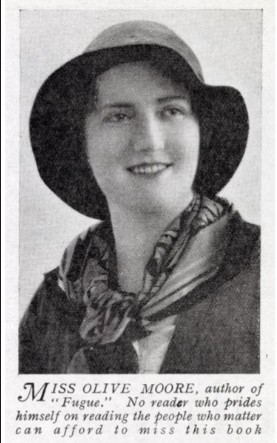 Olive Moore (January 24, 1901 – November 24, 1979) was the pseudonym of Miriam Constance Beaumont Vaughan, an enigmatic and highly talented English modernist writer. Though she was a significant
voice in the literary scene of the early 1930s, her career was characterized by a sudden withdrawal from the public eye, leading to decades of critical neglect until
her work was rediscovered and republished in the 1990s.
Olive Moore (January 24, 1901 – November 24, 1979) was the pseudonym of Miriam Constance Beaumont Vaughan, an enigmatic and highly talented English modernist writer. Though she was a significant
voice in the literary scene of the early 1930s, her career was characterized by a sudden withdrawal from the public eye, leading to decades of critical neglect until
her work was rediscovered and republished in the 1990s.
Born in Hereford, England, in 1901, to Charles Beaumont Vaughan and Leah Miriam Freedberg, Moore’s early life remains somewhat obscure, largely due to her own reticence. She reportedly spent part of her childhood at a
convent abroad and later studied art in Italy and languages at the Sorbonne.
In the 1920s, she moved to London, where she became acquainted with figures in the Bloomsbury Group and frequented radical literary circles. In 1924, she married
the Serbian sculptor Sava Botzaris. Anastas Sava Botzaritch, an arts student and sculpture living at “34 Beak Street, Regent Street, London W” officially registered
the name A. B. Sava as a change of name. Botzaritch’s father, who had been a court painter to King Peter I of Servia, was named Cavaliere Anastras Botzartich Sava,
so the name change reverted to the original family name. Recent archival research suggests they had a child, Peter David Beaumont Botzaritch, who was put up for adoption in 1925, a discovery that has
reshaped critical understanding of the themes of motherhood and pregnancy in her novels. The baby and was taken in by Elizabeth Daisley, the Matron at the maternity
hospital in Kensington, and became Peter David Beaumont Daisley (died 2014). Anastras Botzartich Sava emigrated to Venezuela in 1941.
Moore gained swift recognition for a brief, intense burst of publication in the early 1930s. Her work is often compared to that of
Virginia Woolf or Djuna Barnes for its modernist complexity,
stream-of-consciousness techniques, and biting wit.
Celestial Seraglio (1929): A novel set in a Belgian convent, which Moore described as being semi-autobiographical.
Spleen (1930): Often considered her masterpiece, this novel follows a British woman living on a Mediterranean island with her severely disabled son. It is noted for
its exploration of maternity, disability, and the female experience.
Fugue (1932): A well-reviewed novel that further solidified her reputation as an experimental and intellectually rigorous writer.
The Apple Is Bitten Again (1934): An acerbic collection of essays.
For decades, literary lore held that Olive Moore simply "vanished" from the public sphere after 1934. However, recent scholarly research—notably from studies
published in the 2020s—has corrected this narrative.
While she stepped away from publishing novels, she maintained a long and resourceful career as a journalist and staff writer. She worked for publications such as
The Daily Sketch and contributed extensively to the industrial magazine Scope, where she profiled significant figures of the time, including Le Corbusier and Allen
Lane, between 1942 and 1959.
In later years, Moore was romantically involved with editor John M. Ryan and despite the fact that they were never married, lived with him as ‘Mrs Olive Ryan’ until
he ended their relationship. Around this time, Moore moved to Bolnore House in Haywards Heath, where she lived with her mother, Miriam Leah Beaumont-Vaughan, a former
actress known as Miriam Lewes, until her mother's death in 1964, and then with friend Janet Lobban (who had been the art editor at Scope) until Moore’s death on the
24 November 1979 aged 78, in Cuckfield, West Sussex. Moore’s will is signed ‘Constance Ryan’ and Janet Lobban was the sole inheritor of Moore’s estate.
Olive Moore remained a "forgotten" figure of modernism for much of the 20th century. Her resurgence began in the early 1990s when the Dalkey Archive Press published
her Collected Writings. Today, she is increasingly recognized as a central, if marginalized, figure in the study of female modernism, with scholars exploring her
work’s unique contribution to the portrayal of the female intellectual and the experience of "the outsider."
References:
Other references:
- https://en.wikipedia.org/wiki/Olive_Moore
- https://www.tandfonline.com/doi/full/10.1080/24692921.2021.1964056
- https://themattgonzalezreader.com/2018/09/12/olive-moore/
- https://clereviewofbooks.com/olive-moore-spleen-review/
- https://www.tandfonline.com/doi/abs/10.1080/24692921.2021.1964056
- University of Southampton Faculty of Humanities Department of English ‘Fire From Olympus, Apples From Eden’: Creativity and Dissent in the Work of Olive Moore by Sophie Cavey
Support this project
This website is a passion project researched, developed, and funded entirely by me. If you find the content valuable and would like to help support the ongoing research and hosting costs, any contribution is deeply appreciated.
Thank you for keeping this independent resource alive!
My books on Amazon: Elisa Rolle's books
BACK TO HOME PAGE
