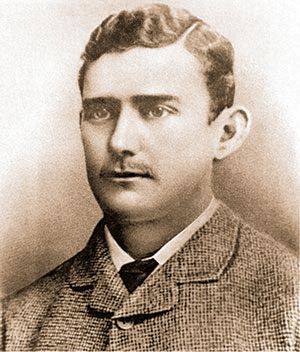
 Neville Ernest Pickering (1857 – October 16, 1886) was a prominent figure in the early diamond fields of South Africa, best remembered for his close personal and
professional association with empire builder Cecil John Rhodes.
Neville Ernest Pickering (1857 – October 16, 1886) was a prominent figure in the early diamond fields of South Africa, best remembered for his close personal and
professional association with empire builder Cecil John Rhodes.Queer Places:
The Kimberley Club Guesthouse, 35 Currey St, Central, Kimberley, 8301, South Africa
Dutoitspan Cemetery, Kimberley, 8300, South Africa
Neville Ernest Pickering (1857 – October 16, 1886) was a prominent figure in the early diamond fields of South Africa, best remembered for his close personal and
professional association with empire builder Cecil John Rhodes.
Born in the Eastern Cape, Pickering previously worked for Dunell, Ebden and Company in Port Elizabeth before moving to Kimberley, where his brother William served as a bank manager. In Kimberley, Pickering established himself as a brilliant diamond broker and joined the De Beers Mining Company in 1881, eventually rising to become its first secretary. He was widely regarded by his peers and directors as the premier diamond broker in the region.
Pickering's life took a tragic turn on June 26, 1884, when he was thrown from a horse-drawn trap and landed inside a thorn bush. Deeply embedded thorns severely injured his legs, introducing a slow-spreading poison and inflammation that ultimately migrated to his lungs. After a prolonged and painful decline that lasted over two years, during which he was temporarily forced to step down from his duties, Pickering died on October 16, 1886, at the age of twenty-nine.
In modern historical and LGBTQ contexts, Neville Pickering is chiefly studied for his intense, deeply bonded relationship with Cecil Rhodes. Shortly after meeting in Kimberley around 1880, Rhodes and Pickering moved out of a rowdy bachelor boarding house—inhabited by men local townspeople dubbed "Rhodes' apostles"—to set up a private cottage together opposite the Kimberley Club. The two men became inseparable companions, living together and sharing domestic life. Graham Bower, deputy to the High Commissioner, famously characterized their dynamic as an "absolutely lover-like friendship".
The depth of Rhodes' attachment was famously memorialized in his second will, drafted on October 27, 1882, in which Rhodes abruptly altered his previous testamentary plans to leave his entire worldly fortune directly to Pickering. In an accompanying letter, Rhodes designated Pickering to execute the secretive, grand plans concerning British imperial expansion. During Pickering's final illness, Rhodes continuously abandoned critical business negotiations—including important gold field talks on the Witwatersrand—to nurse him. Pickering ultimately died in Rhodes' arms, and his death elicited an immense, public display of grief from Rhodes, who never stepped foot in their shared cottage again and was described by observers as profoundly altered by the loss.
While historical interpretations of their bond vary—with some biographers debating the precise physical nature of Victorian male intimacies versus others identifying Pickering as Rhodes' primary romantic partner—modern LGBTQ historiography frequently cites Pickering as the central emotional figure in Rhodes' life. Concurrently, biographical records note that Pickering maintained traditional social engagements alongside these dynamics, having been engaged to marry Miss Maud Christian of Port Elizabeth prior to his death.
References:
Support this project
This website is a passion project researched, developed, and funded entirely by me. If you find the content valuable and would like to help support the ongoing research and hosting costs, any contribution is deeply appreciated.
Thank you for keeping this independent resource alive!
My books on Amazon: Elisa Rolle's books