Queer Places:
Cheltenham Ladies' College, Bayshill Rd, Cheltenham GL50 3EP, United Kingdom
University of Liverpool, Foundation Building, 765 Brownlow Hl, Liverpool L69 7ZX, United Kingdom
University of Leipzig, Augustuspl. 10, 04109 Leipzig, Germany
Beaumaris Town Cemetery, Allt Goch Bach, Beaumaris LL58 8AZ, United Kingdom
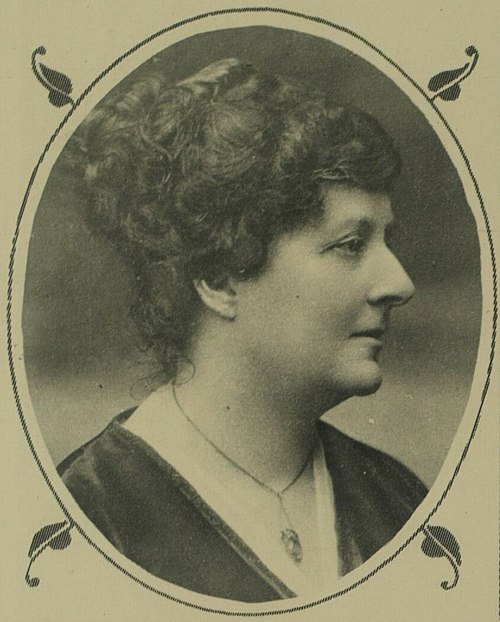 Nessie Stewart-Brown JP (born Nessie Muspratt; September 5, 1864 - April 7, 1958) was born at Seaforth Hall in Seaforth, near Liverpool, to Frances Jane
Baines Muspratt (1840–1910) and Dr. Edmund Knowles Muspratt (1833–1923) of the Muspratt & Co. Chemical Works, which later became part of the United
Alkali Company Ltd. The Muspratt family were staunch supporters of the Liberal Party. She was an elder sister to Liberal MP Sir Max Muspratt (1872–1934),
South African suffragist Julia Solly, Ernest Lincoln Muspratt (1866–1876), Edmund Baines Muspratt (1878–1906), and Clifford M. Muspratt (1881–1938). She
was also an aunt of Nelia Penman, who served as President of the Women's Liberal Federation, and a cousin of other politically active family members.
Displaying an early commitment to academic and intellectual pursuits, Nessie was educated at Cheltenham Ladies' College, Liverpool University, Paris,
and Leipzig. On September 13, 1888, she married Egerton Stewart-Brown (1862–1938) at Sefton Church.
Stewart-Brown emerged as a powerhouse of constitutional suffrage work and municipal reform in the North of England. Early in her civic journey, she
became the Honorary Secretary of the ladies' branch of the Liverpool Royal Society for the Prevention of Cruelty to Animals. She joined the Women's
Liberal Federation in Liverpool, helping form branches at West Derby and Wavertree while serving as President for the West Toxteth branch. In 1891, she
began public speaking on behalf of women's suffrage, making history the following year when she became the first woman to speak on a municipal platform
during her husband's campaign for the Liverpool City Council in 1892. In the same year, she was elected to the national executive committee of the
Women's Liberal Federation, a body on which she served for many years.
Aligning herself with the constitutional movement, she co-founded the Liverpool Women's Suffrage Society (serving as the local branch of the National
Union of Women's Suffrage Societies, or NUWSS) in 1894 alongside Mrs. Alfred Booth and Edith Bright, following a foundational visit and speech by Dame
Millicent Fawcett. Stewart-Brown served as the branch's chairman and held leadership roles across
various regional bodies, including the presidency of the Liverpool Women's Liberal Association and the presidency of the Lancashire and Cheshire Union of
the Women's Liberal Association.
As a dedicated moderate, she firmly opposed the militant tactics deployed by the militant suffragettes. In 1912, she opposed the establishment of the
NUWSS's election fighting fund, which was intended to campaign against Liberal candidates in by-elections and align the NUWSS with the Labour Party. In
October 1911, she collaborated with Eleanor Rathbone to establish the Municipal Women's Association, aimed
at awakening interest in women's suffrage among female municipal voters.
During the First World War, Stewart-Brown shifted her organizing energy toward relief efforts, supporting the Scottish Women's Hospitals' Association
and the Liverpool branch of the National Union of Women Workers. Following the war, she expanded her internationalist and peace-building commitments,
serving as the Liverpool branch chairman for the Women's International League and holding an executive seat on the Liverpool branch of the League of
Nations Union.
Her political career expanded directly into electoral politics following the partial enfranchisement of women. In 1919, standing as a Liberal
candidate, she became only the second woman ever elected to the Liverpool City Council. She subsequently contested the safe Unionist seat of Waterloo as
the Liberal parliamentary candidate during the 1922 General Election, though she did not stand for Parliament again. She also served as President of the
Waterloo Women's Liberal Association.
In 1924, she solidified her public service legacy by becoming one of the first women appointed as a Justice of the Peace, serving on the Liverpool
bench. Her extensive civic portfolio also included serving as President of the Liverpool National Council of Women, Vice-Chairman of the Council of Women
Citizens, and Chairman of the Liverpool Liberal Council. She passed away on April 7, 1958, at the age of 93, and was laid to rest at Beaumaris Town
Cemetery in Beaumaris, Isle of Anglesey, Wales.
Nessie Stewart-Brown's foundational role in the fight for female enfranchisement received prominent national recognition when her name and portrait
likeness were permanently etched onto the plinth of Gillian Wearing’s bronze statue of Millicent Fawcett in Parliament Square, London. Unveiled in
April 2018 as Parliament Square's first monument dedicated to a woman, the plinth honors 59 pivotal figures (55 women and 4 men) from the broader
suffrage movement.
The inclusion of figures like Stewart-Brown alongside many pioneering queer individuals—such as Ray Strachey,
Cicely Hamilton, and numerous others commemorated on the monument—highlights the complex, diverse coalition
that constituted the historical struggle for women's rights. While Stewart-Brown's personal life followed conventional marital paths of her era, the
broader historic landscape of the suffrage movement heavily intersected with early LGBTQ+ history. Many prominent campaigners memorialized on the plinth
lived openly in lifelong same-sex partnerships, defying Victorian and Edwardian social constraints. Scholars and archivists frequently study the
Parliament Square monument as a collective tribute that gathers these diverse figures together, bridging mainstream constitutional reformers and
unconventional radicals under a shared legacy of civic emancipation.
References:
Other references:
- Cowman, Krista (2004). "Brown, Nessie Stewart (1864–1958)." Oxford Dictionary of National Biography, Oxford University Press. (An authoritative biographical entry detailing her public life, suffrage leadership, and political career on Merseyside).
- Muspratt, Edmund Knowles (1917). My Life and Work. Plymouth, England: John Lane Company (Page 206). (An autobiography by her father providing primary familial context and background on the Muspratt family and industrial history).
- Who Was Who (1920–2015). "Muspratt, Edmund Knowles." Oxford University Press. (Biographical reference detailing her family lineage).
- The Lady's Who's Who (1938). (A contemporary historical directory noting her organizational involvements and leadership positions during the interwar period).
- Helmond, Marij van (1992). Votes for Women: The Events on Merseyside 1870–1928. National Museums & Galleries on Merseyside. (Provides comprehensive regional documentation regarding her co-founding of the Liverpool Women’s Suffrage Society and municipal work with Eleanor Rathbone).
- Stocks, Mary D. (1949). Eleanor Rathbone. Victor Gollancz Ltd. (Historical biography mapping the collaborative municipal and suffrage initiatives shared between Stewart-Brown and Rathbone).
Support this project
This website is a passion project researched, developed, and funded entirely by me. If you find the content valuable and would like to help support the ongoing research and hosting costs, any contribution is deeply appreciated.
Thank you for keeping this independent resource alive!
My books on Amazon: Elisa Rolle's books
BACK TO HOME PAGE
