Queer Places:
All Saints Memorial Church Cemetery, 202 Navesink Ave, Navesink, New Jersey 07752 United States
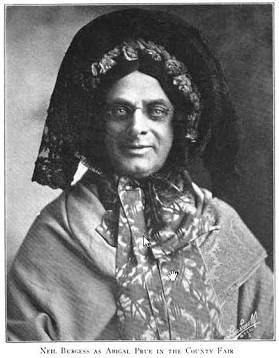 Neilson "Neil" Burgess Jr. (June 29, 1846 – February 19, 1910) was one of the most successful and influential American comedians and female impersonators of the late 19th century. His
legacy is highlighted in Improper Bostonians: Lesbian and Gay History from the Puritans to Playland (1998), a landmark book compiled by the Boston-based
LGBTQ+ historical organization The History Project, which documents Boston's hidden queer lineage.
Neilson "Neil" Burgess Jr. (June 29, 1846 – February 19, 1910) was one of the most successful and influential American comedians and female impersonators of the late 19th century. His
legacy is highlighted in Improper Bostonians: Lesbian and Gay History from the Puritans to Playland (1998), a landmark book compiled by the Boston-based
LGBTQ+ historical organization The History Project, which documents Boston's hidden queer lineage.
Born in Boston, Massachusetts, Burgess did not set out to become a female impersonator. Originally a young tradesman and photographer, his career took an accidental
turn in 1865 when he was 19 years old. While working in Providence, Rhode Island, he was hastily called on to fill in for an ailing actress playing Mrs. Barnaby Bibbs in
the farce The Quiet Family.
His performance was a massive hit, sparking a lifelong career specializing in playing comedic, sharp-tongued, down-East elderly widows and spinsters.
His first major breakthrough came in the title role of The Widow Bedott (1879), or A Hunt for a Husband. He toured extensively with this character, portraying her
with an authenticity that transcended simple parody.
Burgess produced and starred as "Auntie Abigail Prue" in The County Fair (1889), a massive hit. Beyond his acting, Burgess was highly inventive; he patented a
turntable mechanism for this play that allowed real horses to run at full speed on a moving stage, simulating a live horse race.
Unlike the bawdy or highly exaggerated female impersonators of minstrel shows, Burgess's characters were celebrated for their realism. Contemporary critics noted that
he was "not the least bit effeminate" in his personal life, yet on stage, he embodied the mannerisms of a managing, neighborly 19th-century woman so perfectly that
audiences forgot his gender.
In Improper Bostonians, Neil Burgess is reclaimed as a key figure in the pre-modern history of drag and gender play in New England. The book places him within the
rich, complex evolution of "theatrical transvestism" and cross-dressing in Boston.
While modern concepts of gay, trans, and queer identities did not exist in the same way during the 19th century, Improper Bostonians highlights Burgess for several
reasons:
In an era of strict Victorian gender binaries, Burgess normalized cross-dressing for millions of mainstream theatergoers. His immense popularity carved out a safe,
celebrated space for drag as a high-art form, laying the cultural groundwork for the drag and cabaret spaces that would later flourish in Boston's underground queer
scene.
His inclusion in the book serves to connect 19th-century theatrical cross-dressing with the 20th-century drag queens and trans pioneers who would eventually shape the
modern Boston LGBTQ+ community.
References:
Other references:
- https://en.wikipedia.org/wiki/Neil_Burgess_(comedian)
Support this project
This website is a passion project researched, developed, and funded entirely by me. If you find the content valuable and would like to help support the ongoing research and hosting costs, any contribution is deeply appreciated.
Thank you for keeping this independent resource alive!
My books on Amazon: Elisa Rolle's books
BACK TO HOME PAGE
