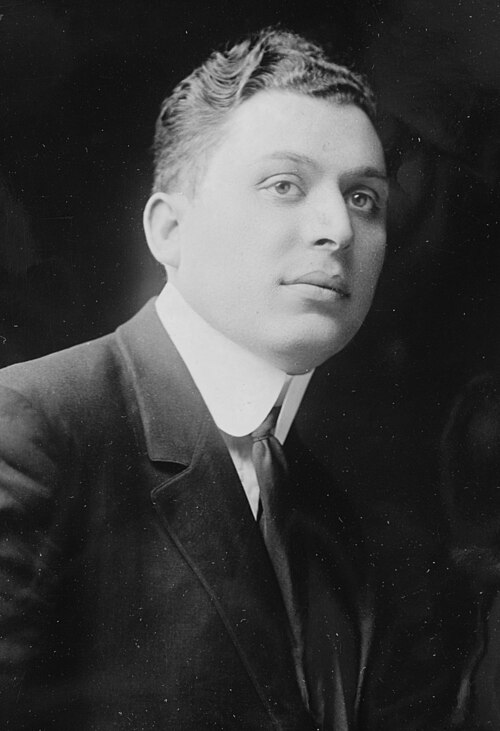
 Morris Gest (also Maurice Guest, March 15, 1875 – May 16, 1942) was an American theatrical producer of the early 20th century.
Queer Places:
Linden Hill Jewish Cemetery, 52-22 Metropolitan Ave, Flushing, NY 11385, United States
Morris Gest (also Maurice Guest, March 15, 1875 – May 16, 1942) was an American theatrical producer of the early 20th century.
Born Moishe Gershnowitz on March 15, 1875, near Vilna in the Russian Empire (present-day Vilnius, Lithuania), Morris Gest was the son of Leon and Elizabeth Gershonovitz. Through his mother, he belonged to the middle-class Michliszanski clan, which linked him directly to his cousin, the famed art historian Bernard Berenson. In 1890, Gest emigrated to Boston with a traveling couple. There, his ambition caught the attention of a local patron, Mr. Thompson, who hired him to work in the United States District Court library and ensured he received a formal education.
Gest quickly gravitated toward the performing arts, taking on various operational roles across Boston’s theatrical scene. Moving to New York in 1901, he joined theatrical legend Oscar Hammerstein at the Manhattan Opera House, eventually advancing to foreign representative. As an independent producer, he staged several Broadway offerings, including the 1919 revues Morris Gest's Midnight Whirl, featuring music by George Gershwin, and Aphrodite, a extravagant faux-Oriental spectacle produced alongside F. Ray Comstock. Although Aphrodite featured choreography by Michel Fokine and costumes by Léon Bakst, critics noted its hollow interior beneath a gorgeous aesthetic. Gest also notably brought opera star Geraldine Farrar into his theatrical orbit. During his rise in New York, his lavishly decorated office—resembling a Pasha’s cozy corner brimming with couches, pillows, Oriental rugs, and incense—became as famous as his productions, serving as the setting for an affair with designer George James Hopkins, who also worked alongside Charles Frohman.
Throughout the 1920s, Gest established himself as a preeminent theatrical impresario by introducing groundbreaking European high art to American audiences. Partnering with Comstock, he imported Nikita Balieff's celebrated troupe La Chauve-Souris and brought Konstantin Stanislavski’s Moscow Art Theatre to New York, achieving immense critical success despite the barrier of Russian dialogue. In 1923, Gest organized the final United States tour for legendary Italian actress Eleonora Duse. The following year, he achieved his artistic pinnacle by importing German director Max Reinhardt to stage The Miracle. Gest’s mastery of publicity and casting proved essential in offsetting the enormous financial risks posed by the show's intricate sets, lavish costumes, and cast of 175 performers. In 1929, he mounted an ambitious Broadway presentation of The Passion Play.
The onset of the Great Depression and the end of his partnership with Comstock severely disrupted Gest's career, leading to a five-year hiatus from major productions. Following his 1936 staging of Lady Precious Stream, Gest suffered a nervous breakdown. He later attempted a comeback at the 1939 New York World's Fair with "Morris Gest's Little Miracle Town," featuring a troupe of midget performers brought over from Germany. The display was widely viewed as a tawdry departure from the high-art European theater he had championed a decade earlier.
Gest died in New York on May 16, 1942, at the age of 67, and was interred at Linden Hill Jewish Cemetery in Ridgewood, Queens. He was survived by his wife, Reina Victoria Belasco Gest, the daughter of famed Broadway playwright and producer David Belasco, whom he had married during the height of his theatrical career; she passed away six years later in 1948.
References:
 Behind the Screen: How Gays and Lesbians Shaped Hollywood, 1910-1969 Paperback – October 29, 2002 by William J. Mann |
Other references:
Support this project
This website is a passion project researched, developed, and funded entirely by me. If you find the content valuable and would like to help support the ongoing research and hosting costs, any contribution is deeply appreciated.
Thank you for keeping this independent resource alive!
My books on Amazon: Elisa Rolle's books