Partner Daisy Tapley
Queer Places:
165 W 136th St, New York, NY 10030, USA
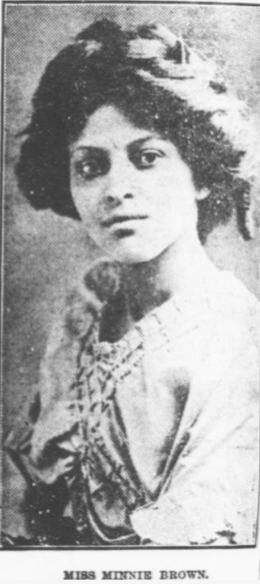 Minnie G. Brown (March 1879 - December 4, 1936) was born in March 1879 in Washington, D.C., the adopted daughter of John H. and Ellen M. Brown. Her early
childhood was spent in Butte, Montana, before her family settled in Spokane, Washington, where she attended Spokane High School. Recognizing her
extraordinary vocal talent, her parents arranged for her to study voice under one of the region's finest instructors, Ethel Child Walton. Brown began
performing at local church and school events, developing a remarkably dynamic vocal range and control that would later earn her the affectionate title of
the "human mockingbird" among her peers.
Minnie G. Brown (March 1879 - December 4, 1936) was born in March 1879 in Washington, D.C., the adopted daughter of John H. and Ellen M. Brown. Her early
childhood was spent in Butte, Montana, before her family settled in Spokane, Washington, where she attended Spokane High School. Recognizing her
extraordinary vocal talent, her parents arranged for her to study voice under one of the region's finest instructors, Ethel Child Walton. Brown began
performing at local church and school events, developing a remarkably dynamic vocal range and control that would later earn her the affectionate title of
the "human mockingbird" among her peers.
In the early 1900s, Brown launched her professional stage career by joining the famed Williams and Walker theatrical troupe as a chorus girl around
1904. Her artistic breakthrough occurred when she filled in for Abbie Mitchell to sing the song "Red, Red Rose," earning critical acclaim across the
country. She further established herself in show business through her performance as Angelina Diggs in The Old Maid in Bandana Land and by understudying
for Lottie Williams, earning a reputation as one of the finest character performers in vaudeville.
Following the dissolution of the Williams and Walker company around 1910, Brown made New York City her permanent home to expand her musical horizons.
She broadened her artistic expertise by studying the cello under H. Leonard Jeter and voice under Harry S. Williams. Brown toured extensively throughout
the Western United States and Ontario, Canada, performing as a concert singer and presenting Negro Spirituals for the New York City Board of Education
across New York, Pennsylvania, and New Jersey. She frequently performed in high-profile oratorios alongside renowned Black classical artists such as
Roland Hayes, Harry Burleigh, and Jules Bledsoe.
Parallel to her theatrical success, Brown harbored a deep passion for sacred music. She secured the position of leading soprano soloist at St. Mark’s
Methodist Episcopal Church in Harlem, a role she held for two decades. Through her leadership, she elevated the church's ministry of song and assembled
one of the finest private collections of church music owned by an African American musician of her era.
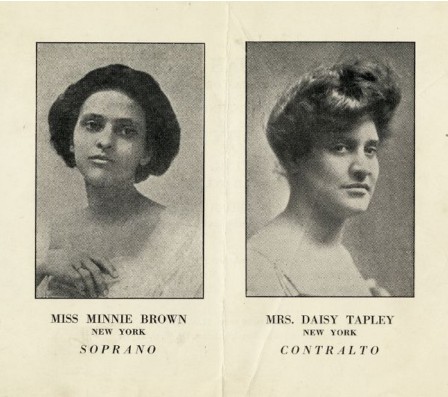
While working with the Williams and Walker troupe, Brown met singer and contralto Daisy Tapley, who was then
married to vaudeville actor Green Henri Tapley. After the company dissolved, Daisy separated from her husband, and she and Brown moved into an apartment
together on West 136th Street in Harlem around 1910. The two women became lifelong romantic and professional partners, sharing a summer home in
Sag Harbor, Long Island, and living together for nearly fifteen years. Census records alternately listed Brown as Tapley's sister or lodger, reflecting
the era's social constraints around non-normative relationships.
Together, Brown and Tapley became central figures in the cultural, civic, and political life of Harlem. They performed together in concert recitals,
taught piano, organ, and voice, and directed YWCA glee clubs. As active suffragists and civil rights advocates, they fought tirelessly for racial and
gender equality through organizations like the Empire State Federation of Women’s Clubs—a branch of the National Association of Colored Women—and the
National Association of Negro Musicians, founded in 1919. In April 1913, Brown sang and delivered remarks at the memorial service for Harriet Tubman at
St. James Presbyterian Church. In July 1917, Brown and Tapley participated in the NAACP's historic Silent March down Fifth Avenue to protest anti-Black
violence and lynching, with Tapley leading the women's division. In 1918, when the YMCA attempted to segregate the audience at a concert they were
organizing, the couple chose to cancel the event entirely rather than tolerate discrimination. They subsequently launched an independent series of
educational recitals to promote Black classical talent to integrated audiences.
When Daisy Tapley died of ovarian cancer on February 5, 1925, Brown took charge of her final arrangements, wrote her obituary, and oversaw her
interment at their shared Sag Harbor property. Brown processed her grief through public and religious acts of devotion. She donated memorial flowers at
St. Mark’s Church and published an annual "In Memoriam" notice in the New York Age dedicated to Tapley every February 5th for the rest of her life, using
their public names to boldly honor the depth of their intimacy.
Following Tapley's passing, Brown remained an influential figure in Harlem's music scene. Operating from her studio on West 136th Street, she taught
music and directed both the Lincoln Nurses' Chorus and the Young People's Chorus at the Martin-Smith School of Music. On March 21, 1935, the Harlem
community honored her with a grand testimonial concert at Mother A.M.E. Zion Church, where prominent writers, clergymen, and musicians gathered to
celebrate her lifelong contributions to classical art.
In late 1936, Brown fell severely ill and was admitted to a Harlem sanitarium. She passed away shortly thereafter, before December 4, 1936, at
approximately 57 years of age. Survived by an adopted son, Minnie G. Brown was remembered in contemporary obituaries as a musician of the first
magnitude, whose warmth, artistry, and unwavering dedication left an enduring legacy in American music and civil rights history.
References:
Other references:
- E. Azalia Hackley Collection, Detroit Public Library, Detroit, Michigan. Elijah Chorus concert program, Jordan Hall, Boston (April 1915).
- The Appeal (Saint Paul, MN). Notice of performance with Williams & Walker (February 18, 1905).
- The Freeman (Indianapolis, IN). Notice of parental visit to Spokane, Washington (July 25, 1908).
- The New York Age (New York, NY): Annual "In Memoriam" Notices for Daisy Tapley (Published annually every February 5, 1926–1936).
- New York Musical World Honors Minnie Brown with Testimonial Musical Concert by Robert J. Douglas (March 30, 1935, p. 5).
- Card of Thanks and Acknowledgement (December 1936).
- The Northwest Enterprise (Seattle, WA): Notice of Illness in New York Sanitarium (November 20, 1936).
- Obituary: Two Pioneers Die (December 4, 1936).
- United States Federal Census (1880): Entry for John H. Brown and Ellen M. Brown, Washington, District of Columbia.
- United States Federal Census (1900): Entry for John H. Brown and Ellen M. Brown, Spokane, Washington.
- New York State Census (1915): Entry for Daisy Tapley and Minnie Brown, New York City.
- United States Federal Census (1920): Entry for Daisy Tapley and Minnie Brown (listed as "lodger"), New York City.
- Harriet Tubman Memorial Service Program: St. James Presbyterian Church, New York City (April 1913).
- Empire State Federation of Women’s Clubs: Conference proceedings on child welfare and hospital equality (July 1914).
- NAACP Silent Protest Parade Documentation: Fifth Avenue March Records, New York City (July 28, 1917).
Support this project
This website is a passion project researched, developed, and funded entirely by me. If you find the content valuable and would like to help support the ongoing research and hosting costs, any contribution is deeply appreciated.
Thank you for keeping this independent resource alive!
My books on Amazon: Elisa Rolle's books
BACK TO HOME PAGE
