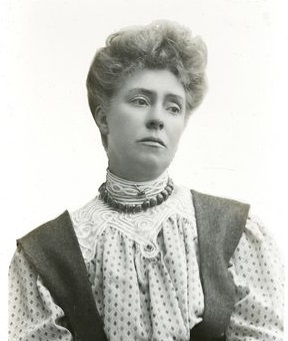
 Lucy Minnie Rogers Baldock (November 20, 1864 – December 10, 1954) was a British working-class suffragette, social reformer, and pioneering political
activist.
Queer Places:
(1906) 10 Eclipse Rd, London E13 8LX, UK
(1954) 73 Lake Rd, Poole BH15 4LF, UK
St. Michael's Churchyard, Blandford Rd, Hamworthy, Poole BH15 4HR, United Kingdom
Lucy Minnie Rogers Baldock (November 20, 1864 – December 10, 1954) was a British working-class suffragette, social reformer, and pioneering political
activist.
Born into poverty in East London, she spent her early years working grueling hours in a sweated labor shirt factory. In 1888, she married Henry "Harry" Baldock (1865–1934), a fitter who later became an Independent Labour Party (ILP) councillor, and together they raised two sons: Henry Rogers "Harry" Baldock (1890–1960) and John Francis Baldock (1896–1971). Grounded in the impoverished realities of the East End, Baldock became deeply committed to labor rights and social justice. Following the election of socialist Keir Hardie as their local Member of Parliament in 1892, the Baldocks joined the ILP. Working alongside prominent reformers like Charlotte Despard and Dora Montefiore, Baldock took charge of a local unemployment fund designed to mitigate extreme hardship, and in 1905, the ILP chose her as their candidate to sit on the West Ham Board of Guardians.
In January 1906, Baldock joined forces with Annie Kenney to co-create the Canning Town branch of the Women's Social and Political Union (WSPU), marking the organization's very first branch established outside of Manchester. Known for her articulate delivery and ability to bridge working-class realities with wider political audiences, Baldock became a paid employee and traveling organizer for the WSPU, mentoring figures like Daisy Parsons and working closely with leaders such as Emmeline Pethick-Lawrence, Flora Drummond, Christabel Pankhurst, and Mary Clarke. Her activism frequently involved high-profile, theatrical direct action. On December 21, 1905, she attended a pre-election Liberal meeting at the Royal Albert Hall dressed as a maid to Annie Kenney, sitting in a box where Kenney hung a 'Votes for Women' banner. The following day, she visited Sir Henry Campbell-Bannerman alongside Kenney and Teresa Billington to demand action on female suffrage.
Baldock's militant activities led to multiple arrests and imprisonments. On October 23, 1906, she was arrested alongside Nellie Martel and Anne Cobden-Sanderson for disorderly conduct during the opening of Parliament. In November 1907, after being ejected from a Liberal MP's event on the Isle of Dogs, she stood undeterred on a chair outside a window calling out "Votes for Women." In February 1908, she was arrested alongside Emmeline Pankhurst and others after walking single file toward the House of Commons to present a petition and protest the refusal to treat suffragist offenders as first-class misdemeanants. Refusing to pay a fine, she served a month-long sentence in Holloway Prison in the second division, during which fellow suffragettes sent toys to support her two boys at home. Upon her release, she affirmed her dedication, writing, "I love freedom so dearly that I want all women to have it, and I will fight for it until they get it." As a formerly imprisoned suffragette, she was given the honor of planting a commemorative tree at Eagle House in Somerset in February 1909. Throughout her WSPU career, she participated in numerous regional campaigns—building up branches in Nottingham with Elsa Gye, renting a house in Bristol with Annie Kenney to assist activists hiding out to disrupt a Liberal cabinet minister's speech, and facing further arrests alongside Flora Drummond and the Pankhursts.
By 1911, Baldock's direct involvement with the escalating militancy of the WSPU shifted after she was diagnosed with cancer and underwent major surgery performed by Louisa Aldrich-Blake. Although she stepped back from the WSPU, she remained politically active, boycotting the 1911 census, maintaining ties with Edith How-Martyn, and remaining a member of the Church League for Women's Suffrage. Economic and health reasons prompted moves to Liverpool in 1913 so her sons could seek work in the shipyards, and later to Southampton in 1914. In her later years, she honored the movement by carrying the colors at Emmeline Pankhurst's funeral in 1928, attending her statue unveiling in 1930, and supporting the Suffragette Fellowship. She spent her final years in Hamworthy, Poole, where she passed away in 1954 at the age of 90. She was laid to rest at St. Michael's Churchyard in Hamworthy. Her life has been commemorated posthumously through a 2011 short film titled The Right to Vote and the inclusion of her name and picture on the plinth of the statue of Millicent Fawcett in Parliament Square, London, unveiled in 2018.
Minnie Baldock's historical network and the collective cohort honored on the Fawcett statue plinth intersect with several figures who challenged traditional Victorian and Edwardian gender and sexual paradigms. The 59 figures memorialized on the plinth include notable campaigners, writers, and radicals with well-documented queer histories or non-conforming lifestyles, such as Radclyffe Hall, author of the seminal lesbian novel The Well of Loneliness. Furthermore, many of Baldock's closest organizational partners within the militant suffrage movement—including Annie Kenney and fellow WSPU workers who lived independent, female-centered lives and forged deep professional and personal solidarities outside of traditional marriage—reflected a broader cultural upheaval. This climate frequently overlapped early feminist demands for autonomy with the roots of modern queer history.
References:
 The Women's Suffrage Movement (Women's and Gender History) 1st Edition by Elizabeth Crawford |
Other references:
Support this project
This website is a passion project researched, developed, and funded entirely by me. If you find the content valuable and would like to help support the ongoing research and hosting costs, any contribution is deeply appreciated.
Thank you for keeping this independent resource alive!
My books on Amazon: Elisa Rolle's books