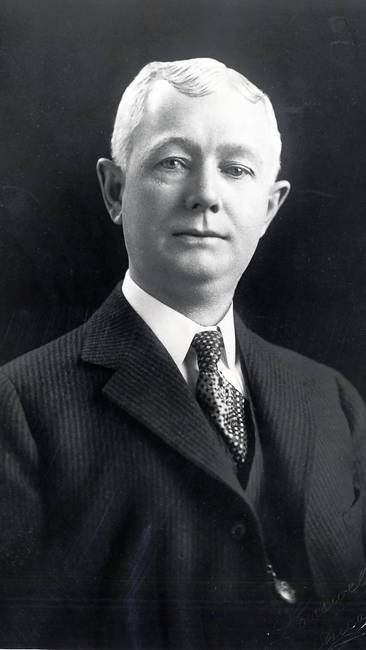
 Michael "Hinky Dink" Kenna (August 20, 1857 – October 9, 1946) was a towering, if physically diminutive, figure in Chicago municipal politics, serving as an alderman for the
city's 1st Ward from 1897 to 1923 and again from 1939 to 1943.
Michael "Hinky Dink" Kenna (August 20, 1857 – October 9, 1946) was a towering, if physically diminutive, figure in Chicago municipal politics, serving as an alderman for the
city's 1st Ward from 1897 to 1923 and again from 1939 to 1943.Partner John "Bathhouse" Coughlin
Queer Places:
Calvary Catholic Cemetery, 301 Chicago Ave, Evanston, IL 60202, United States
Michael "Hinky Dink" Kenna (August 20, 1857 – October 9, 1946) was a towering, if physically diminutive, figure in Chicago municipal politics, serving as an alderman for the
city's 1st Ward from 1897 to 1923 and again from 1939 to 1943.
Born on August 20, 1857, to Irish immigrants Catherine and John Kenna on Chicago's Near West Side, Kenna entered the working world at age ten as a newsboy following his father's death. By age twelve, he was an orphan who borrowed fifty dollars from a barkeeper to purchase a lucrative newsstand at Monroe and Dearborn Streets. He paid off the debt within a month and ran the stand until 1877. During this time, he earned the enduring moniker "Hinky Dink"—reportedly bestowed by Chicago Tribune publisher Joseph Medill due to his short, five-foot-four-inch stature—though Kenna frequently deflected its origin. After a brief stint working for a newspaper in Leadville, Colorado, Kenna returned to Chicago in 1881 and established a saloon on Clark Street known as the Workingman's Exchange. There, he cultivated his political base by distributing food and lodging to the indigent and homeless in exchange for political loyalty and votes.
Kenna's ascent coincided with the heyday of Chicago's notorious 1st Ward, a powerhouse district encompassing the city's central business loop and the expansive Levee vice district. As the political machine of gambling kingpin Mike McDonald faded, Kenna forged a legendary, decades-long alliance with fellow 1st Ward Alderman John "Bathhouse" Coughlin in 1893. While Coughlin acted as the flamboyant public face of the machine, Kenna operated as the brilliant, calculating tactician behind the scenes. Together, they constructed a robust, corrupt political empire that dominated Chicago affairs for the first half of the twentieth century, earning the duo the moniker "Lords of the Levee." Their operation relied on systemic graft, voter fraud, and the systematic bribing of homeless individuals to secure election victories, all while offering protection to local madams, bootleggers, gamblers, and saloon owners in exchange for millions of dollars in political kickbacks. Despite frequent condemnation from reform-minded groups like the Municipal Voters' League and exposes by the press, Kenna and Coughlin remained practically invincible at the ballot box due to their deep-rooted populist support, providing genuine aid to the impoverished and unemployed when formal social safety nets were non-existent.
Kenna's most notable connection to LGBTQ history is anchored directly in the First Ward Ball, an outrageous annual charity event hosted by Kenna and Coughlin from 1896 to 1908. Held in venues such as the 7th Regiment Armory and the Coliseum, all brothels, gambling dens, bathhouses, and saloons in the Levee District were compelled to buy blocks of tickets to the ball as a protection payoff to the aldermen. The event served as a massive, defiant display of the district's underworld culture, featuring a grand march led by Coughlin that included madams, sex workers, and female impersonators. The open display of non-conforming gender presentation, extravagance, and debauchery eventually drew intense public and religious backlash. In 1908, Walter T. Sumner, dean of the Chicago Episcopal Cathedral of Saints Peter and Paul, attended the ball as an observer and publicly denounced it as an everlasting disgrace to Chicago, bringing immense pressure that forced the event to be permanently shut down.
As the decades progressed, the political landscape shifted with the rise of Prohibition, powerful organized crime figures like Al Capone, and the sweeping reform machine of Mayor Anton Cermak. After the state reduced the number of aldermen per ward, Kenna stepped aside in 1923 to let Coughlin hold the single 1st Ward seat, retiring to run a local cigar and candy store while remaining a powerful party committeeman. Following Coughlin's death in 1938, an aging Kenna returned to the City Council unopposed in 1939 to maintain factional peace, though he largely served as a figurehead while de facto power shifted to figures like Jack Guzik. Kenna declined reelection in 1943 and stepped down as 1st Ward committeeman in 1944. He passed away from diabetes and myocarditis at the Blackstone Hotel on October 9, 1946, leaving behind a multi-million-dollar estate and a legacy as one of the most influential and colorful political bosses in American history.
References:
 We’ve Been Here All Along: Wisconsin’s Early Gay History Hardcover – Illustrated, May 7, 2019 by R. Richard Wagner |
Other references:
Support this project
This website is a passion project researched, developed, and funded entirely by me. If you find the content valuable and would like to help support the ongoing research and hosting costs, any contribution is deeply appreciated.
Thank you for keeping this independent resource alive!
My books on Amazon: Elisa Rolle's books