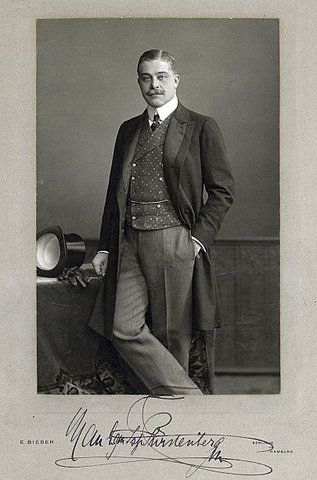
 Maximilian Egon Christian Karl Aloys Emil Leo Richard Anton, Prince of Fürstenberg (October 13, 1863 - August 11, 1941), was a prominent German landowner,
investor, and high-ranking nobleman.
Maximilian Egon Christian Karl Aloys Emil Leo Richard Anton, Prince of Fürstenberg (October 13, 1863 - August 11, 1941), was a prominent German landowner,
investor, and high-ranking nobleman.Queer Places:
Lány Castle, Zámecká 2, 270 61 Lány, Czechia
Schloss Donaueschingen, Fürstenbergstraße 2, 78166 Donaueschingen, Germany
Schloss Heiligenberg, Vorhof 1, 88633 Heiligenberg, Germany
Schlosskapelle Heiligenberg, Heiligenberg, Bodenseekreis, Baden-Württemberg, Germany
Maximilian Egon Christian Karl Aloys Emil Leo Richard Anton, Prince of Fürstenberg (October 13, 1863 - August 11, 1941), was a prominent German landowner,
investor, and high-ranking nobleman.
He was born on October 13, 1863, at Lány Castle in Bohemia. As the head of the princely House of Fürstenberg from 1896 until his death, he commanded vast economic and political influence across Central Europe. He inherited extensive territorial titles spanning Prussia, Austria, Hungary, Württemberg, and Baden, which granted him hereditary seats in the House of Lords across all five states, including serving as vice-president of the Prussian House of Lords prior to the First World War.
Beyond his political offices, Prince Max was a wealthy industrialist and landowner, holding massive deer forests, coal mines, breweries, and hotels. His primary residence was the opulent Princely Palace at Donaueschingen, situated near the source of the Danube. He was notably a close personal friend, confidant, and adviser to German Emperor Wilhelm II, frequently hosting the Kaiser for grand hunting expeditions and international trips. In 1889, he married Countess Irma von Schönborn-Buchheim, with whom he had five children. Later in life, following the collapse of the German Empire, Prince Max developed an affinity for the Nazi regime, joining the Nazi Party and the Sturmabteilung (SA) in 1933 after meeting Adolf Hitler and Ernst Röhm. He lived out his later years during the Second World War and died on August 11, 1941, at Heiligenberg Castle.
The legacy of Prince Max’s estate and his inner circle is heavily intertwined with one of the most sensational cover-ups of Imperial Germany, which directly intersects with early 20th-century history concerning homosexuality and militarism. On the evening of November 14, 1908, Prince Max hosted an exclusive imperial hunting party for Kaiser Wilhelm II and his closest retinue at Donaueschingen Castle.
To amuse the Emperor and the assembled guests after dinner, 56-year-old General Dietrich Graf von Hülsen-Haeseler—the Chief of the German Military Cabinet—performed an impromptu cabaret routine. He dressed in a pink ballet tutu, a rose garland wreath, and ballet slippers, executing a full ballet performance featuring pirouettes, leaps, and flirtatious gestures toward the audience. Immediately after finishing his routine and bowing to the applause, the general suffered a massive, fatal heart attack and died on the scene.
This bizarre event occurred at the height of the Eulenburg Affair, a massive public and domestic scandal centered on allegations of widespread homosexual conduct and a homoerotic inner circle among the Kaiser's closest advisers (often referred to as the Liebenberg Round Table). Terrified that public disclosure of a high-ranking military official dying dressed in drag would spark moral panic, inflame ongoing public accusations about the court's sexual culture, and deeply embarrass the Kaiser, the imperial court aggressively suppressed the details of the incident. The sudden death was officially attributed to natural causes occurring elsewhere, successfully concealing the theatrical spectacle at Donaueschingen for years.
References:
Support this project
This website is a passion project researched, developed, and funded entirely by me. If you find the content valuable and would like to help support the ongoing research and hosting costs, any contribution is deeply appreciated.
Thank you for keeping this independent resource alive!
My books on Amazon: Elisa Rolle's books