Partner Corinne Johnson
Queer Places:
Beth Olom Cemetery, 2 Cypress Hlls St., Brooklyn, NY 11208, United States
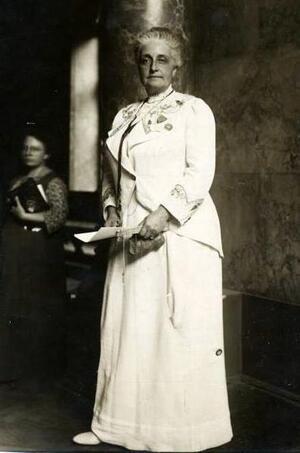 Maud Nathan (October 20, 1862 - December 15, 1946) was a prominent American social reformer, suffragist, and activist born on October 20, 1862, in New York City. She came
from a distinguished and privileged Sephardic Jewish family with deep roots in America, counting poet Emma Lazarus and Supreme
Court Justice Benjamin Cardozo among her cousins. Her sister, Annie Nathan Meyer, went on to found Barnard College. In 1880, at the age of seventeen, Maud married her
thirty-five-year-old first cousin, Frederick Nathan. The couple had one daughter, Annette, who tragically passed away at the age of eight in 1895.
Maud Nathan (October 20, 1862 - December 15, 1946) was a prominent American social reformer, suffragist, and activist born on October 20, 1862, in New York City. She came
from a distinguished and privileged Sephardic Jewish family with deep roots in America, counting poet Emma Lazarus and Supreme
Court Justice Benjamin Cardozo among her cousins. Her sister, Annie Nathan Meyer, went on to found Barnard College. In 1880, at the age of seventeen, Maud married her
thirty-five-year-old first cousin, Frederick Nathan. The couple had one daughter, Annette, who tragically passed away at the age of eight in 1895.
In an effort to cope with her profound grief, Nathan threw herself into charitable and civic activities. She taught English to Jewish immigrants on the board of directors
for the Hebrew Free School Association and became involved with various community organizations. Through her connection with Josephine Shaw Lowell, Nathan co-founded the
New York City Consumers' League in 1890 to combat the exploitation of working women and children. She served as the president of the New York Consumers League from 1897 to
1927, spearheading efforts to improve hazardous retail and factory conditions, eliminate child labor, and publish "white lists" of fair-wage employers.
Nathan's relentless lobbying of state legislators revealed a fundamental barrier: because women could not vote, lawmakers routinely dismissed their political opinions.
This realization propelled her directly into the forefront of the women's suffrage movement. She became a prominent international lecturer, served as the first vice
president of the New York Equal Suffrage League, and headed the women's suffrage committee in the National Progressive Party. Her husband, Frederick, strongly supported her
activism and the broader suffrage cause, frequently standing by her side at demonstrations as an active member of the Men's League for Equal Suffrage.
Beyond labor reform and suffrage, Nathan was an influential voice within Jewish intellectual and religious life. In 1897, she became the first woman to speak from the
bimah of an American synagogue—Shearith Israel in New York—delivering a landmark address entitled “The Heart of Judaism,” which urged her community to prioritize social
justice, universal truths, and active civic reform. She also authored notable written works, including The Story of an Epoch-Making Movement (1926) and her autobiography,
Once Upon a Time and To-day (1933).
Following the death of her husband in 1919, Nathan shared her later decades with a close female companion, Corinne Johnson. The two women traveled the world together to
continue advocating for consumer education, workers' rights, and equal suffrage. They also established a shared summer home in Litchfield, Connecticut, where they deeply
embedded themselves in local civic action, supporting community institutions and presenting annual graduation awards to local students. Nathan passed away on
December 15, 1946, leaving behind an enduring legacy of progressive social change and women's empowerment.
References:
Other references:
- Nathan, Maud. The Story of an Epoch-Making Movement. Garden City, NY: Doubleday, Page & Company, 1926. (Her contemporary historical account detailing the origins, campaigns, and structural growth of the Consumers' League).
- Nathan, Maud. Once Upon a Time and To-day. New York: G.P. Putnam's Sons, 1933. (Nathan's personal autobiography, offering first-person context regarding her family background, her intellectual evolution, her involvement in social reform, and her later life).
- Maud and Frederick Nathan Papers: Preserved within major historical repositories, these collections include extensive correspondence, personal journals, public address transcripts, and newspaper clipping scrapbooks documenting her decades of civic engagement, suffrage advocacy, and international travels.
- National Consumers' League Records: Located within manuscript divisions tracking American labor reform, containing official administrative records, correspondence, and public educational pamphlets authored or co-signed by Nathan during her tenure as president.
- "Nathan, Maud (1862–1946)." Women in World History: A Biographical Encyclopedia. Accessible via Encyclopedia.com. (Provides a comprehensive breakdown of her lineage, chronological milestones, and public leadership roles).
- "Maud Nathan." Jewish Women's Archive (JWA) Encyclopedia. Written by historical researchers, this profile details her Sephardic heritage, her ground-breaking role at Shearith Israel, her public speaking career, and her later decades shared with her companion Corinne Johnson in Litchfield, Connecticut.
- Brody, Seymour. Jewish Heroes & Heroines of America: 150 True Stories of American Jewish Heroism. Hollywood, FL: Lifetime Books, 1996. (Features a profile on Nathan's civic legacy and pioneering social action).
Support this project
This website is a passion project researched, developed, and funded entirely by me. If you find the content valuable and would like to help support the ongoing research and hosting costs, any contribution is deeply appreciated.
Thank you for keeping this independent resource alive!
My books on Amazon: Elisa Rolle's books
BACK TO HOME PAGE
