Partner Alzina Parsons Stevens
Queer Places:
Hull House, 800 S Halsted St, Chicago, IL 60607, United States
Denison House, 93 Tyler St, Boston, MA 02111
Saint Joseph Cemetery, 990 Lagrange St, Boston, MA 02132, United States
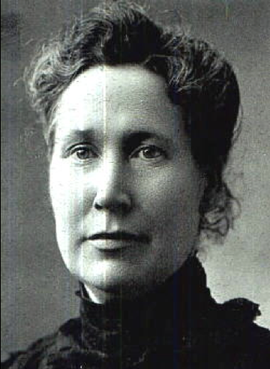 Mary Kenney O'Sullivan (January 8, 1864 - January 18, 1943) was born on January 8, 1864, in Hannibal, Marion County, Missouri, to Irish immigrant
parents. Achieving only a fourth-grade education, she began her working life by spending two grueling years apprenticing as a dressmaker with no pay. The
poor treatment and harsh conditions she experienced as a victim of poor treatment in her job taught her the vital importance of workplace solidarity and
unions. Post-dressmaking, she learned the bindery trade, becoming an accomplished bookbinder. Moving to Chicago in 1888 to support her disabled mother,
she continued her career in the bookbinding industry, where she joined the Ladies Federal Local Union Number 2701 (also noted in records as 2703) and
organized her own group from within, the Woman's Bookbinding Union Number 1.
Mary Kenney O'Sullivan (January 8, 1864 - January 18, 1943) was born on January 8, 1864, in Hannibal, Marion County, Missouri, to Irish immigrant
parents. Achieving only a fourth-grade education, she began her working life by spending two grueling years apprenticing as a dressmaker with no pay. The
poor treatment and harsh conditions she experienced as a victim of poor treatment in her job taught her the vital importance of workplace solidarity and
unions. Post-dressmaking, she learned the bindery trade, becoming an accomplished bookbinder. Moving to Chicago in 1888 to support her disabled mother,
she continued her career in the bookbinding industry, where she joined the Ladies Federal Local Union Number 2701 (also noted in records as 2703) and
organized her own group from within, the Woman's Bookbinding Union Number 1.
Her organizing efforts caught the attention of social reformer Jane Addams, leading to her membership in
Addams's settlement house movement. She moved into Hull House in the 1880s, where she gained Addams's permission to hold union meetings and also assisted
in vital investigations of sweatshops and tenements in 1892. O'Sullivan eventually established her own cooperative within Hull House specifically for
low-wage working women. Her union organization became a branch of the American Federation of Labor (AFL), leading to her election as a delegate to the
Chicago Trades and Labor Assembly. In 1892, she achieved a historic milestone when Samuel Gompers appointed her as the first woman AFL-employed organizer
on a full salary. During her year-long appointment, she traveled extensively on the East Coast and across Massachusetts, organizing garment workers in
New York City and Troy, New York, as well as printers, binders, shoe workers, and carpet weavers in Massachusetts. Following this position, she continued
her labor work and advocated for women's suffrage in Chicago, campaigning for a suffrage bill that unfortunately did not pass at the time.
In 1894, she married labor editor and organizer John "Jack" O'Sullivan in Boston. They moved into Denison House, another prominent settlement house,
creating an unusually progressive household for the era where both husband and wife worked and shared household duties. Throughout their marriage,
O'Sullivan continued her organizing primarily through the settlement house, hosting discussion groups for working women focused on the necessity of
solidarity. Together, they had four children (also cited in some family records as three). Tragically, her husband died in a streetcar accident in the
fall of 1902, leaving her grief-stricken as a widow and single mother to continue her tireless advocacy.
From the discussions at Denison House emerged the groundwork for an organization that would give working women a unified national voice. In November
1903, at an AFL convention, Samuel Gompers granted O'Sullivan time at the microphone to announce the founding of the National Women's Trade Union League
(NWTUL), serving as its first secretary. In addition to labor rights, she championed women's voting rights, speaking in 1906 to a U.S. House of
Representatives committee on the constitutional amendment for suffrage by arguing that every economic producer retains the right to vote. Considered the
industrial branch of the suffrage movement, the NWTUL frequently saw O'Sullivan announce the AFL's renewed support for a suffrage amendment, and she
later authored a circa 1913-1915 circular for the National American Woman Suffrage Association titled 'Why the Working Woman Needs the Vote'.
Her tenure with the NWTUL came to an end in 1912 during the Lawrence Textile Strike. Initially, the NWTUL operated a relief station providing strikers
with survival goods, with O'Sullivan acting as its operator. However, because the AFL opposed the strike while the rival Industrial Workers of the World
(IWW) supported it, the AFL demanded that all affiliated organizations, including the NWTUL, withdraw their support. While the NWTUL complied, O'Sullivan
chose to stay on with the IWW to support the workers, earning the ire of the AFL. Although she disagreed with the IWW's broader politics, she admired
their organizing tactics and their inclusive policy toward diverse ethnic and craft divisions, which she believed fostered a spirit of confidence. She
played a key role in meeting with strikers, serving on the strike committee, and negotiating with American Woolen Company chairman William Wood, helping
the strike ultimately end in favor of the workers.
Following her relief work in Lawrence, she focused on getting legislation passed to improve factory conditions in Massachusetts. In 1914, she was hired
by the state as an inspector for the Massachusetts Board of Labor and Industries, a position she held for 20 years until her retirement in January 1934,
giving her the power to enforce the very laws she helped champion. During her years as an inspector, she remained active in public advocacy, serving as a
delegate to the Women's Peace Conference in 1926 and speaking frequently at Boston's Ford Hall Forum. Mary Kenney O'Sullivan died at the age of 79 on
January 18, 1943, at her home in West Medford, Massachusetts. She was buried alongside her husband at Saint Joseph Cemetery in West Roxbury, Suffolk
County, Boston, Massachusetts. In 1999, her legacy was honored at the Massachusetts State House with a series of six tall marble panels featuring a bronze
bust and etched quotations alongside fellow trailblazers Florence Luscomb, Dorothea Dix, Josephine St. Pierre Ruffin, Sarah Parker Remond, and
Lucy Stone.
Mary Kenney O'Sullivan is closely linked through her collaborative networks to
Alzina Parsons Stevens. Stevens and O'Sullivan worked side-by-side as pioneering trade union
organizers, factory inspectors under Florence Kelley, and social reformers within the Chicago progressive
community centered around Hull House. Together, they collaborated on building institutional power for wage-earning women and establishing cooperative
housing projects for self-supporting women, such as the Jane Club. Historians examining late-Victorian same-sex relationships, woman-identified spaces,
and independent female networks frequently study figures like Alzina Parsons Stevens—who chose personal and financial independence following an early
divorce—alongside close collaborators like O'Sullivan who forged alternative models of community, domestic life, and professional partnership outside of
traditional patriarchal structures.
References:
- Nutter, Kathleen Banks. The Necessity of Organization: Mary Kenney O'Sullivan and Trade Unionism for Women, 1892–1912. New York: Garland Publishing, 2000. (The definitive biographical and historical study on her life and labor organizing).
- O'Sullivan, Mary Kenney. Why the Working Woman Needs the Vote. New York: National American Woman Suffrage Association, 1910 (Circa 1913–1915 circular/pamphlet).
- American National Biography (ANB). Entry on "O'Sullivan, Mary Kenney," Vol. 16, 1999, pp. 816–817.
- Women in World History: A Biographical Encyclopedia. Entry on "O'Sullivan, Mary Kenney (1864–1943)".
- James, Edward T., Editor. Papers of the Women's Trade Union League and its Principal Leaders. Woodbridge, CT: Research Publications, 1979.
- Deutsch, Sarah. Women and the City: Gender, Space, and Power in Boston, 1870–1940. Oxford University Press, 2002.
Support this project
This website is a passion project researched, developed, and funded entirely by me. If you find the content valuable and would like to help support the ongoing research and hosting costs, any contribution is deeply appreciated.
Thank you for keeping this independent resource alive!
My books on Amazon: Elisa Rolle's books
BACK TO HOME PAGE