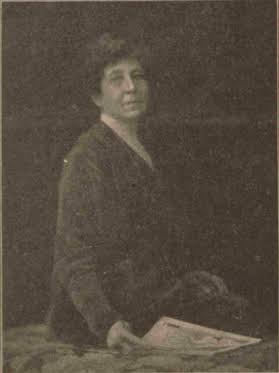
 Mary Harris Smith (November 27, 1844 - October 13, 1934) is one of the most resilient figures in the history of professional women.
Queer Places:
King's College School, Southside, Wimbledon Common, London SW19 4TT, United Kingdom
1 Queen Victoria Street, London, EC4N 4XY
Mary Harris Smith (November 27, 1844 - October 13, 1934) is one of the most resilient figures in the history of professional women.
As the world’s first female Chartered Accountant, she waged a decades-long campaign against the institutional patriarchy of the City of London, securing a landmark victory for gender equality just as she was entering her mid-seventies.
Mary Harris Smith was born in Kingsland, London, to Susanna and Henry Smith. Her father, a banker and navy agent, recognized her sharp mathematical mind early on and encouraged her talents. She began her education informally by assisting him with bank bookkeeping at home.
In 1860, at the age of sixteen, she studied mathematics privately under a Master at King's College School. Recognizing the limited professional avenues for women, she quickly enrolled in some of the first formal bookkeeping classes organized by the Society for Promoting the Employment of Women (SPEW), a pioneering group dedicated to helping women achieve economic independence.
After gathering nine years of mercantile experience in the City and working as the head accountant for the Royal School of Art Needlework, Harris Smith took a bold step. In 1887, she opened her own independent practice, trading under the strategically gender-neutral name "M. Harris Smith, Accountant and Auditor" to ward off immediate prejudice from male clients. In women’s periodicals, however, she proudly styled herself a "lady accountant" to welcome female entrepreneurs.
Despite building a thriving practice with a flawless reputation, she was locked out of the official credentials required to scale her business. What followed was a 30-year siege on the accountancy elite:
1887–1891: She applied repeatedly to the Society of Accountants and Auditors (SAA). Her first application was met with literal laughter by the council.
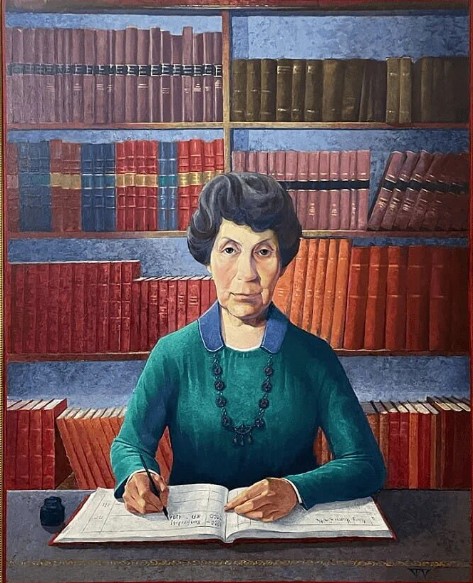
The portrait of Mary Harris Smith
Commissioned to celebrate the centenary of Mary Harris Smith becoming the world's first female chartered accountant
1891: She applied to become a Fellow of the Institute of Chartered Accountants in England and Wales (ICAEW). While the admissions committee recommended her, the Institute's legal counsel blocked her, arguing that because the Royal Charter used the pronouns he and him, women were legally excluded.
1895: Infuriated by the moving goalposts, she famously declared in an interview: "Require of me what you would require of a man and I will fulfill it."
1896: She asked to sit the formal ICAEW examinations to prove her competence, but was flatly refused.
The wall finally crumbled with the passage of the Sex Disqualification (Removal) Act 1919, which made it illegal for professional bodies to bar members based solely on sex.
The SAA capitulated first, making her an Honorary Fellow on November 12, 1919. Not content with an honorary title, Harris Smith immediately re-applied to the ICAEW. In May 1920, at the age of 75, she was officially admitted as a Fellow (FCA), cementing her status as the first female Chartered Accountant in history.
When examining Mary Harris Smith’s biography through a modern lens, it is crucial to understand the historical context of her networks. While there is no direct historical evidence or surviving archival record indicating that Mary Harris Smith identified as LGBTQ+ herself, she operated entirely within a deeply interconnected, radical network of first-wave feminists, suffragists, and reformers where same-sex partnerships and gender-nonconforming lifestyles were heavily prevalent.
Harris Smith’s practice survived and flourished precisely because she became the trusted financial architect for the British women’s movement. She served as the official auditor for the National Union of Women's Suffrage Societies (NUWSS) and worked closely with its leader, Millicent Garrett Fawcett.
The suffrage elite of this era relied on intense, lifelong same-sex romantic friendships and domestic partnerships (often referred to as "Boston marriages") to sustain their dangerous political work. By embedding herself as the primary financial manager for these women and their organizations, Harris Smith was a vital ally and pillar of an community that explicitly rejected heteronormative family structures.
Her lifelong connection to the Society for Promoting the Employment of Women (SPEW) brought her into the immediate orbit of radical gender trailblazers like Emily Davies (who actively championed Harris Smith's cause to the ICAEW in 1893). These circles actively subverted 19th-century expectations of womanhood, creating safe spaces where women could live independently of men, choose female partners, and openly challenge rigid binary roles in the workforce.
Because of her defiance of male monopolies and her deep alignment with early feminist and gender-equality networks, Mary Harris Smith has been embraced by modern queer and feminist historians.
In 2022, she was officially added to the City of Women London map—a high-profile public history project spearheaded by Reni Eddo-Lodge and Emma Watson that re-imagines the London Underground. The project replaces traditional station names with the names of women, trans, and non-binary people who radically shaped London’s history, permanently pairing her legacy with the broader fight for LGBTQ+ and gender liberation.
Harris Smith did not view her late-life victory as a mere retirement token. She continued practicing well into the 1923–1924 cycle, notably hiring and mentoring a new generation of pioneering female clerks, such as Eslie Margaret Charlesworth.
She eventually retired to St Leonards-on-Sea, where she passed away in 1934 at the age of 89. Today, she is commemorated with a prestigious Blue Plaque at the City of London Magistrates' Court—one of only a tiny handful dedicated to individual women in the square mile—marking the ground near where her historic office once stood.
References:
Support this project
This website is a passion project researched, developed, and funded entirely by me. If you find the content valuable and would like to help support the ongoing research and hosting costs, any contribution is deeply appreciated.
Thank you for keeping this independent resource alive!
My books on Amazon: Elisa Rolle's books