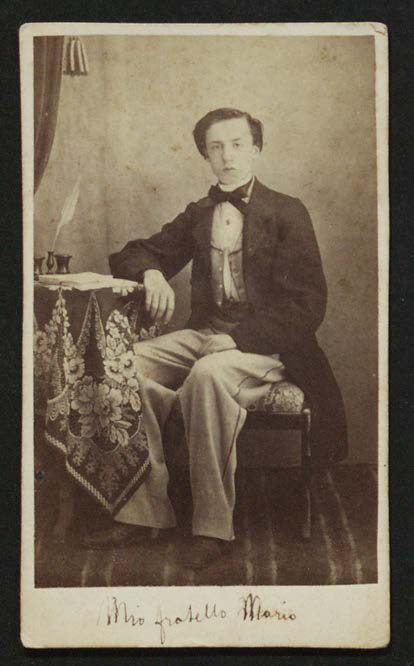
 Mario Pratesi (November 11, 1842 – September 3, 1921) was born in Santa Fiora, in the Tuscan Maremma region of Italy, on November 11, 1842. Growing up in a modest and often
struggling provincial environment, he pursued his education and initially worked as a schoolteacher and educational inspector, a career that deeply informed his intimate,
unflinching observations of rural Tuscan society. His early literary ambitions culminated in his emergence as a prominent figure of Italian verismo—the literary movement
that sought to depict Italian life with scientific objectivity, social critique, and a stark focus on the harsh realities of the working and lower-middle classes. Pratesi's
fiction, including his masterwork Il mondo di sotto (1881) and novels such as L'eredità (1889) and In provincia (1883), earned the deep admiration of contemporary literary
giants like Giovanni Verga and Luigi Capuana. Despite gaining critical acclaim, his life was marked by persistent financial insecurity, personal isolation, and a sense of
alienation from the mainstream literary establishments of Florence and Rome. He spent his final decades continuing to write and teach before passing away in Florence on
September 3, 1921.
Mario Pratesi (November 11, 1842 – September 3, 1921) was born in Santa Fiora, in the Tuscan Maremma region of Italy, on November 11, 1842. Growing up in a modest and often
struggling provincial environment, he pursued his education and initially worked as a schoolteacher and educational inspector, a career that deeply informed his intimate,
unflinching observations of rural Tuscan society. His early literary ambitions culminated in his emergence as a prominent figure of Italian verismo—the literary movement
that sought to depict Italian life with scientific objectivity, social critique, and a stark focus on the harsh realities of the working and lower-middle classes. Pratesi's
fiction, including his masterwork Il mondo di sotto (1881) and novels such as L'eredità (1889) and In provincia (1883), earned the deep admiration of contemporary literary
giants like Giovanni Verga and Luigi Capuana. Despite gaining critical acclaim, his life was marked by persistent financial insecurity, personal isolation, and a sense of
alienation from the mainstream literary establishments of Florence and Rome. He spent his final decades continuing to write and teach before passing away in Florence on
September 3, 1921.
Pratesi’s connection to the broader circles of European aestheticism and queer history is notably illuminated through his relationship with the formidable Anglo-Italian
author and cultural essayist Vernon Lee (the pen name of Violet Paget). Lee, who lived much of her life in Florence and maintained an
openly independent lifestyle alongside her partner Kit Anstruther-Thomson, was a central node in a transnational
network of queer intellectuals, aesthetes, and writers at the turn of the twentieth century. Within this cosmopolitan milieu, Lee and Pratesi shared a profound intellectual
and literary affinity. Lee recognized in Pratesi's gritty provincial realism a psychological depth and observational power that transcended mere regionalism, championing his
work to international readers and helping to bridge the gap between Italian verismo and European aesthetic circles. Their correspondence and intellectual exchanges reflect a
mutual respect that crossed conventional boundaries of gender, nationality, and literary school, aligning Pratesi—if peripherally through his association with Lee's radical,
freethinking circle—with the broader currents of nineteenth- and twentieth-century figures who lived and wrote outside strict societal orthodoxies.
References:
- Treccani, Dizionario Biografico degli Italiani (entry on Mario Pratesi by Jole Soldateschi)
- Anne Urbancic, Reviewing Mario Pratesi: The Critical Press and Its Influence (University of Toronto Press, 2014)
- Sistema Informativo Unificato per le Soprintendenze Archivistiche (SIUSA), Archival records and correspondence fonds for Mario Pratesi (including papers preserved at the Pratt Library, Victoria University, Toronto)
- Vernon Lee, The Countess of Albany (London: W.H. Allen & Co., 1884) — featuring the author's explicit dedication and acknowledgment of gratitude to Mario Pratesi
- Rita Severi, "Vernon Lee in Italy: a happy choice" (University of Verona / The Sibyl Blog)
Support this project
This website is a passion project researched, developed, and funded entirely by me. If you find the content valuable and would like to help support the ongoing research and hosting costs, any contribution is deeply appreciated.
Thank you for keeping this independent resource alive!
My books on Amazon: Elisa Rolle's books
BACK TO HOME PAGE